
CRITICAL EDGE #5
May 2025, Handbag Factory Vauxhall
Blending sculpture, painting, print, and film, this exhibition from Critical Edge Collective explores alternative ways of engaging with Vauxhall’s cultural heritage, power, and physicality – both visible and invisible – and reflects on the notion of the factory. The exhibition was a collection of pieces created by 25 artists in response to their exploration, research and engagement with The Handbag Factory, its surrounding area and history, bringing together unique perspectives, new ideas and innovative approaches to their work.
Critical Edge Collective’s initial research into The Handbag Factory gallery did not uncover any evidence that it was historically a handbag factory. The space, in some ways, is defined by an inaccessibility and invisibility of origin and history. For this show, we sought to make a new industry of production: we asked that all participating artists find inspiration related to The Handbag Factory and contribute their research to a shared drive. As the show approached, we looked at each others’ investigations and used the breadth of information in the archive to each develop a new artwork. To emphasise the value of collaboration and dialogue, all participating artists shared their findings that informed their creative processes and the final pieces exhibited. Each artist has added to and helped build a research archive that is also displayed during the exhibition.
Participating artists: Alan Oliver, Carmen Van Huisstede , Cass Breen , Cat Needs, Chisara Vidale, Eleanor Street, Emiline Trenton, Eva Barkardóttir , Iliana Ortega-Alcázar, Jane Hughes , Jessica Brauner, Jolene Liam, Joy Stokes, Kate Kelly, Laurelle Blake , Matty Emery, Nasus Y Ram, Natsuki Iwamoto, Nele Bergmans , Nimmi Hutnik, Megan Segre, Rhi Stanton, Sabrina Rodrigues, StevieRay Latham, Te Palandjian.
The exhibition was held from 22nd to 26th of May 2025 at the Handbag Factory Vauxhall, 3 Loughborough St, London SE11 5RB.
All photography by Nele Bergmans and Eleanor Street.

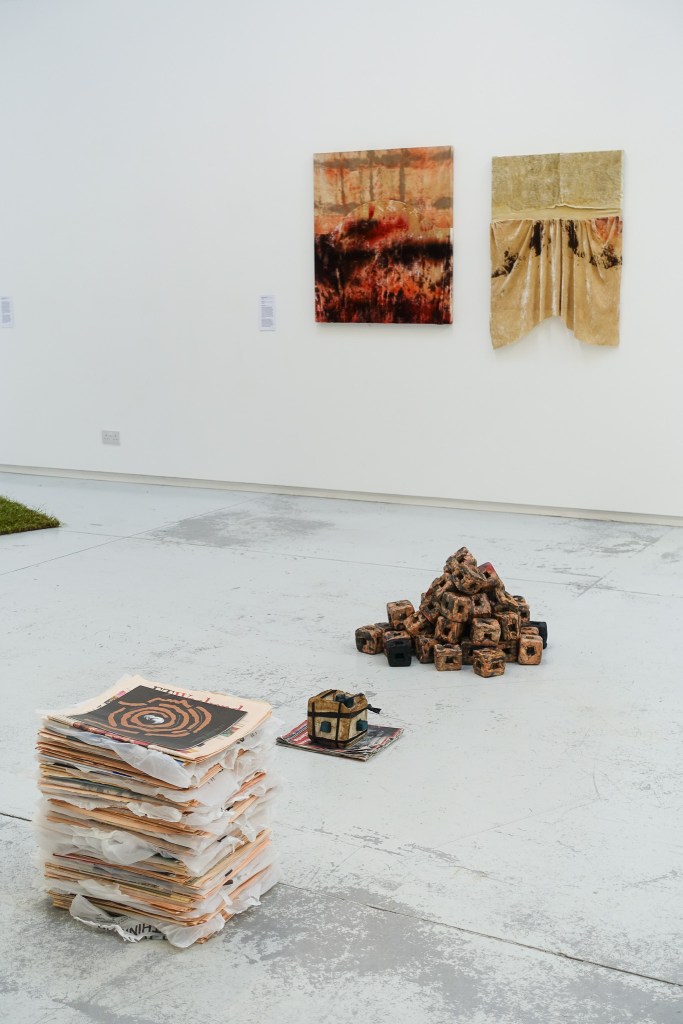
An overview of the artists and their work, including links to their website and socials, can be found below.
Alan Oliver

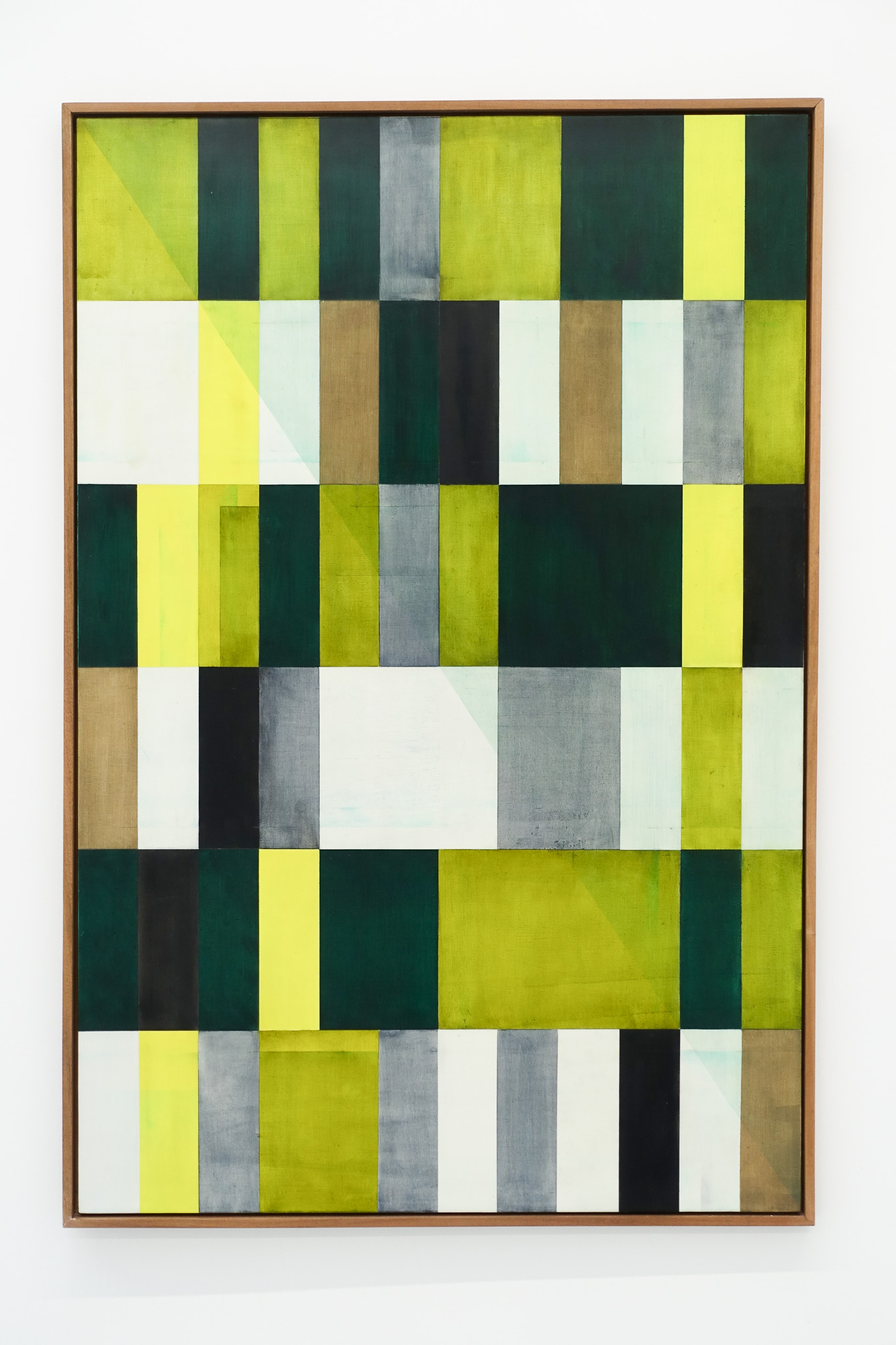
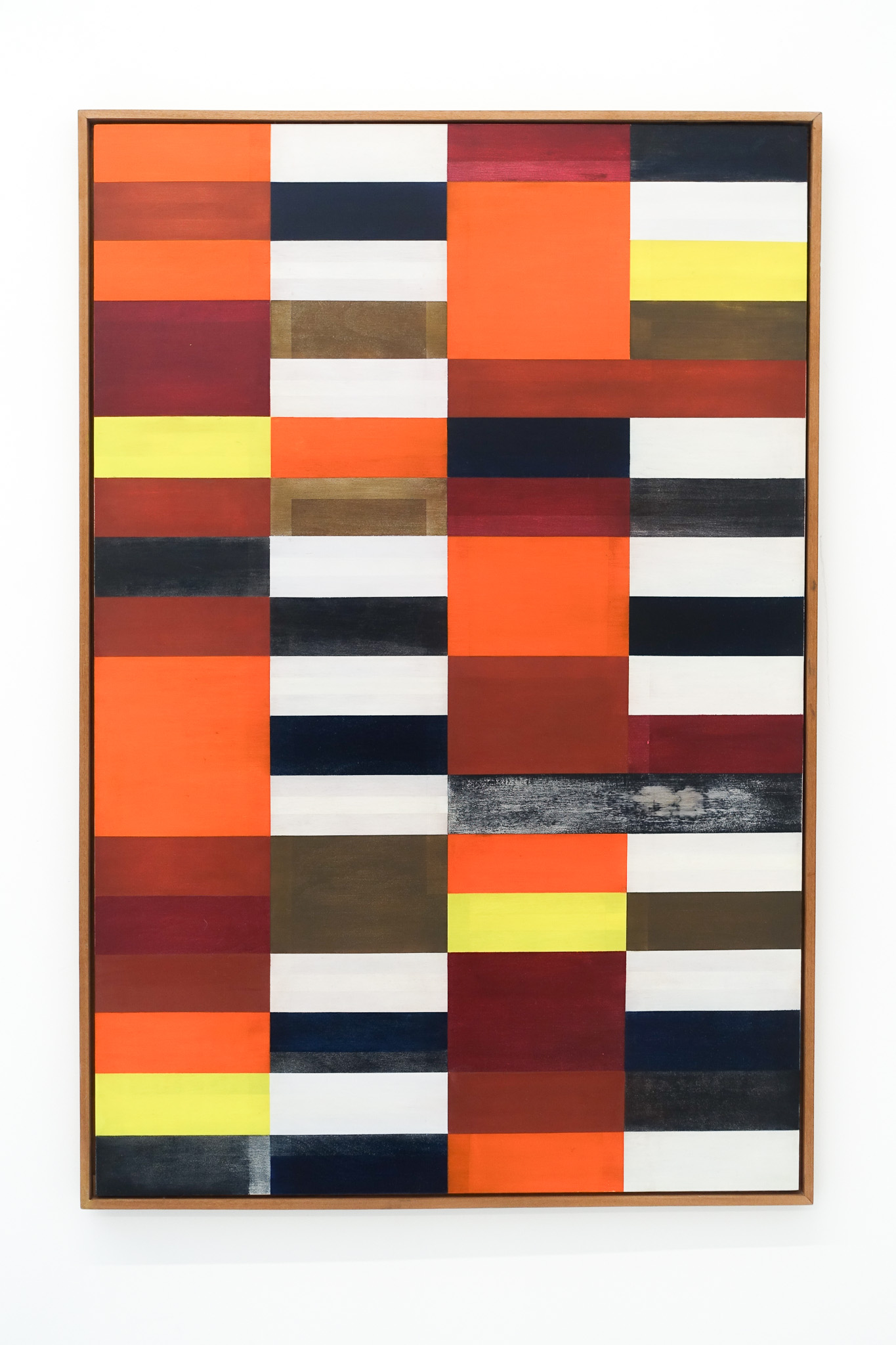
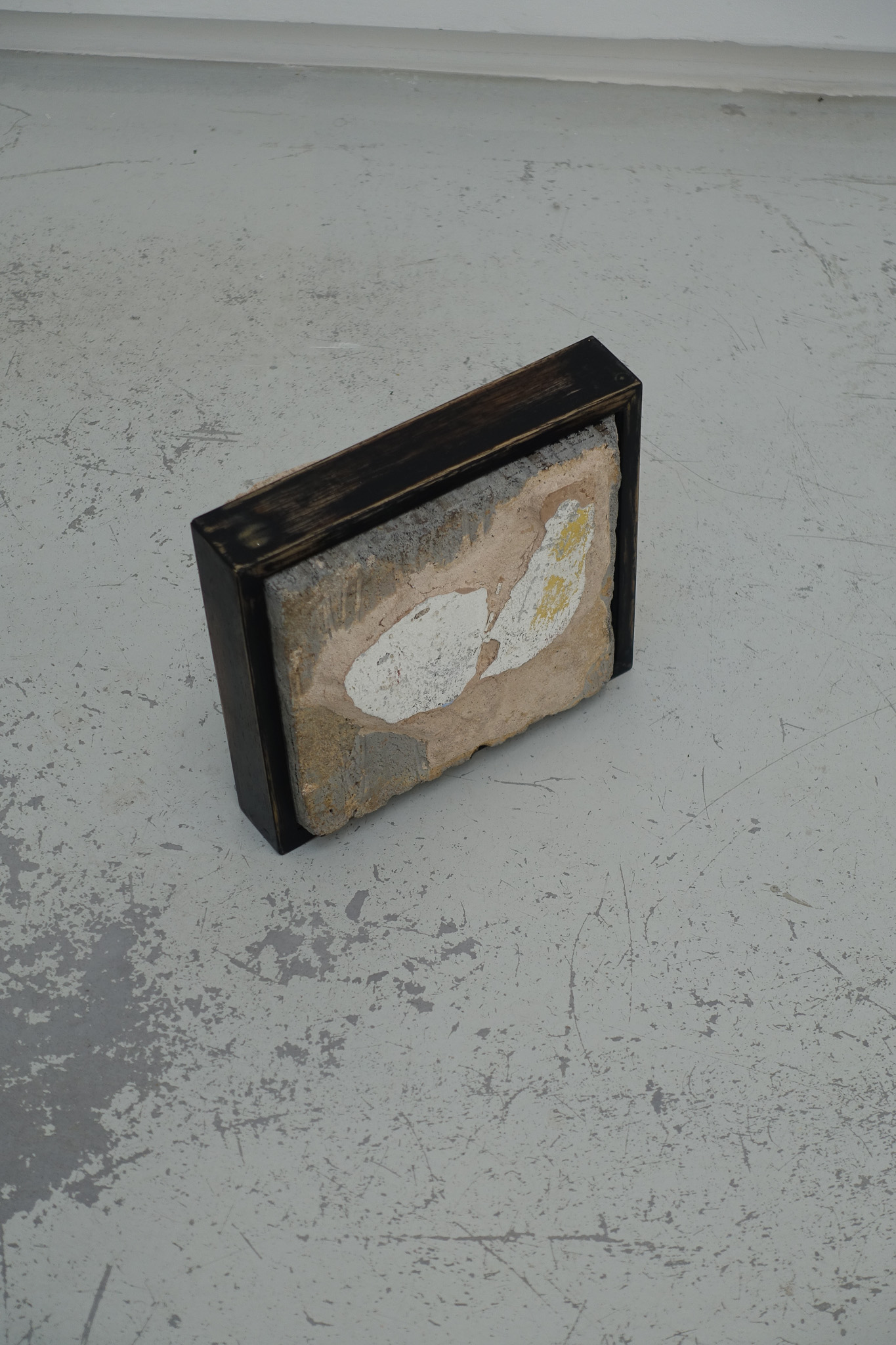
Wild Boy, 2025
Oil on plywood panel , 85 x 125cm
Alan’s studio sits on the edge of the Aylesbury Housing Estate – a ghostly place in the final phase of its life. He and a handful of artists, and the last remaining residents, watch, as the huge edifices are emptied and demolished. The buildings that make up the estate are named after villages around Aylesbury in Buckinghamshire, creating a strange juxtaposition to the decaying and abandoned urban landscape Alan inhabits daily. The building where he works, Taplow, and the one his studio overlooks, Northchurch, are half-derelict and home to several squats; drug use is everywhere. In his memoir, A Sort of Life, Graham Greene recounts how the village of Northchurch, close to where he grew up, had an ‘atmosphere of standing outside the pale: a region of danger where nightmare might easily become reality’. And in the churchyard of St Mary’s in Northchurch lies the grave of Peter the Wild Boy.
There were Aunties Everywhere, 2025
Oil on plywood panel, 85 x 125cm
In 1997 the Aylesbury Housing Estate played host to Tony Blair’s first speech as Prime Minister. Home to some of the poorest people in Britain, the Aylesbury had become synonymous with crime and poverty, and New Labour was keen to demonstrate that no one would be left behind in their new Britain. That same year Alan’s future husband arrived in Britain, from Lagos, aged 13. He lived across London but recalled trips to East Street and the Aylesbury Estate in the late 90s. A sizeable Nigerian community had emerged on the estate and his mother would take him to visit friends and family. He recalls a vibrant community, with the shops on the 2nd floor concourse open, and lots of people around, doing their groceries and socialising: “There were Aunties everywhere. You couldn’t get away with anything! If you wanted to have any fun you had to go down to street level.”
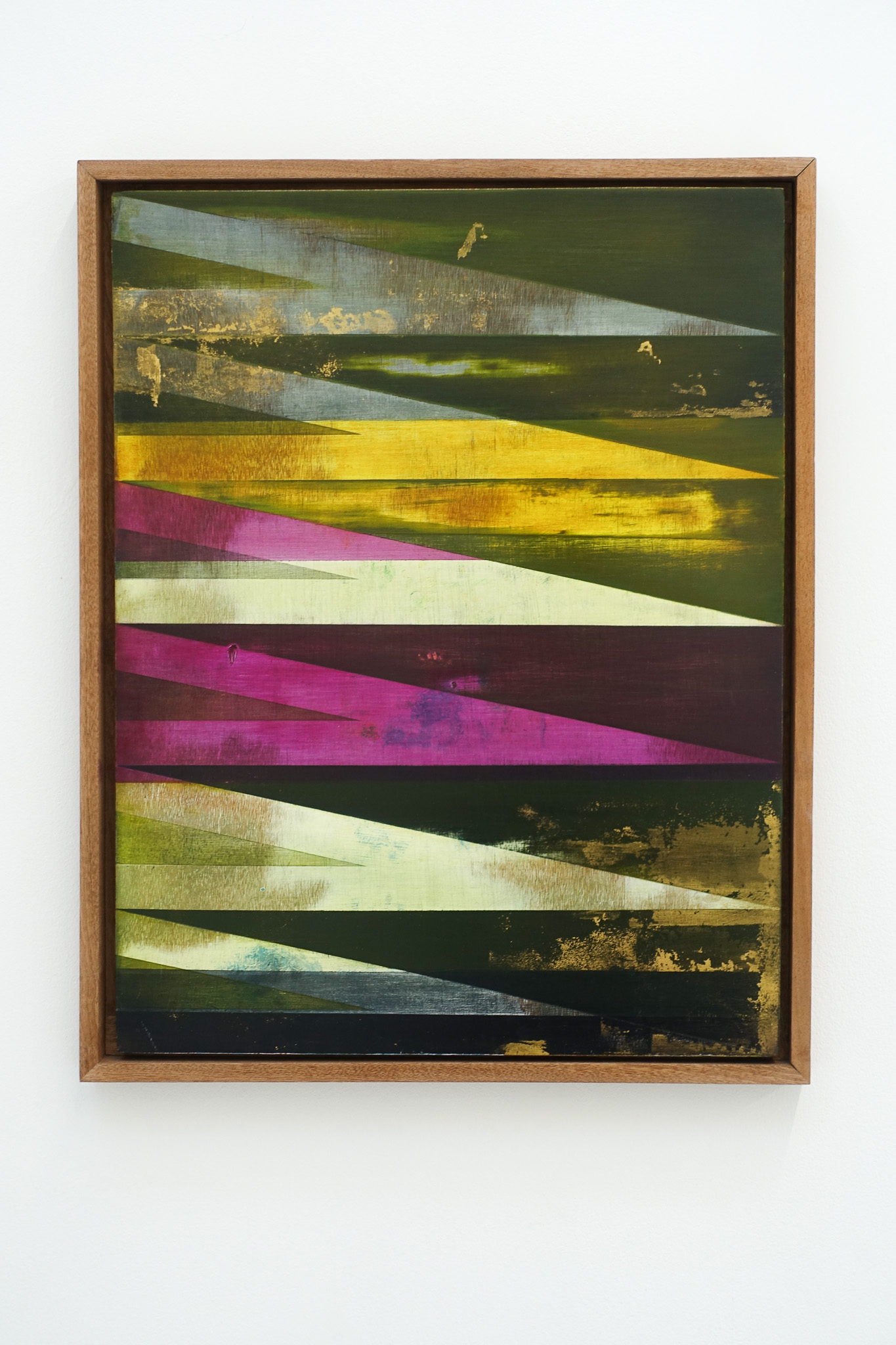
Current II, 2025
Oil on plywood panel, 50 x 40cm
The Thames is a symbol of London and its history, in myriad ways. At Vauxhall Pleasure Gardens early revellers would have arrived by boat, the surrounding area being mainly marsh land, and the nearest crossing London Bridge, (Westminster Bridge was not completed until 1750). Even beyond that point in time the river remained the most efficient way of getting from east to west. The Thames continued to be one of the main arteries of the city right up until the 20th century, but, also, a receptacle for the effluence of innumerable businesses along the riverbank, including many at Vauxhall. As a symbol of the city, however, the Thames represents far more, it is synonymous with trade and commerce, Empire, subjugation and immigration, whilst at its heart remains an ancient, mystic English river.
www.alanoliver.co.uk @alan_oliver_weaver
Carmen Van Huisstede
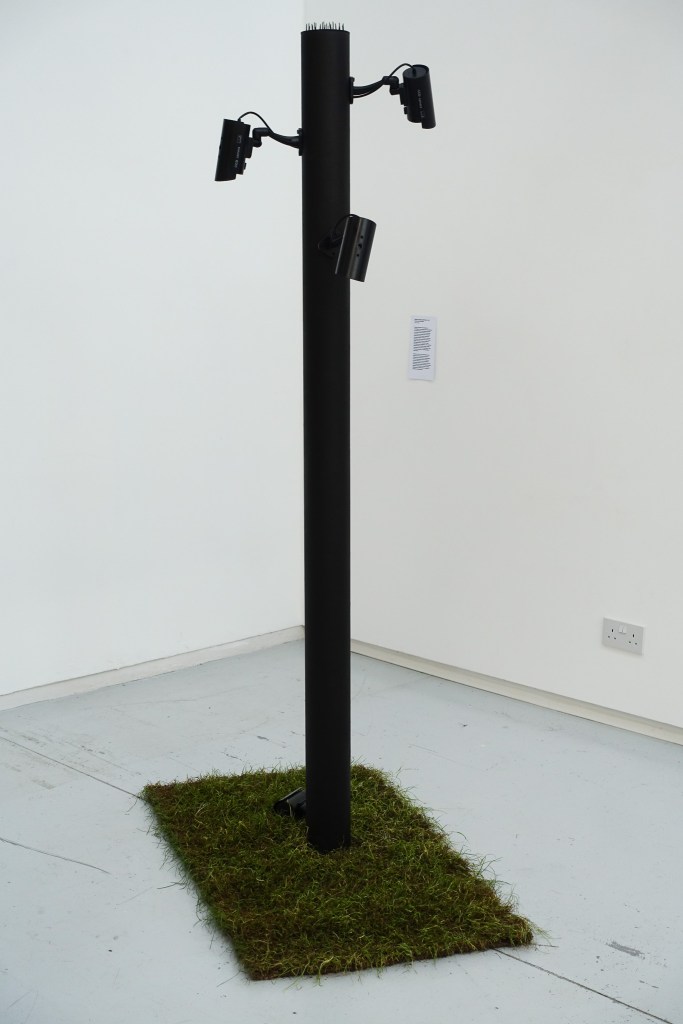
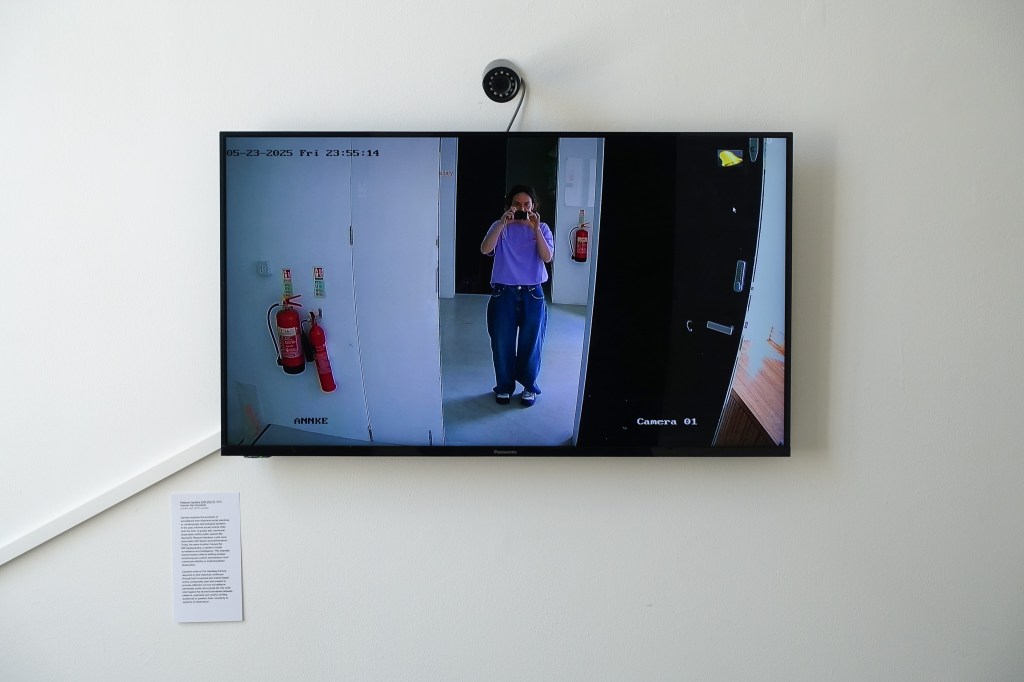
Pleasure Gardens 2025 (Part I&II), 2025
Mixed media, monitor and CCTV camera
Carmen explores the evolution of surveillance from historical social practices to contemporary technological systems. In the past, informal social control often took the form of gossip and communal observation within public spaces like Vauxhall’s Pleasure Gardens, a site once associated with leisure and performance. Today, the same location houses the MI6 headquarters, a symbol of state surveillance and intelligence. This dramatic transformation reflects shifting societal monitoring and control mechanisms, from communal visibility to institutionalised observation. Carmen’s work at The Handbag Factory responds to this historical continuum through both sculptural and media-based works, juxtaposing past and present to provoke reflection on how surveillance permeates public and private life. Her work interrogates the blurred boundaries between pleasure, spectacle and control, inviting audiences to question their complicity in systems of observation.
www.carmenart.co.uk @carmenart_vh
Cass Breen
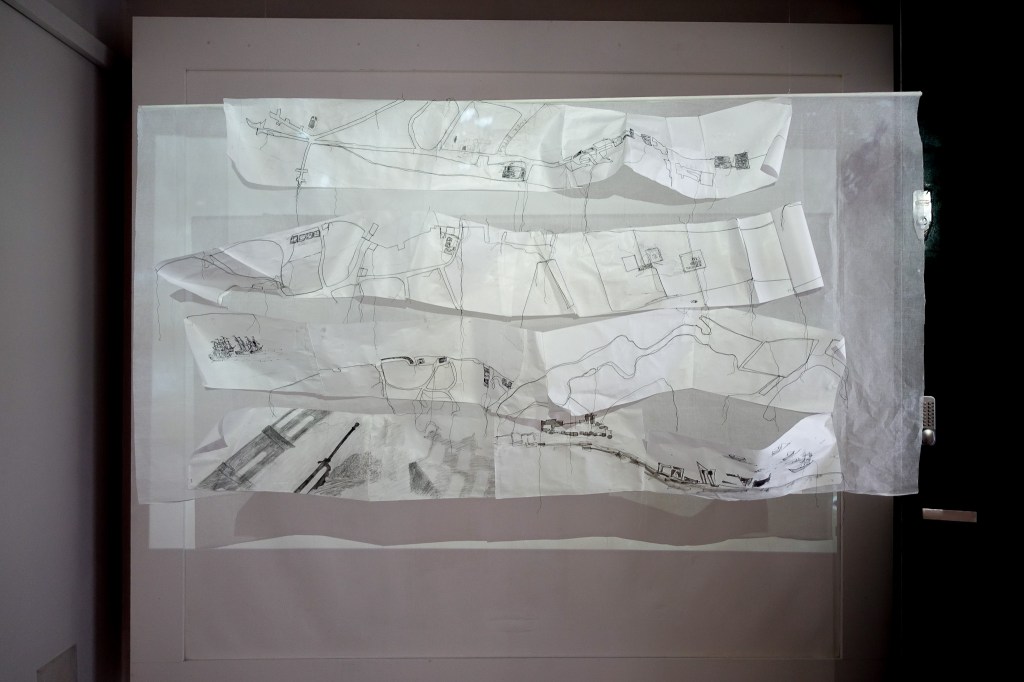
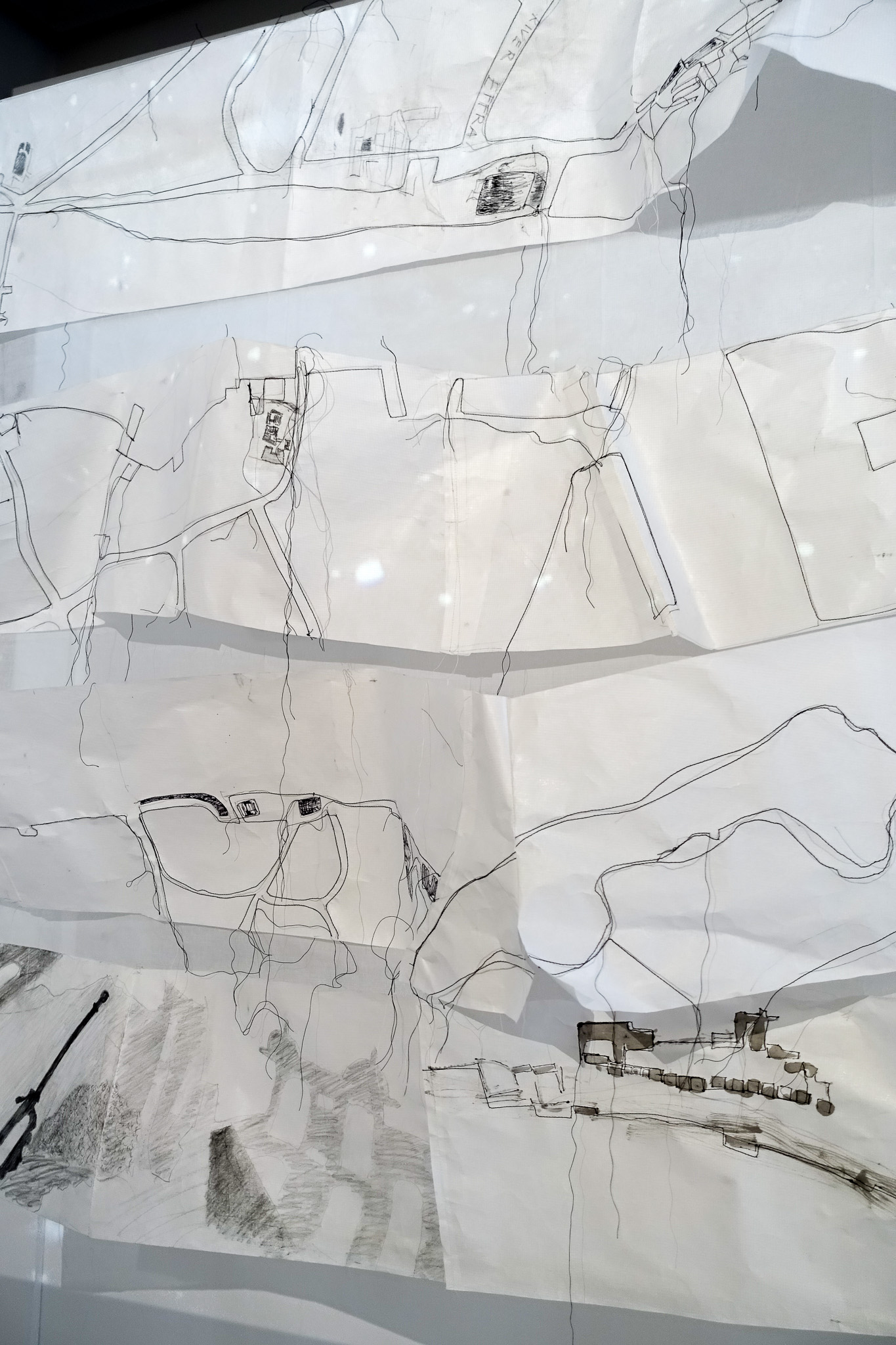
Curb 2025
graphite, ink and stitch on hosho paper and lens tissue; film, 200 x 150cm
For this piece, Cass looked at historic maps of the river’s southern edge at Vauxhall, close to the site of The Handbag Factory, and to where she lives. The maps, including one by the master cartographer and engraver John Rocque, illustrate encroachments on the river over the past few hundred years, when parts of the foreshore were developed for industrial and commercial purposes and tracts of land, that once were marsh, were reclaimed from the river on the south side. The embankment was built in the mid 1800s, giving the river its recognisable footprint, and was heavily bombed during WW2. Cass imagines the gradual confinement of the river bank through drawing and stitch. The piece includes a short projected film of the river at Vauxhall with its fast, brackish swell.
www.cassbreenart.com @cass.breen
Cat Needs
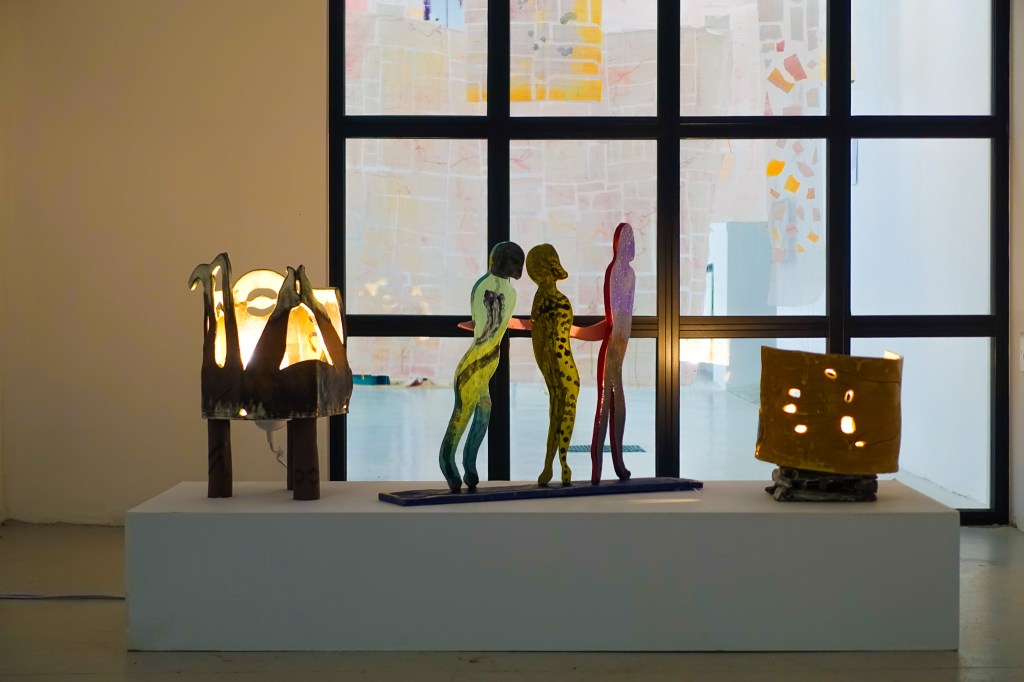
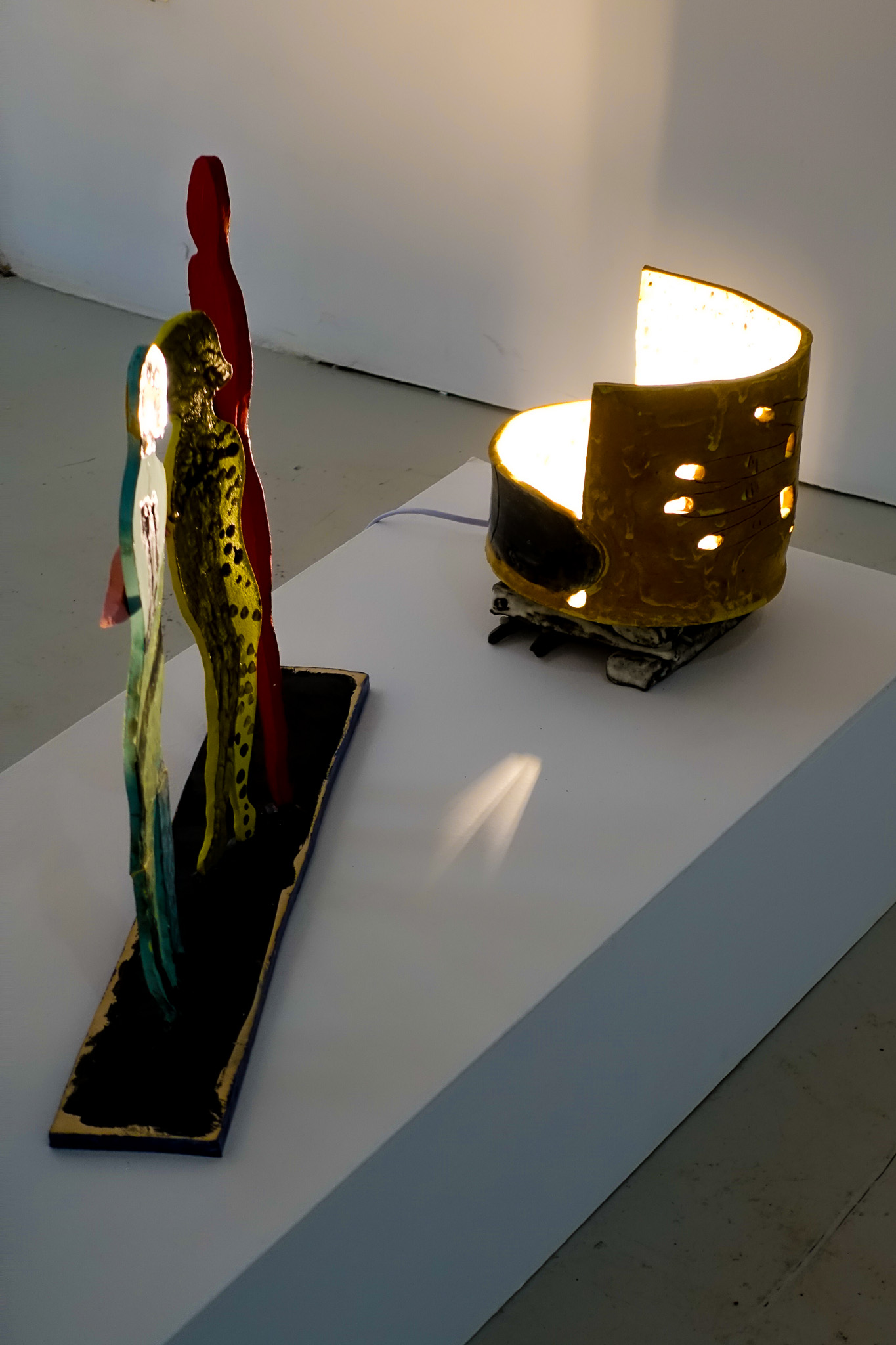
Untitled, 2025
earthenware glazed ceramic light installation, 20 x 18 X 20cm, 19 x 24 x 17cm
Cat’s works are inspired by her exploration of the Vauxhall Pleasure Gardens, visualised as a queer utopia of the past. Her research centred on the masquerade balls once held there, which brought together Londoners from many corners of society. Hidden behind masks and liberated by disguise, these gatherings became popular sites for queer connection and subversion. The work seeks to celebrate the early public expression of queerness, while also questioning the role the Pleasure Gardens played in shaping the current nature of queer space in London.
Chisara Vidale
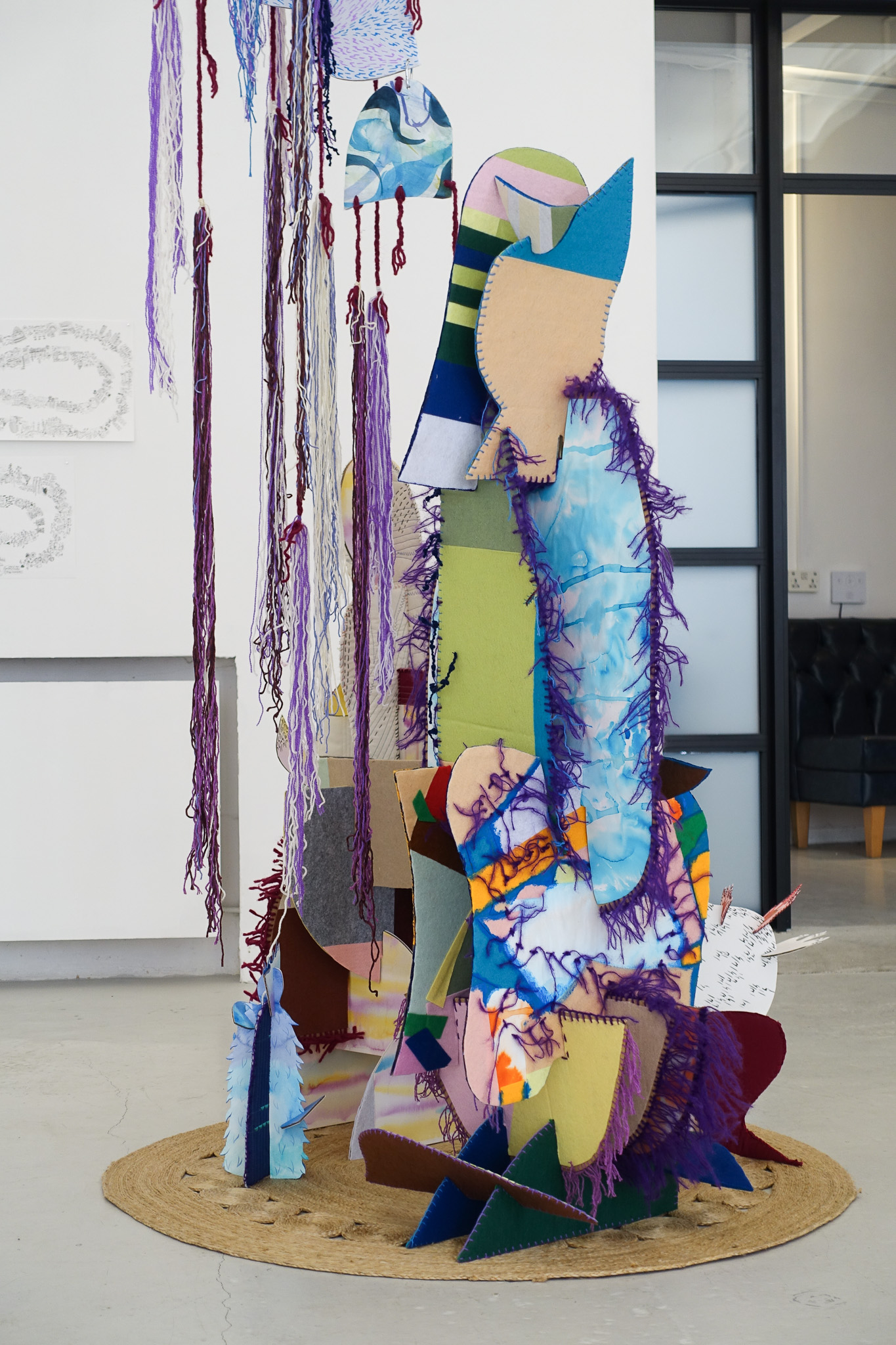
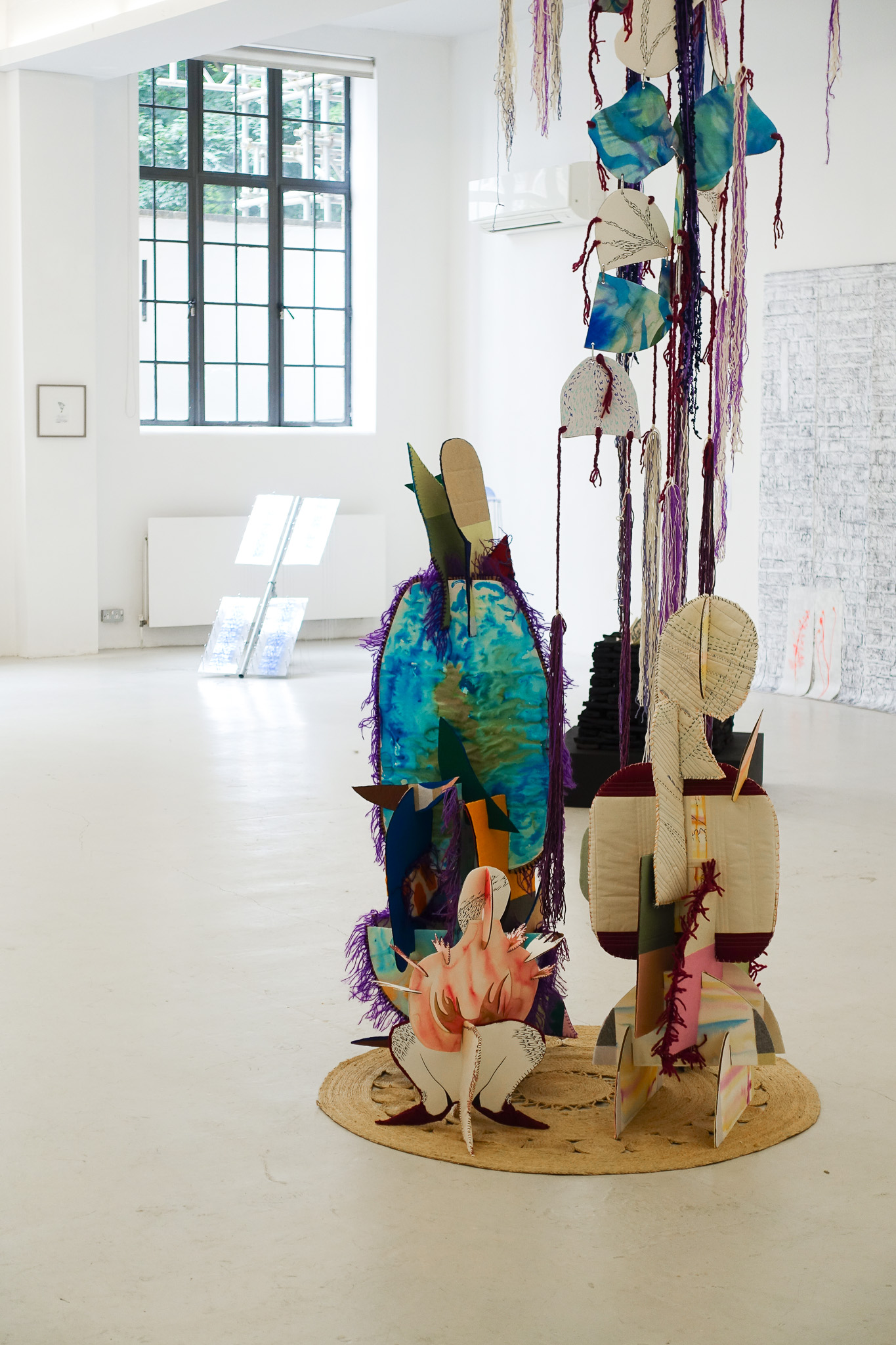
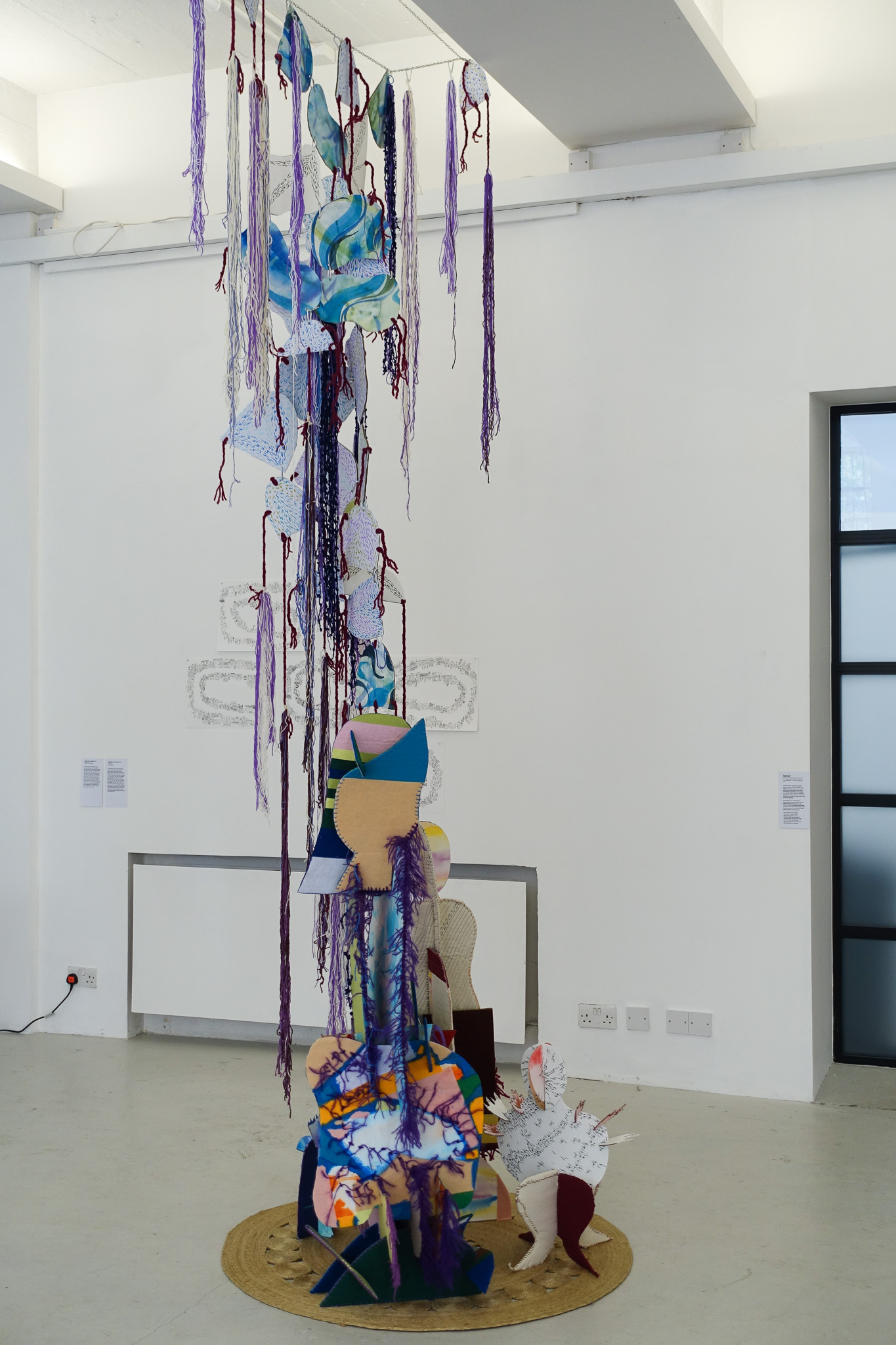
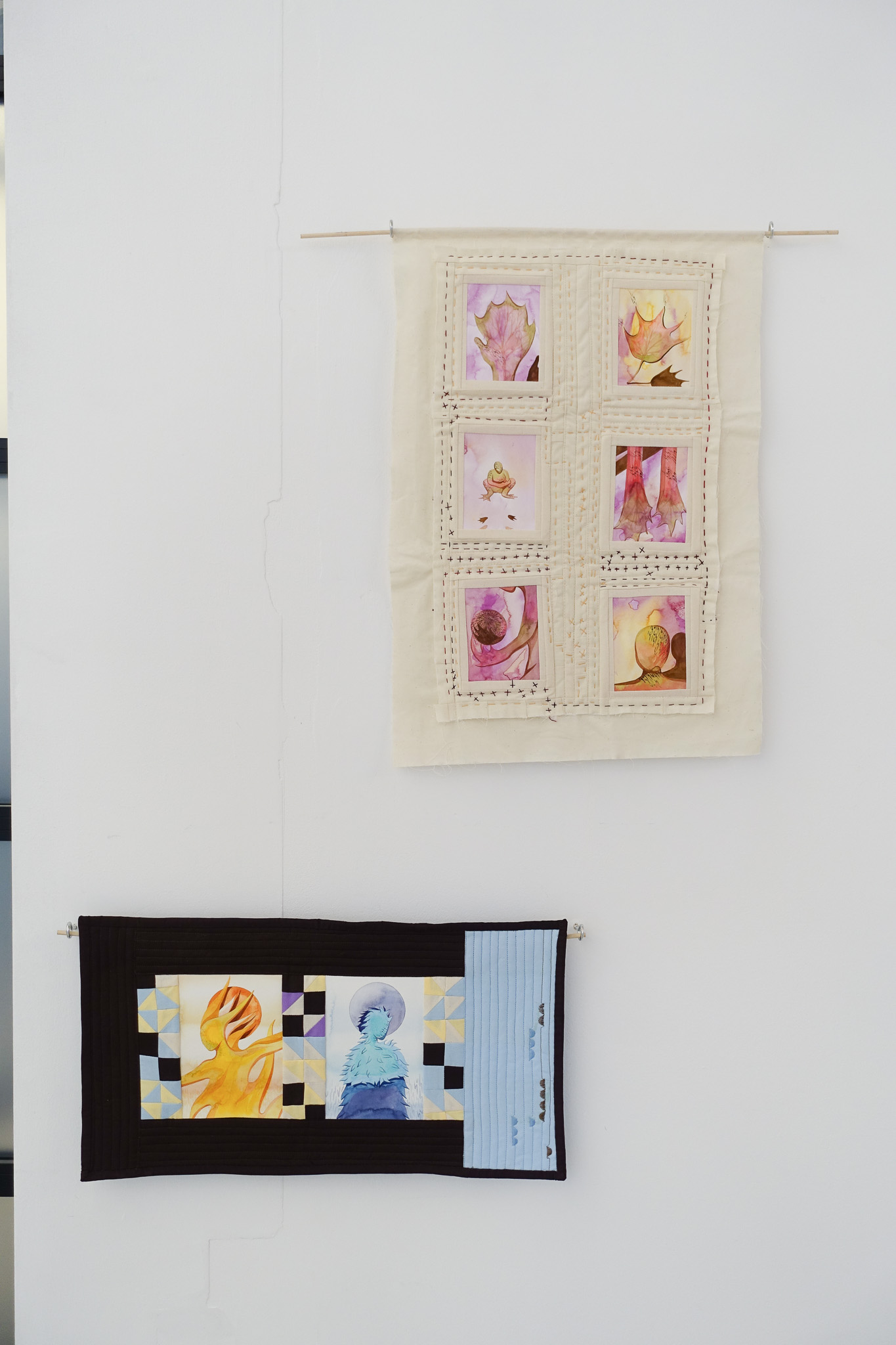
Elemental, 2025
mixed media textile, paper and watercolour, 111 x 130cm sculpture; 60 x 42cm & 55 x 30cm wall pieces; 110 x 60cm suspended piece
Chisara chose to explore the Vauxhall Pleasure gardens, being interested in the histories of the place and how we inhabit natural spaces. She looked at old maps, drawings and engravings of the revellers who enjoyed theatre, music and scandal in the gardens. Chisara imagined disembodied spirits of trees, plants and elementals joining in with the festivities. The installation is a combination of sculptural and wall-based pieces that she sees as these spirits, hanging-out and having fun. They are a group of non-human revellers, having a secret rendezvous in the Vauxhall gardens. This 18th century ballad extract captures the atmosphere:
“Each profession, ev’ry trade
Here enjoy refreshing shade,
Empty is the cobbler’s stall,
He’s gone with tinker to Vauxhall,
Here they drink, and there they cram,
Chicken, pasty, beef and ham
Women squeak and men drunk fall
Sweet enjoyment of Vauxhall.”
www.chisaravidale.com @chisara__
Eleanor Street
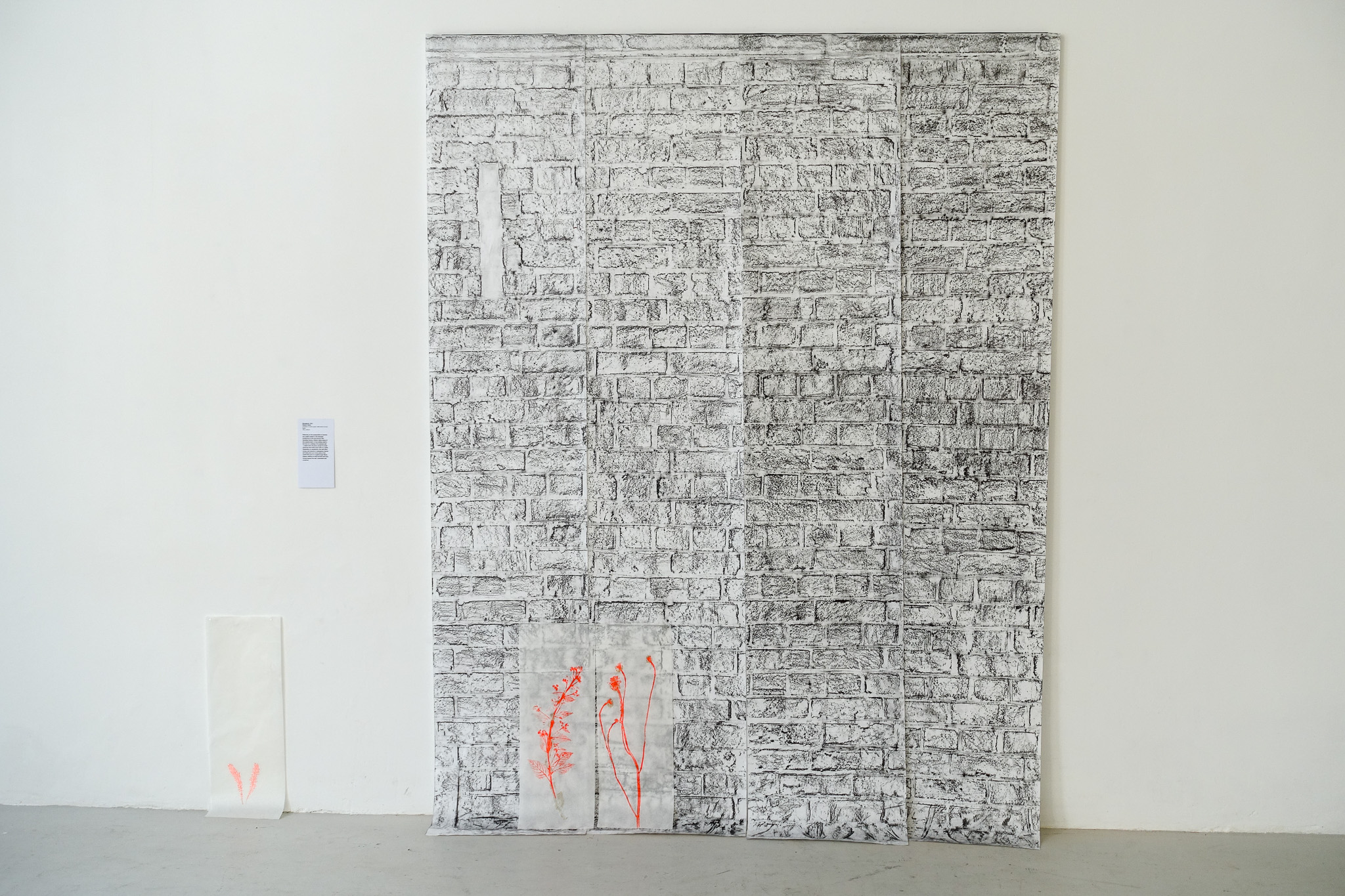
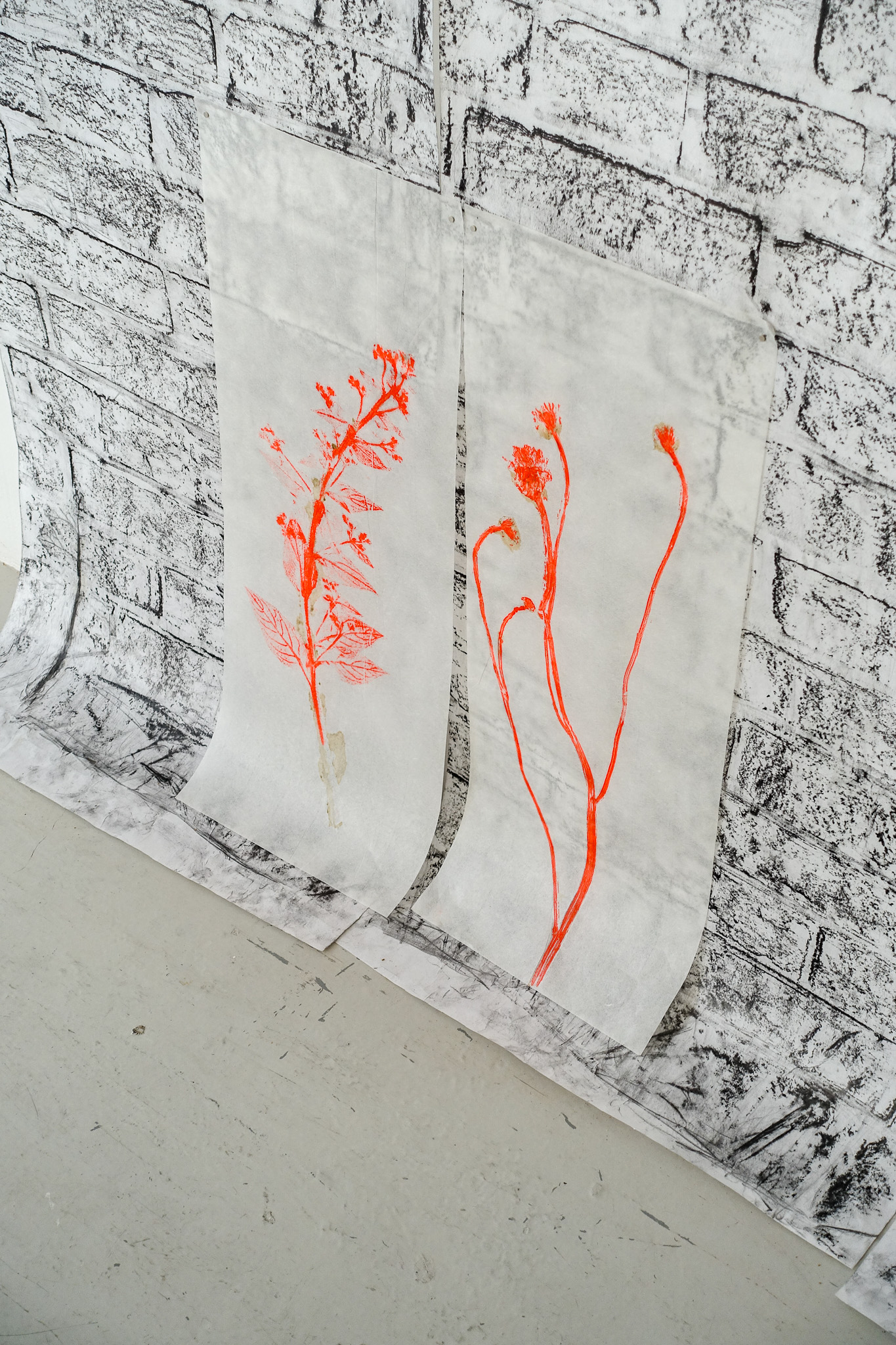
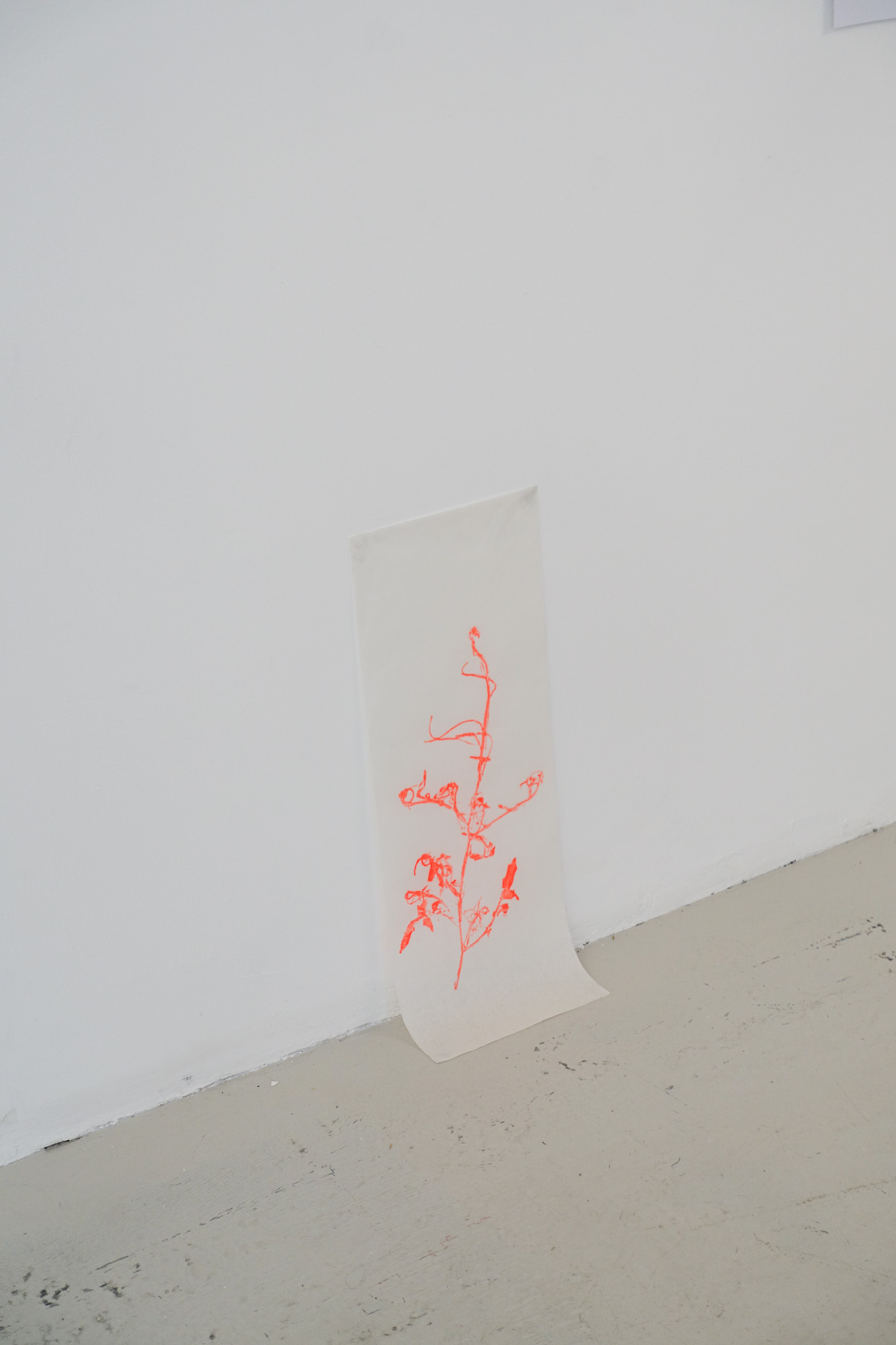
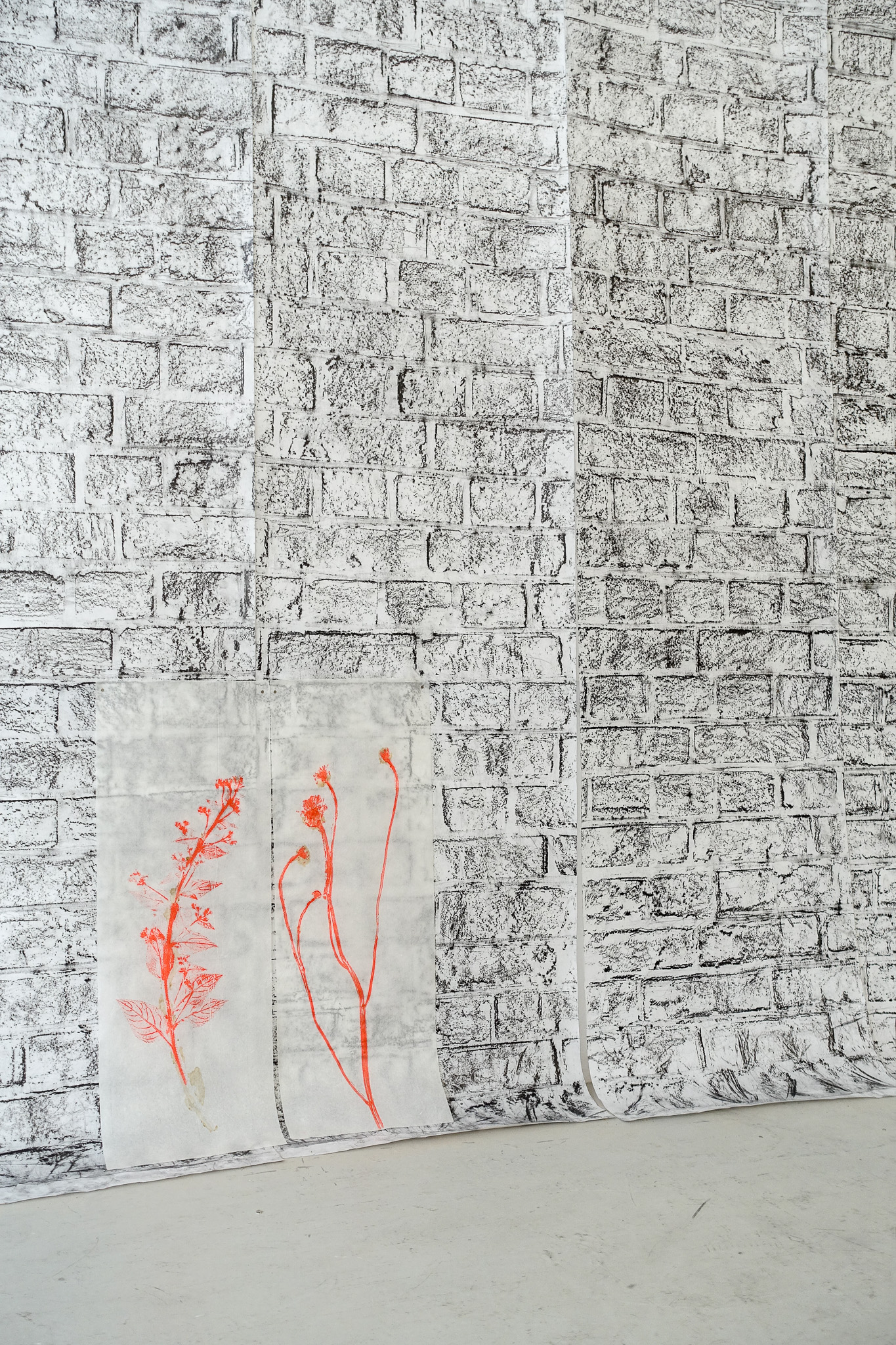
Stronghold, 2025
graphite on hosho paper; relief prints on kozo paper,190 x 250cm
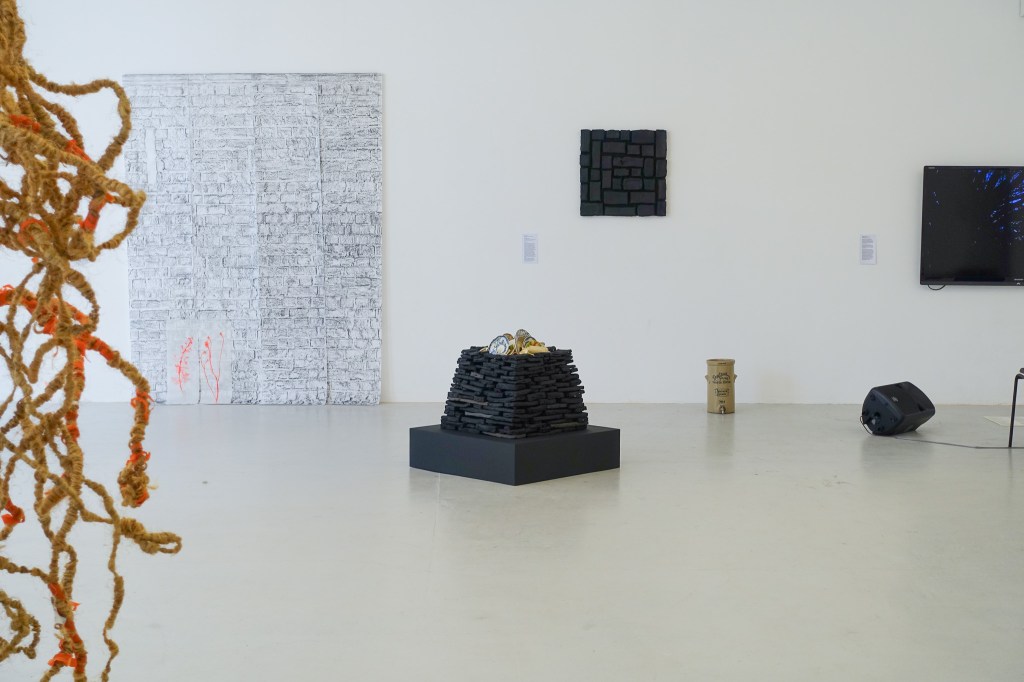
Reflecting on the juxtaposition of poverty and wealth evident in the domestic architecture in the area around The Handbag Factory, Eleanor takes traces of the material fabric of the building itself in the form of a rubbing of its external wall – a blank brick structure, except for small apertures that evoke arrow slits in a castle. Depending on perspective, the wall offers privacy and security or represents a barrier and being shut out. In her prints of the weeds that grow in Loughborough Street, Eleanor reflects on what survives and even thrives beyond the wall, overlooked and underfoot.
www.eleanorstreet.net @eleanor__street
Emiline Trenton
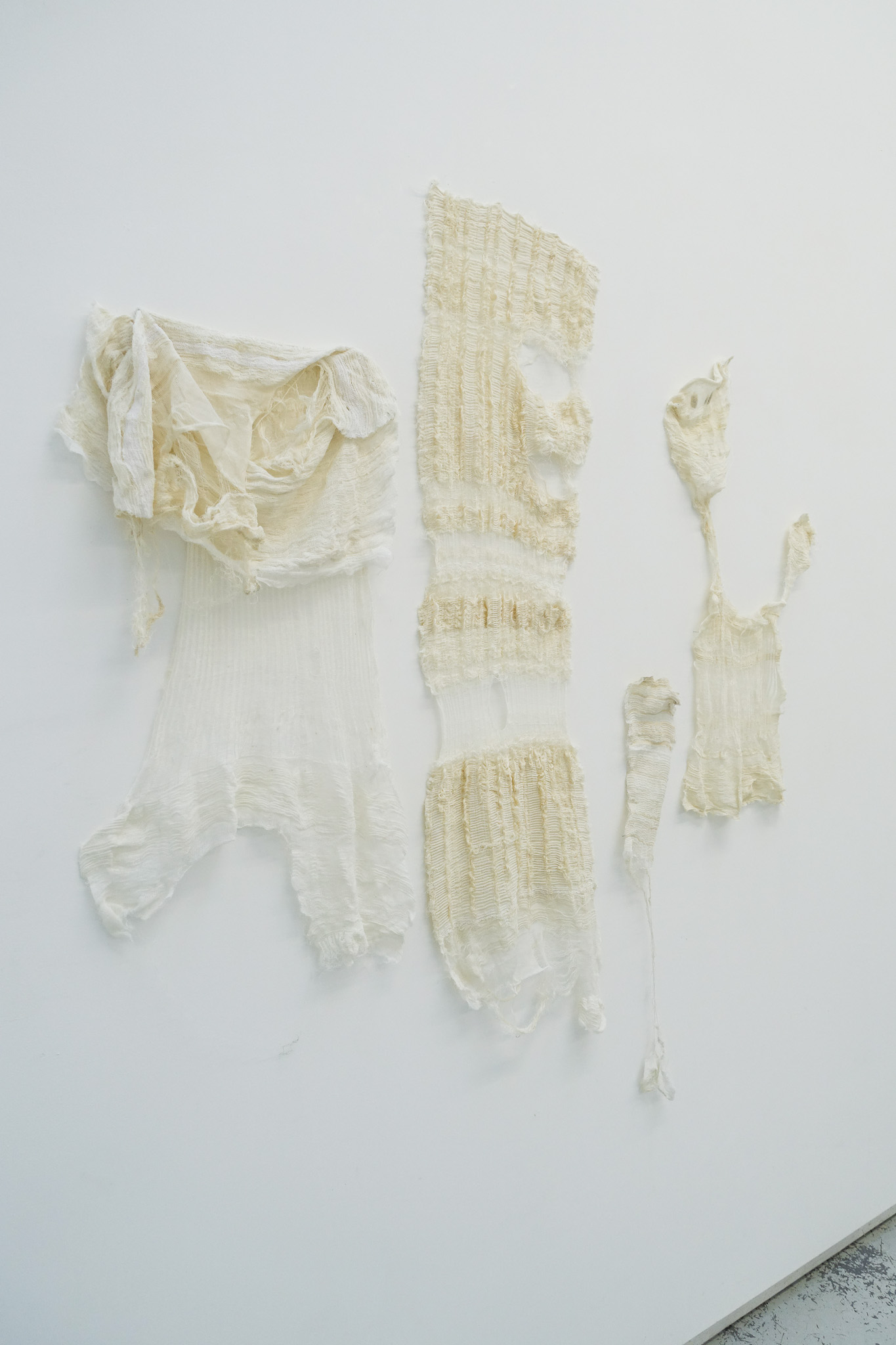
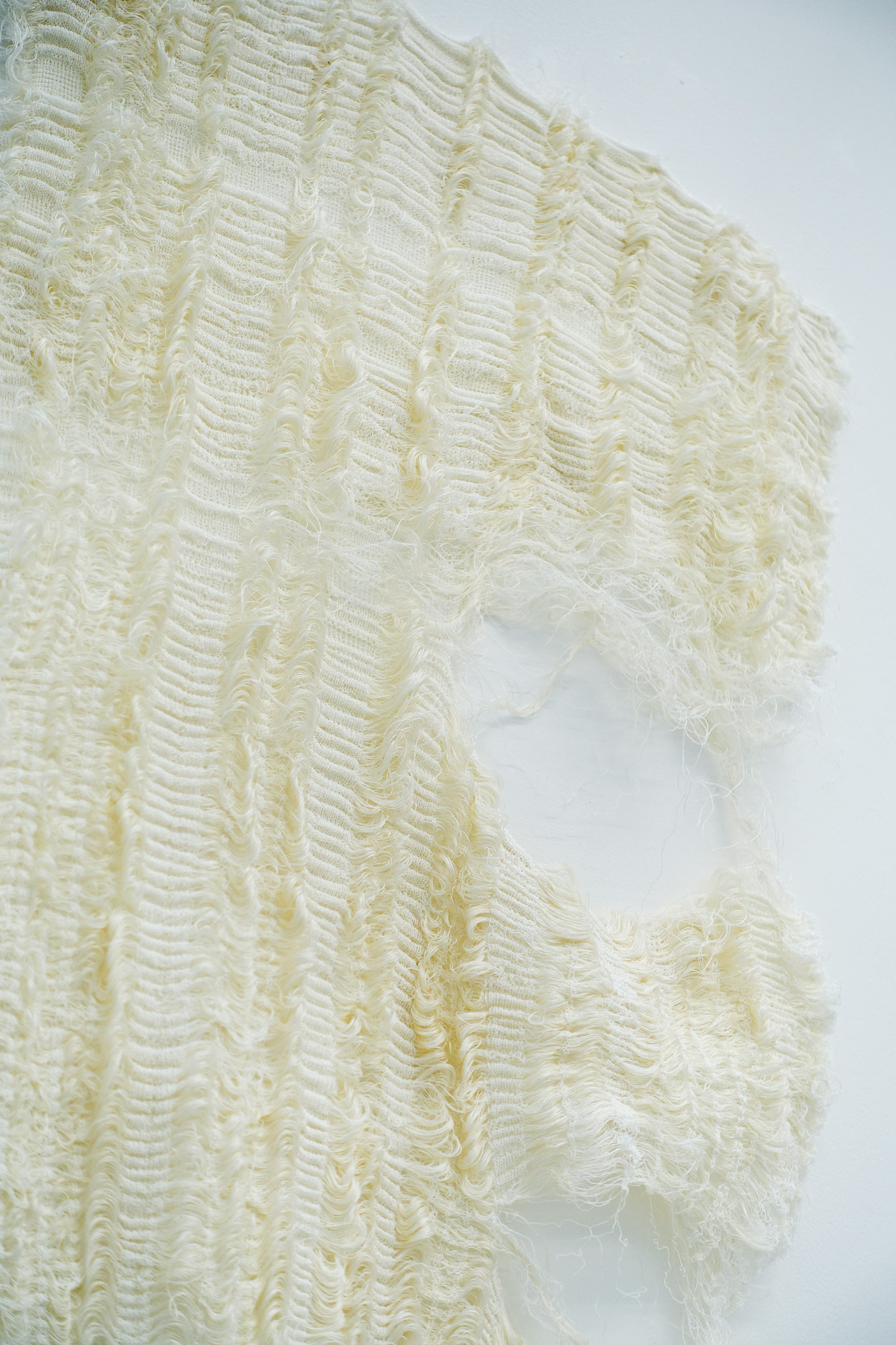
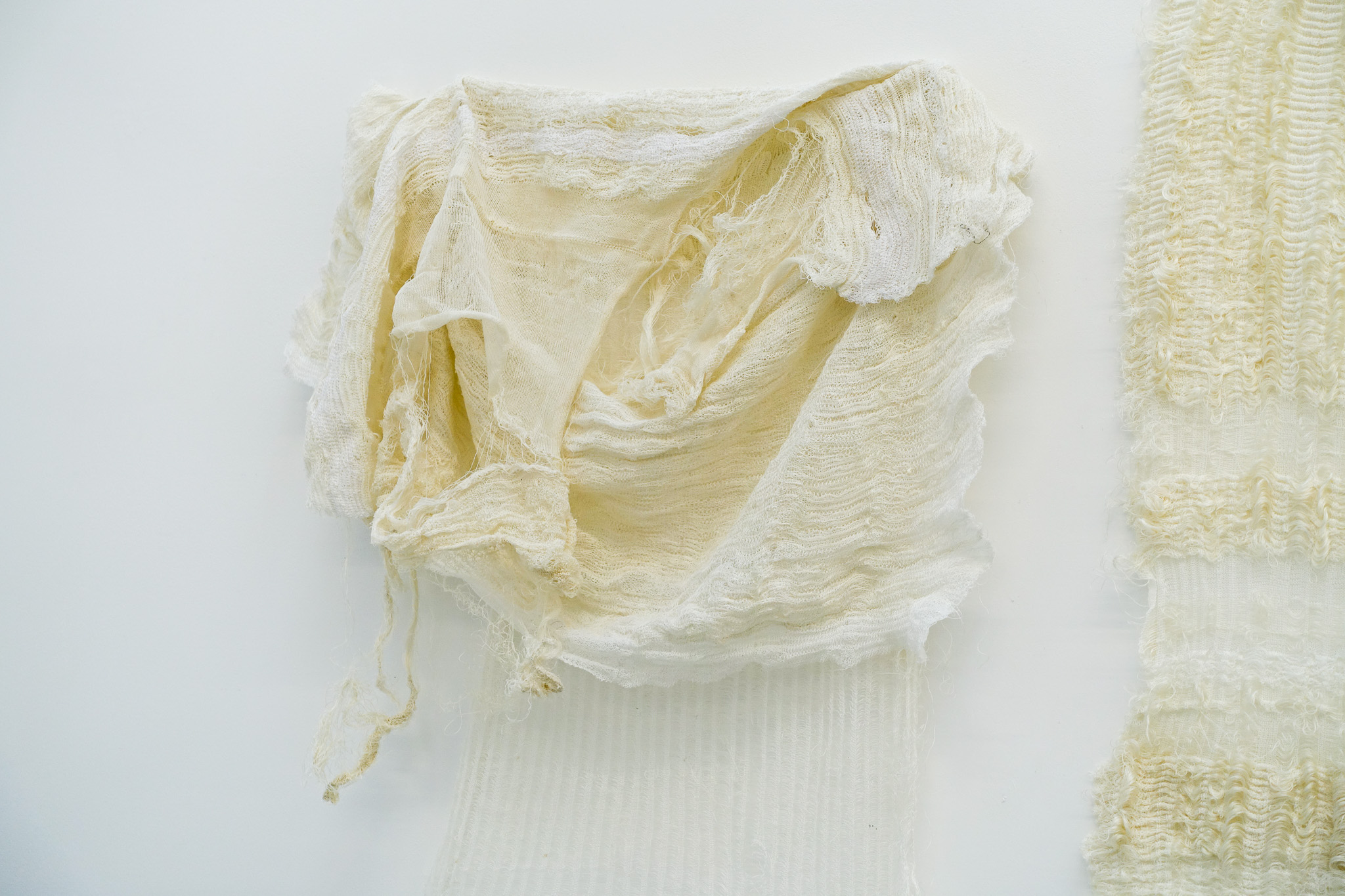
Untitled, 2025
knitted textiles, spun silk and cotton yarn
Emotional and structural membranes—soft architectures that hold memory and transformation. Knitted forms and inlay techniques investigating the interplay of light, shadow, and space, evoking the tension between past and present. It is the grounding of soil, engaging with natural fibres. Textured surfaces of inlaid yarn reflect the accumulation of memories, echoing touch and presence. Subtle yet rigid, the layered forms hold traces of lived moments. It is what the body absorbs, remembers, and ultimately heals. By allowing light to filter through and cast shadows, the work becomes an ephemeral map of presence and absence—a space where memory and form coexist. It is a meditation on the tactile and the temporal, offering a quiet space to reflect on what remains grounded amidst change.
www.emilinetrenton.com @emilytrenton
Eva Barkardóttir
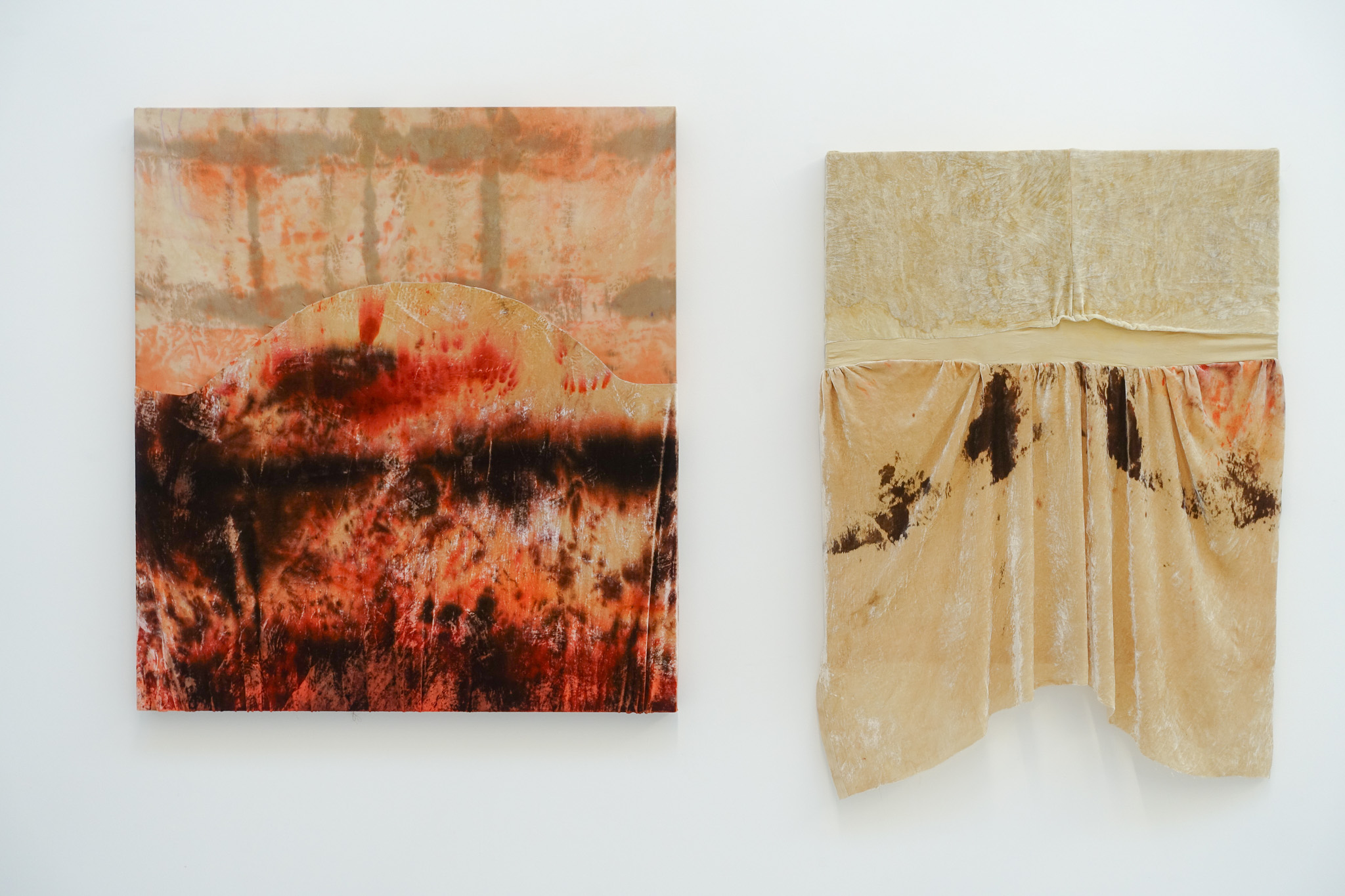
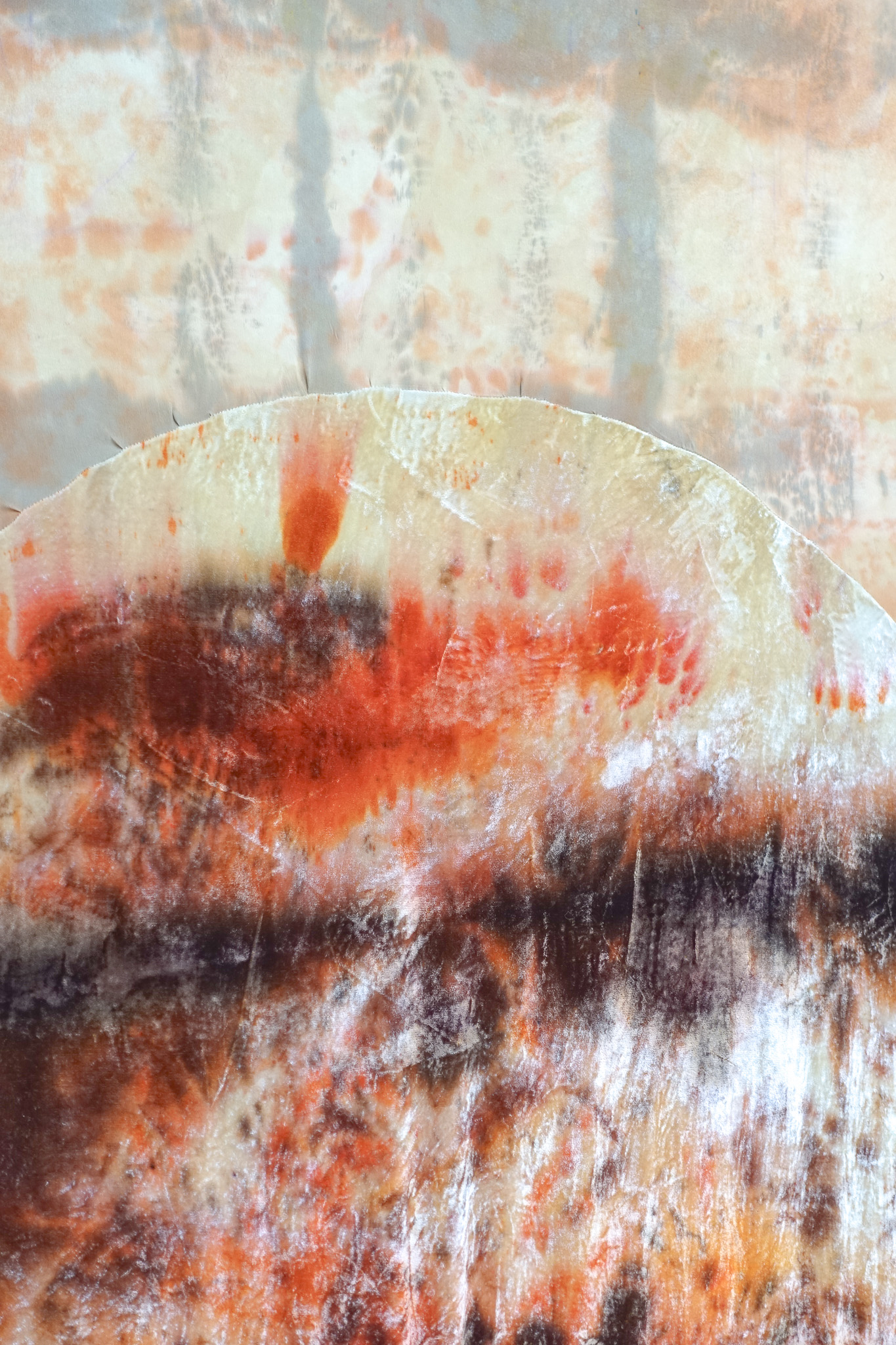
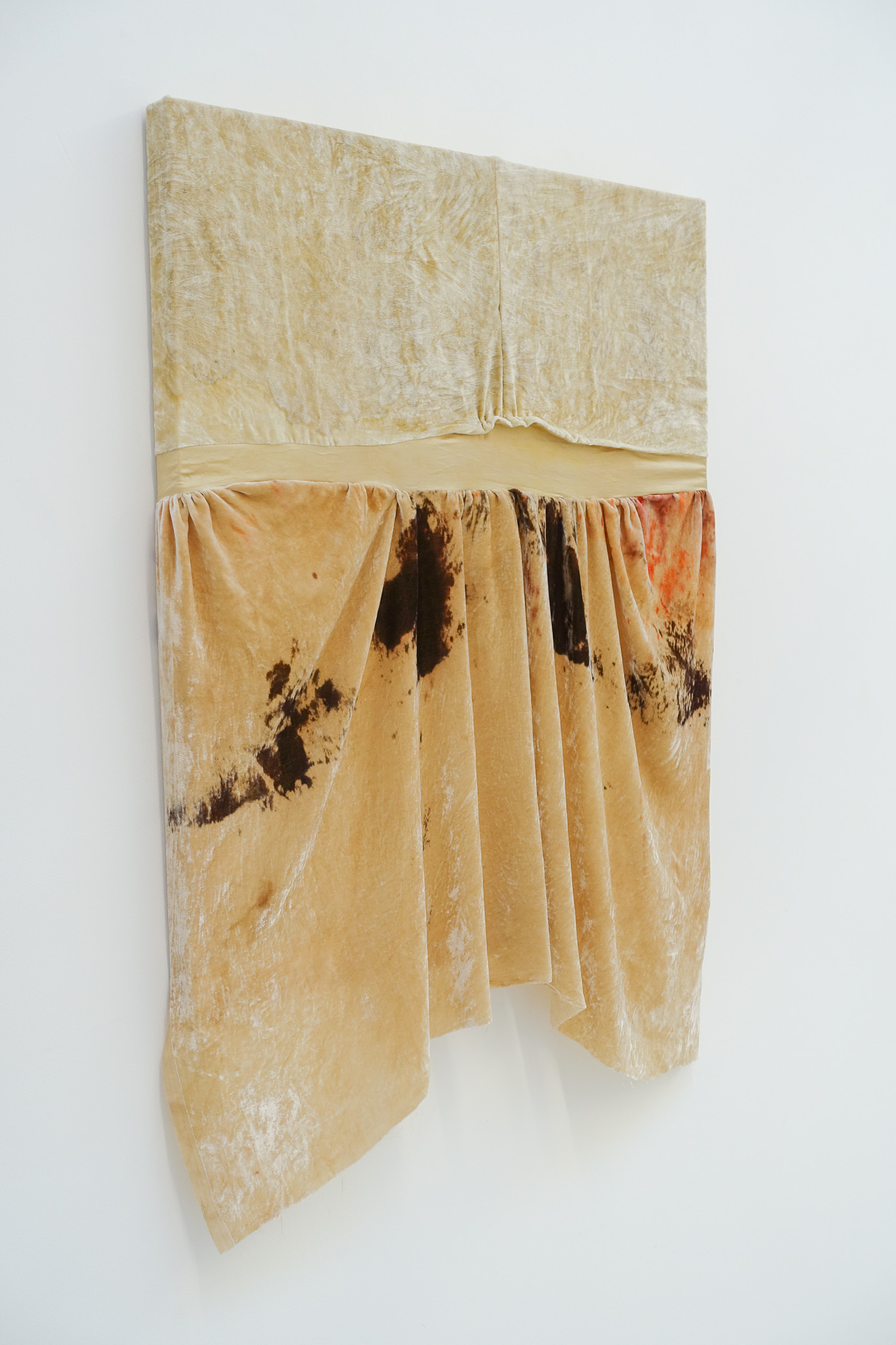
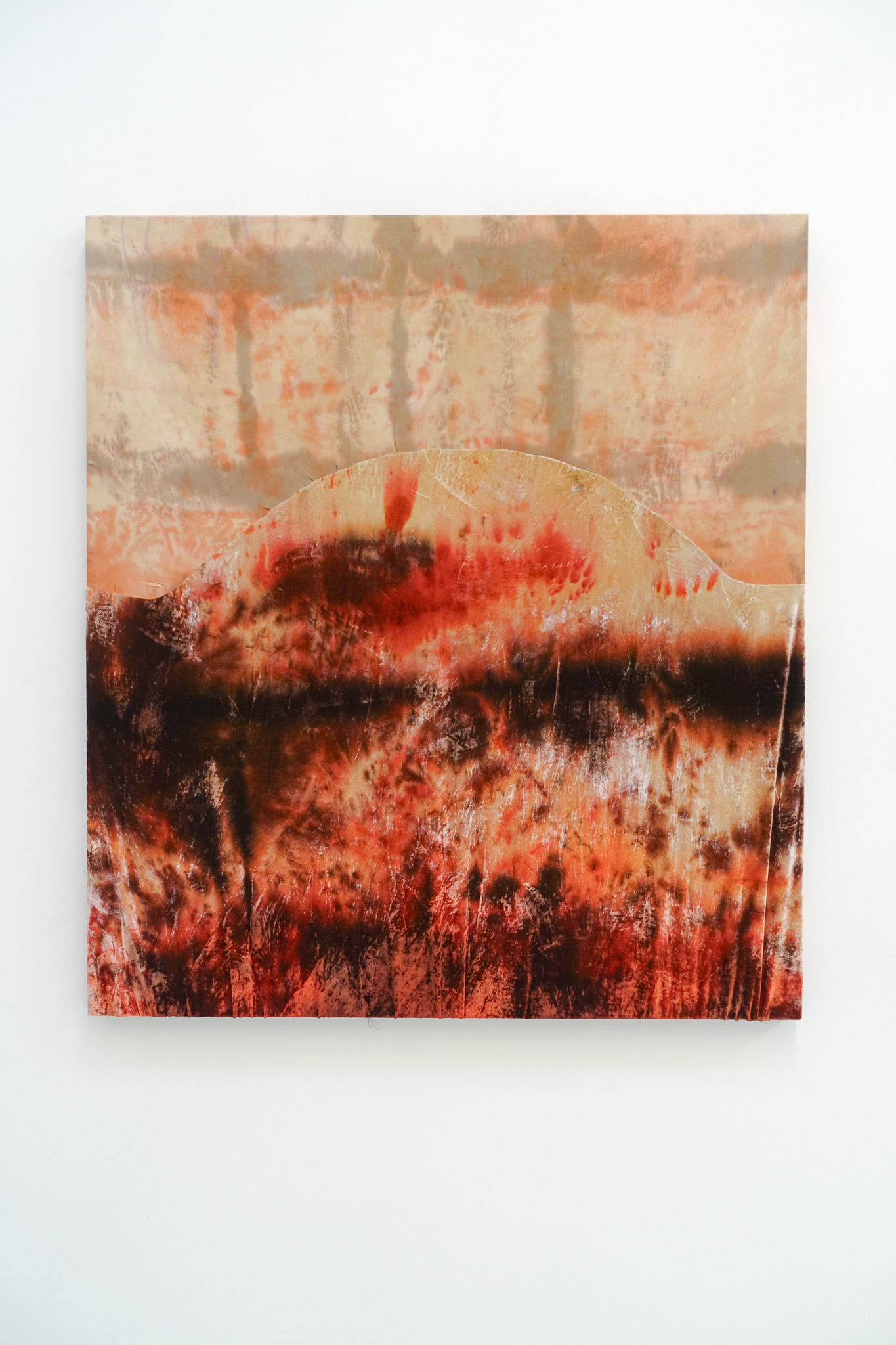
Penelope Weaving, 2025
natural dye and pigment on dead-stock silk and silk velvet, 95 x 85cm
Exploring ideas around production led to Penelope’s (The Odyssey) cunning use of her craft to expand time and shape fate. Penelope keeps her suitors at bay by stating that no one will be chosen until her project at the loom is hemmed. Each day, she sits at work only to secretly unravel her progress each night. Biding, creating, producing, and weaving time. Through endless labour, she keeps the men at bay, for now, but their fate is sealed. The witches of destiny will cut the thread shortly.
Nábrók, 2025
natural dye and pigment on dead-stock silk and silk velvet, 70 x 100cm
Researching the ideology of private enterprise led down a path to ancient Icelandic witchcraft. The Icelandic (most likely mythological) spell for endless riches requires a pact made between two men; whoever outlives the other will craft ’Nábrók’ or Necropants from the skin of the other. The activation of the spell requires a coin to be stolen from the poorest of widows.
www.barkardottir.com @eva.barkardottir
Iliana Ortega-Alcázar
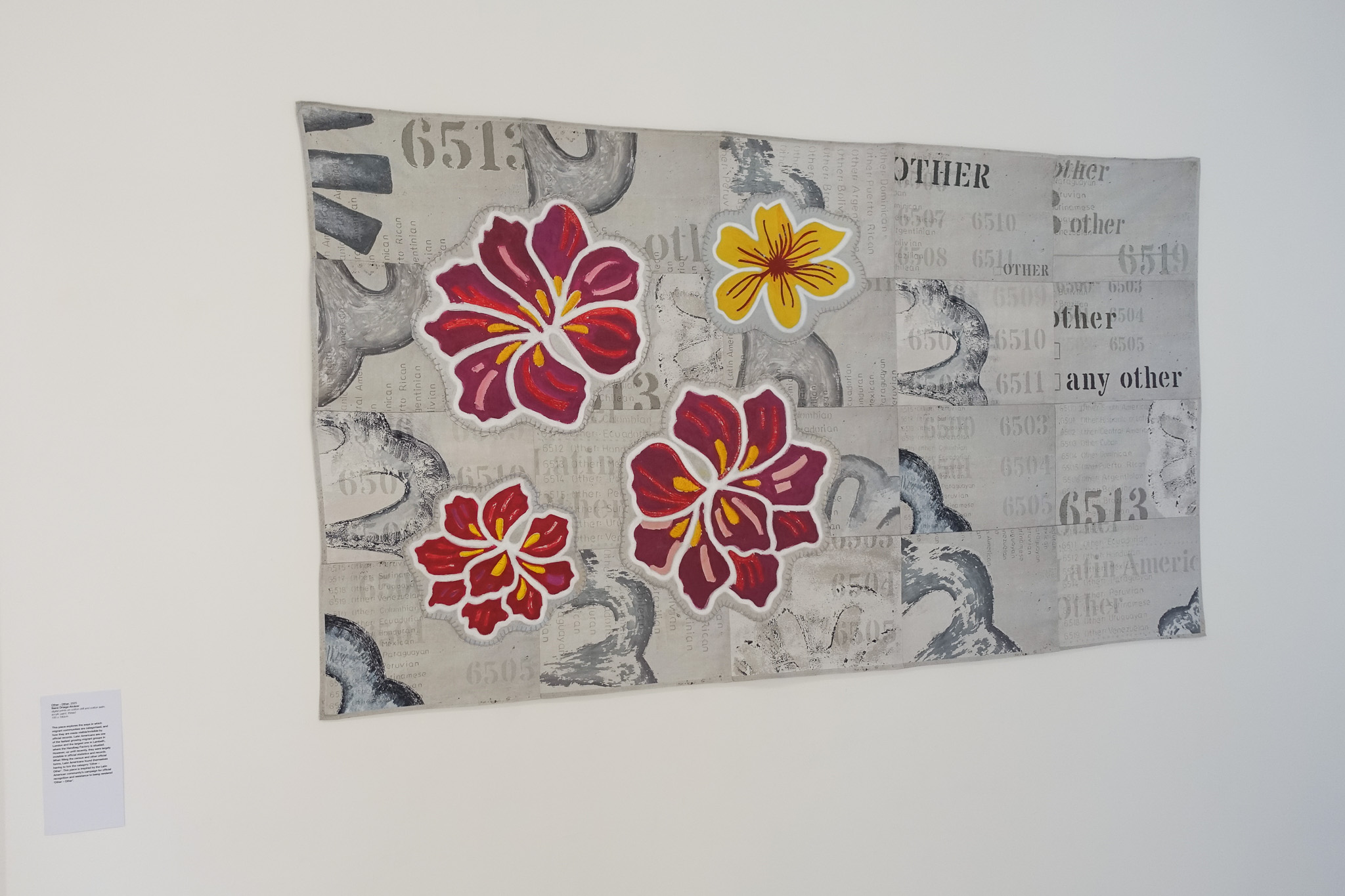
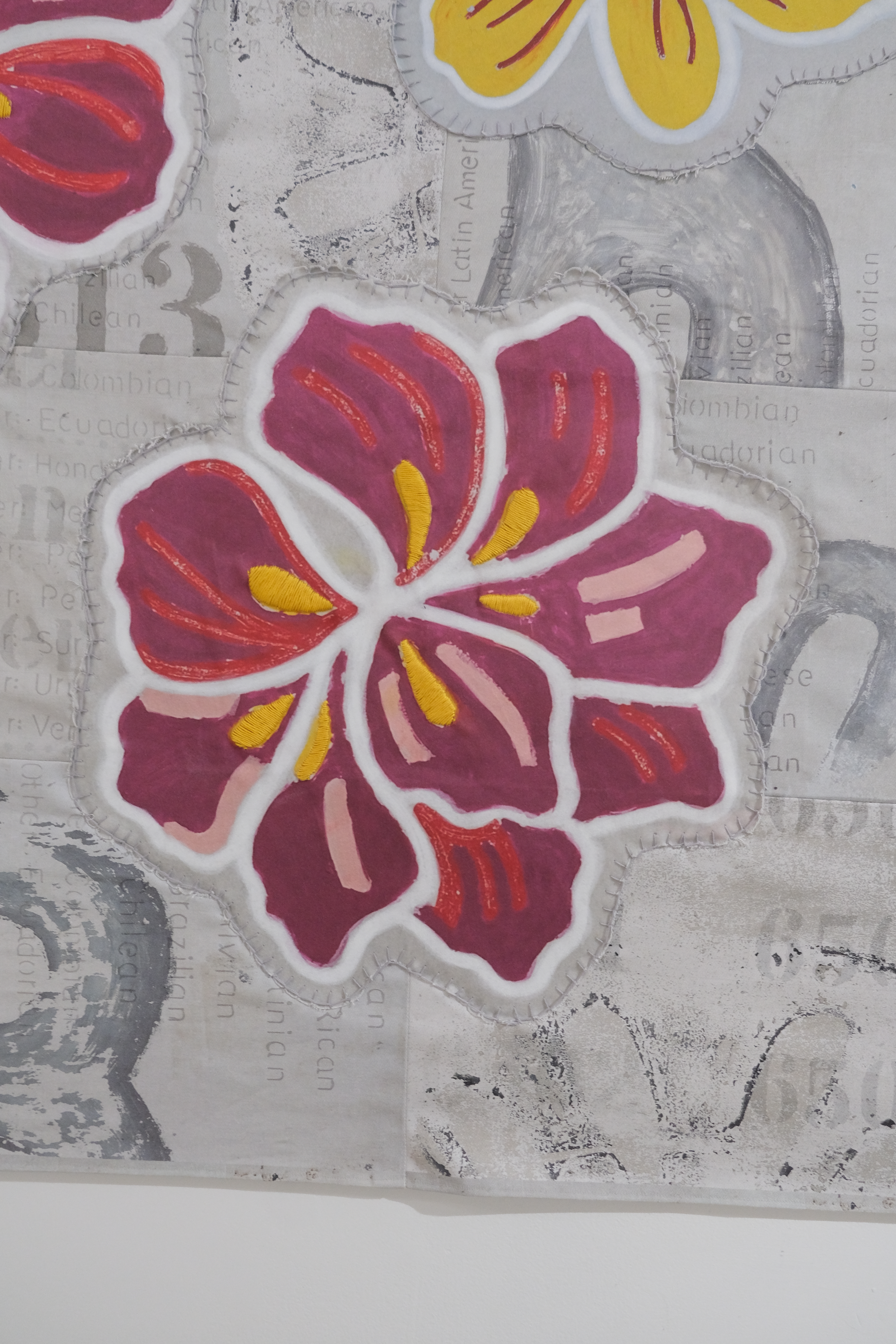
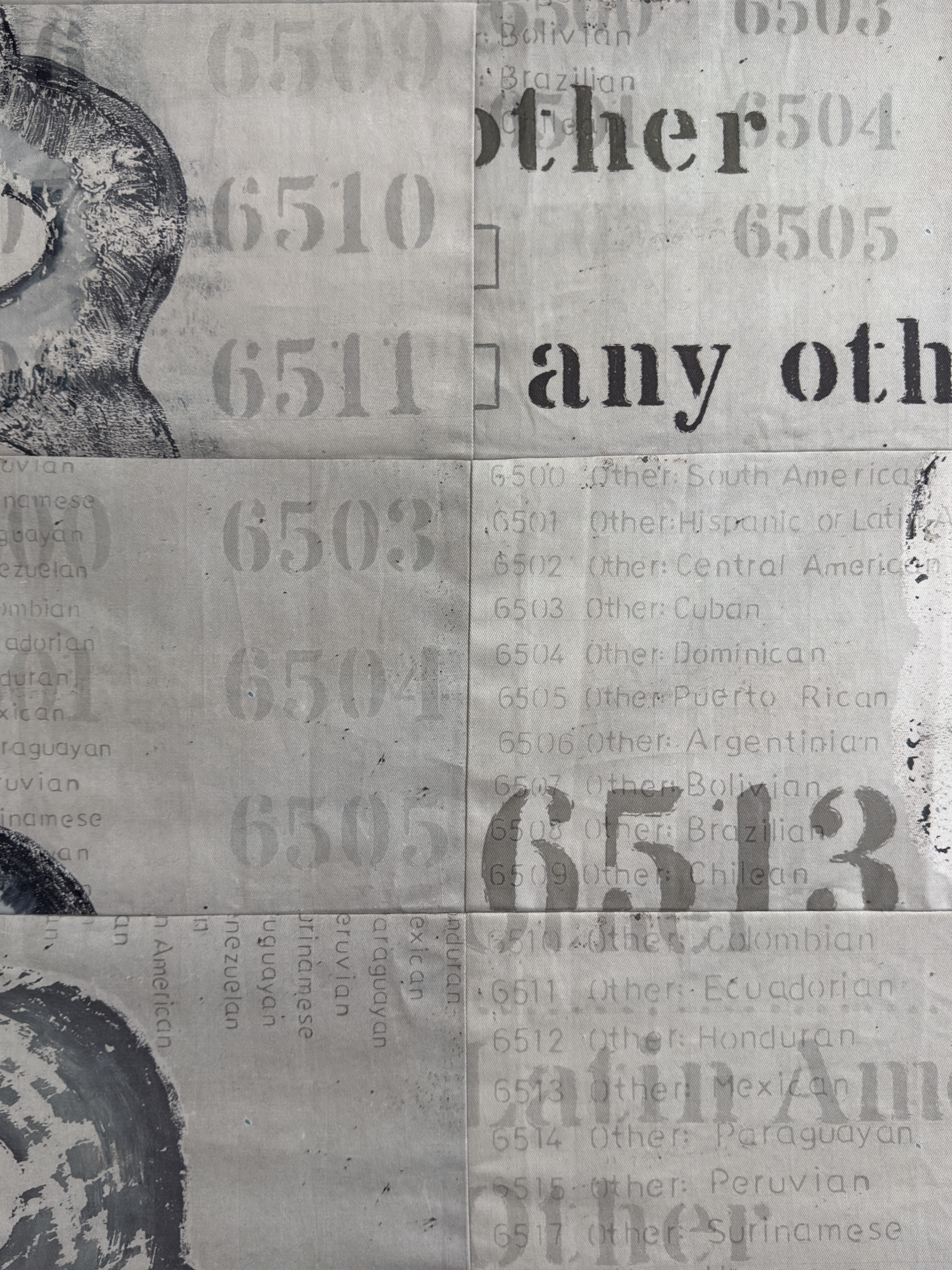
Other – Other, 2025
digital prints on cotton drill and cotton satin, acrylic paint, thread, 100 x 180cm
This piece explores the ways in which migrant communities are categorised, and how they are made visible/invisible by official records. Latin Americans are one of the fastest growing migrant groups in London and the largest one in Lambeth, where the Handbag Factory is situated. However, up until recently, they were largely invisible in official statistics and records. When filling the census and other official forms, Latin Americans found themselves having to tick the category ‘Other – Other’. This piece is inspired by the Latin American community’s campaign for official recognition and resistance to being rendered ‘Other – Other’.
Jane Hughes
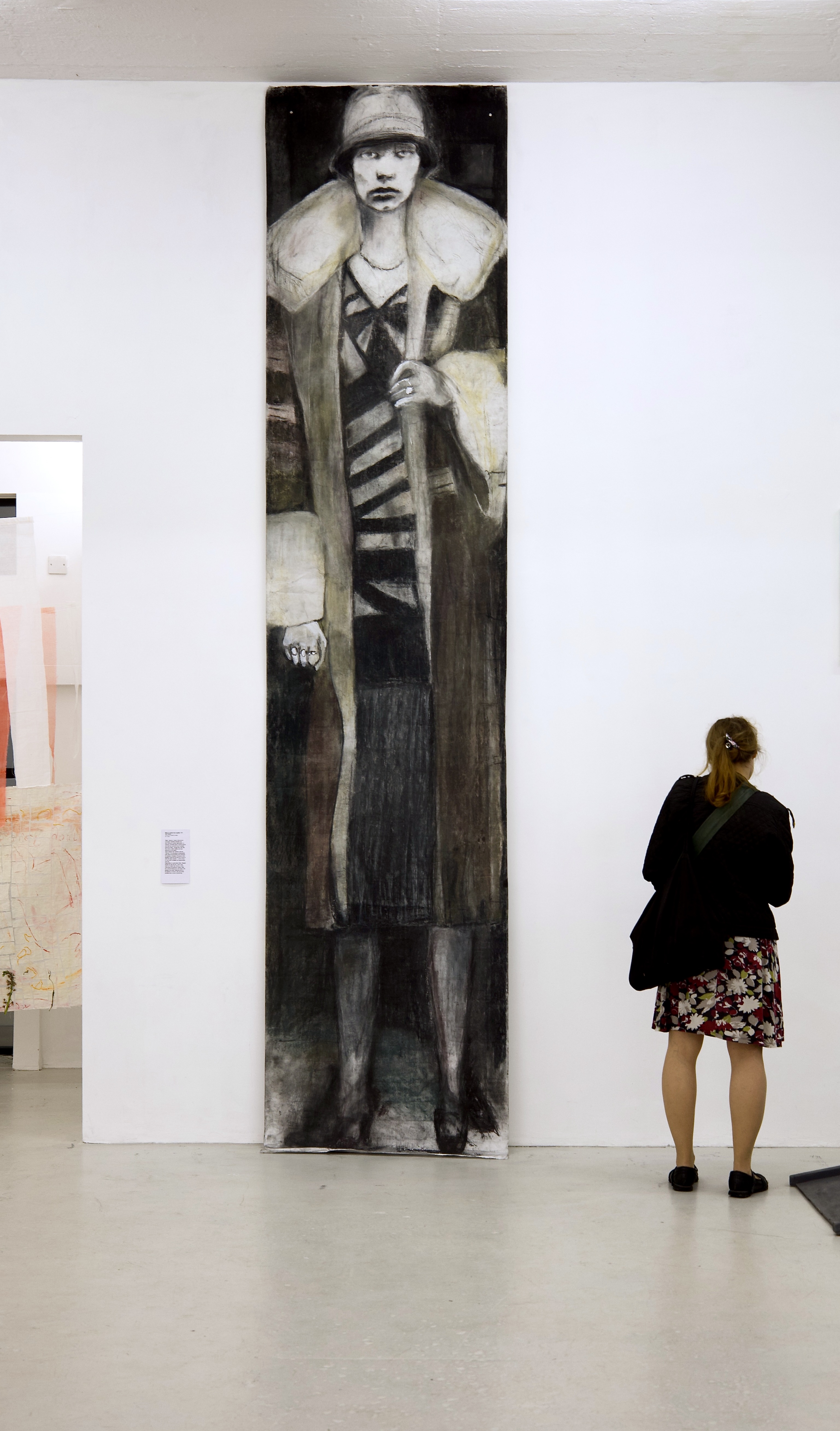
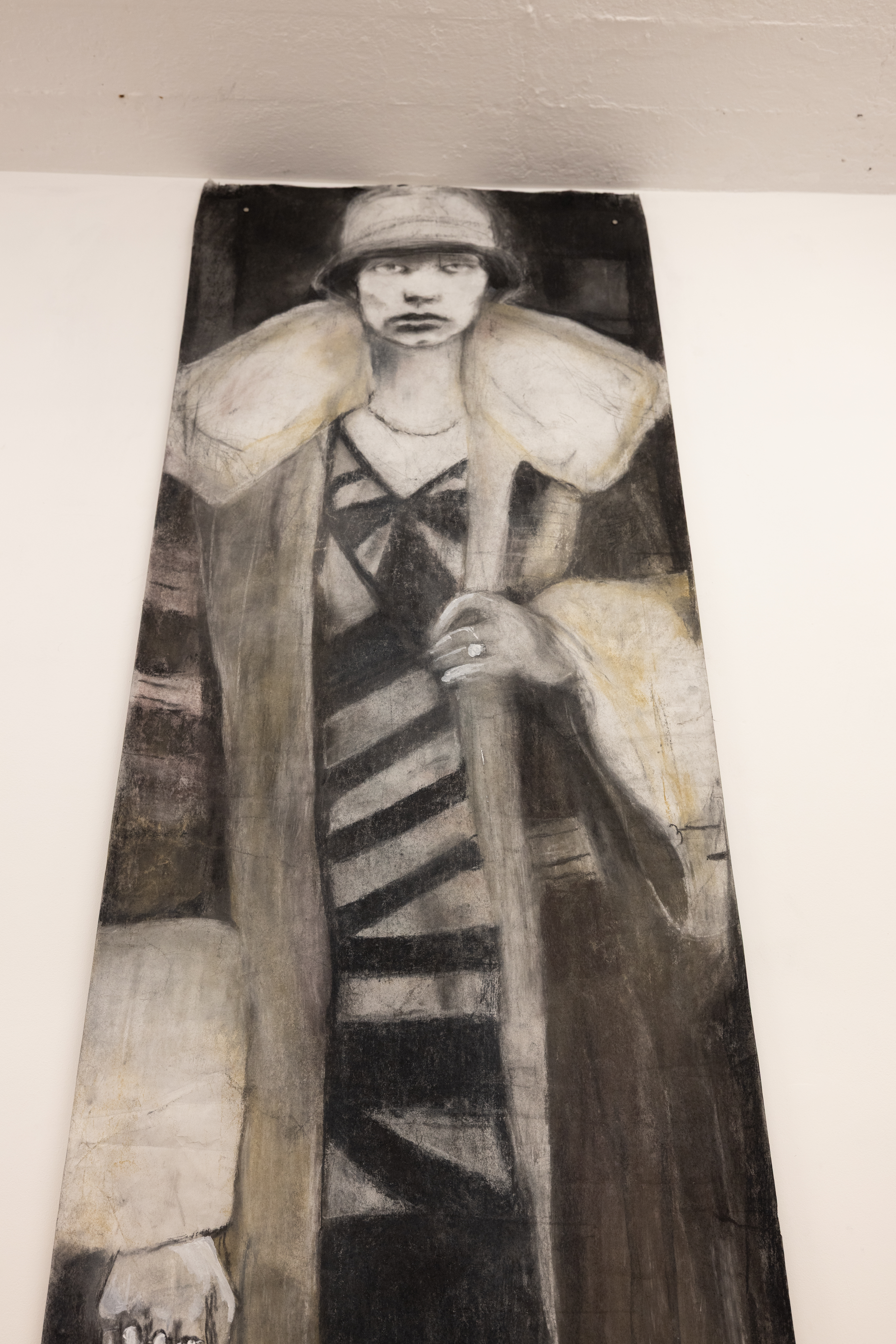
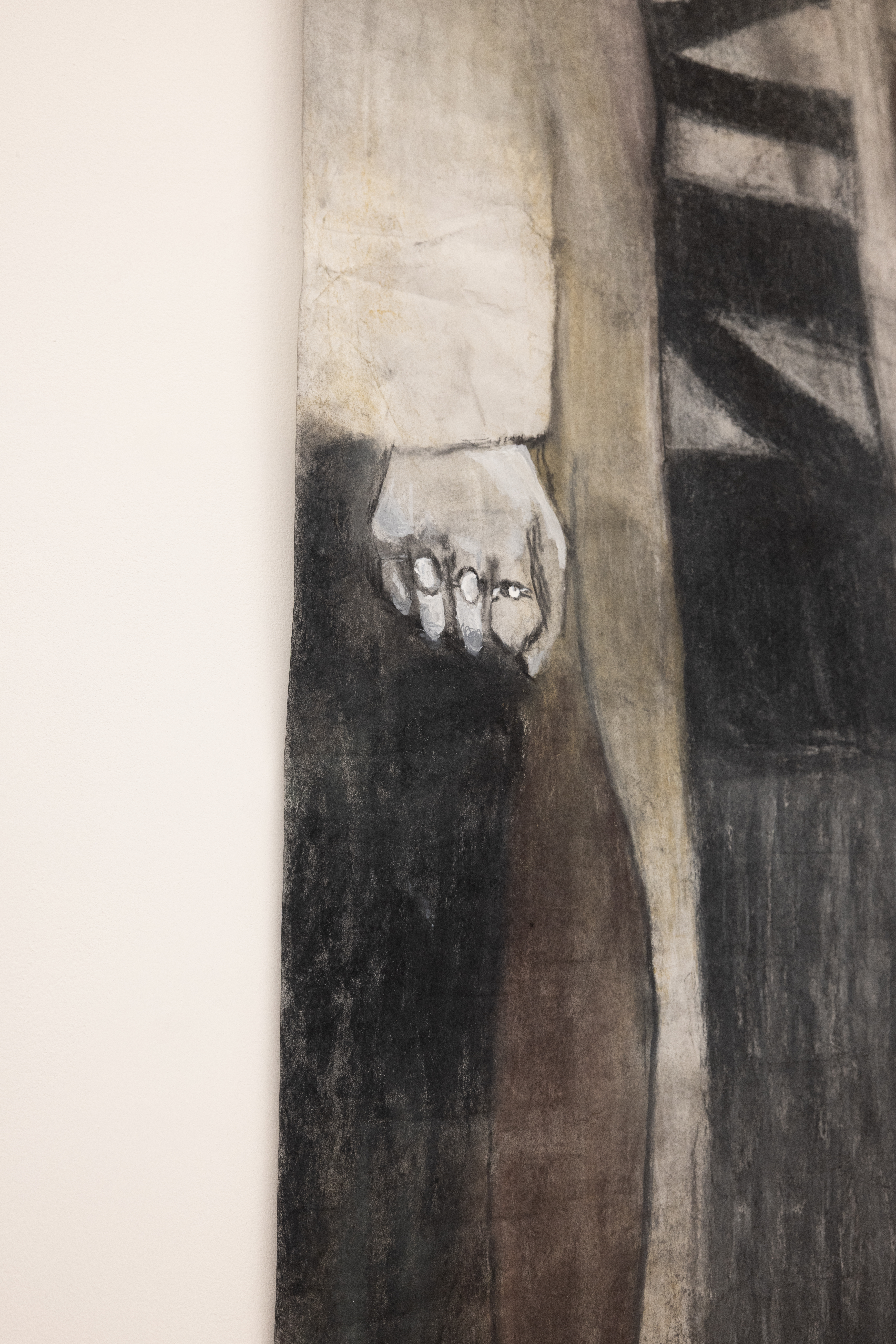
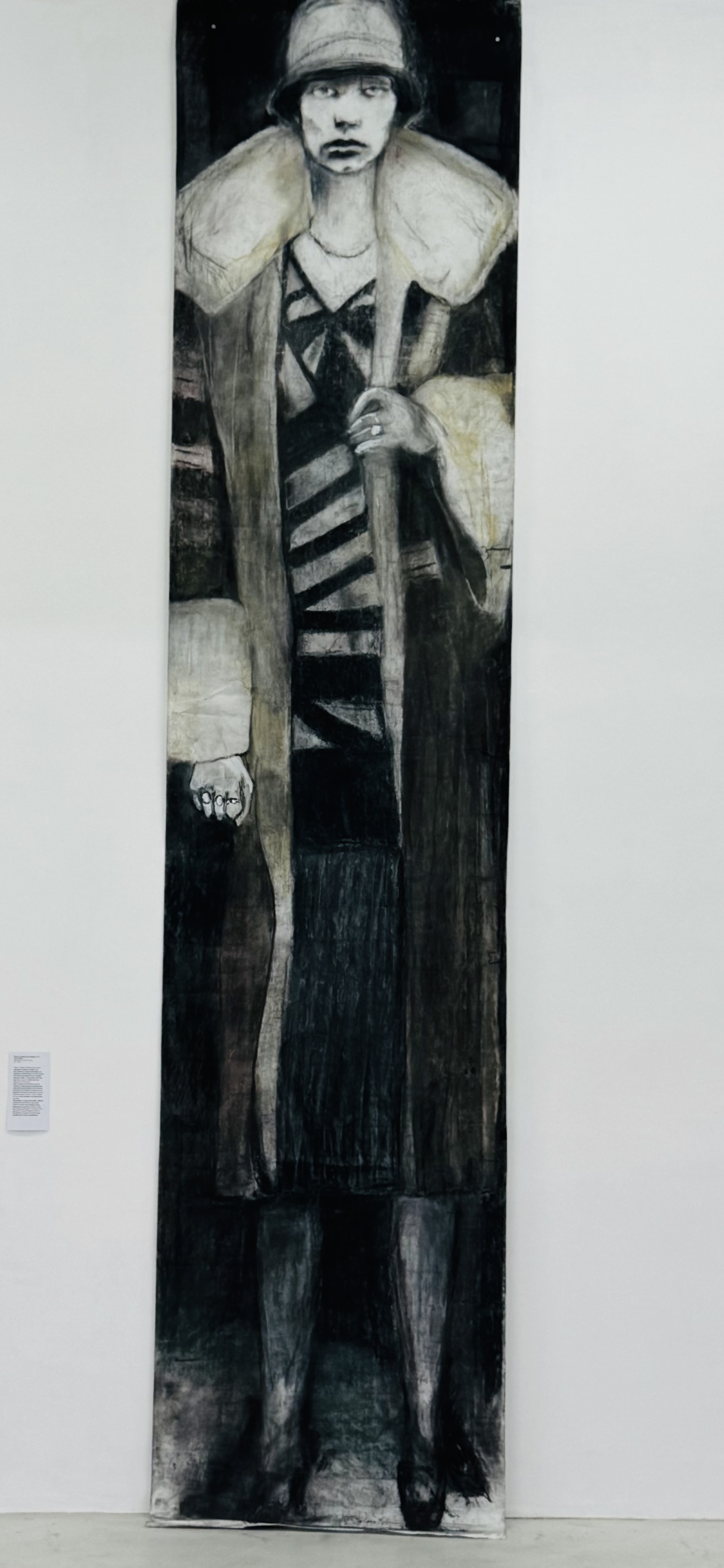
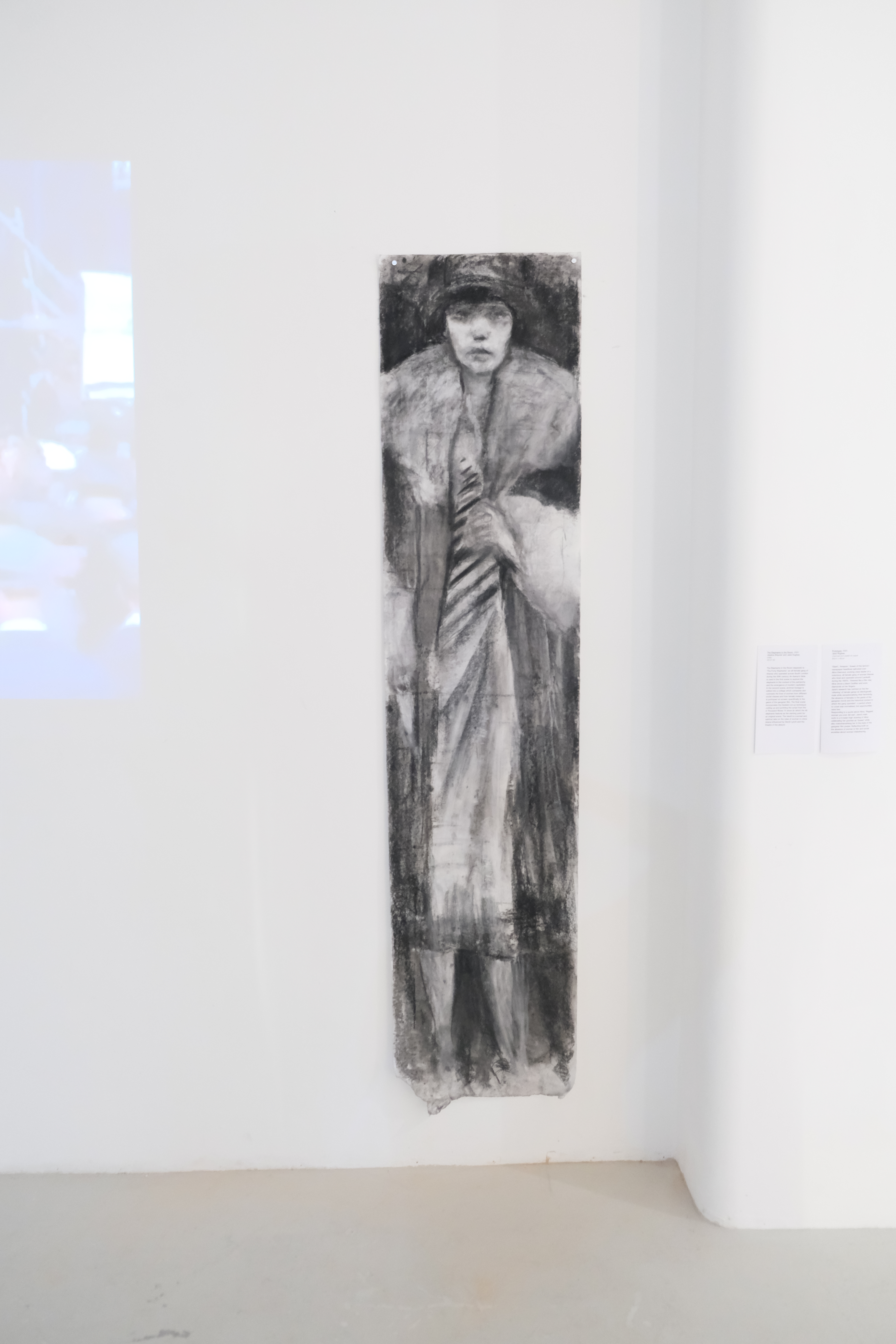

Birds of a feather flock together, 2025
charcoal and pastel on paper, 4m x 94cm
Prototype, 2025
charcoal and pastel on paper, 90cm x 45cm
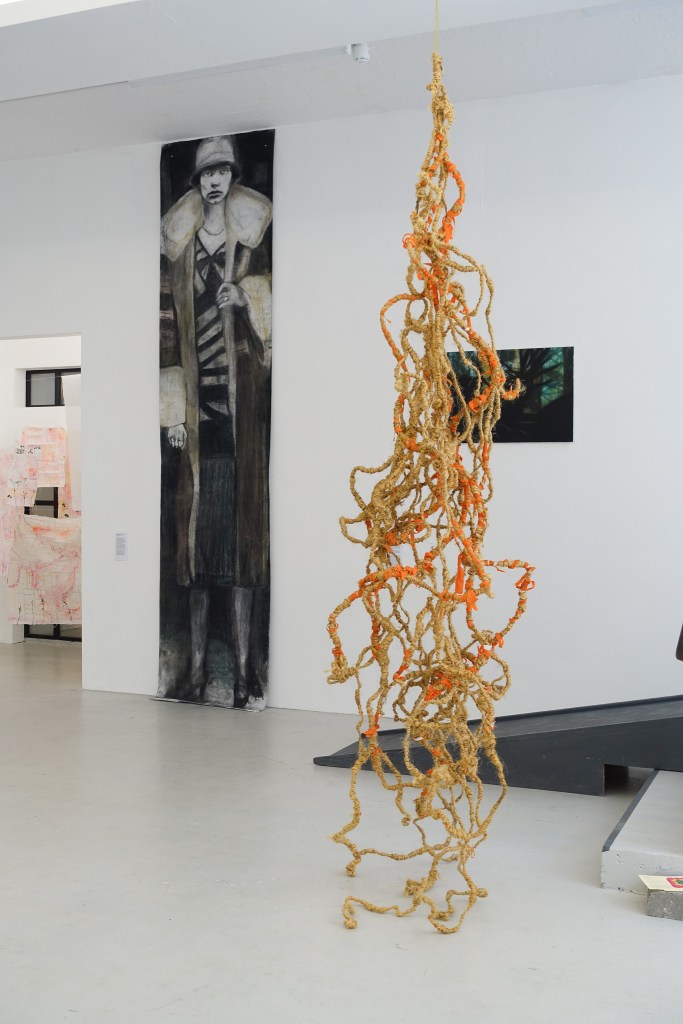
‘Giant’, ‘Amazon,’ Queen of the terrors’: newspaper headlines salivated over Alice Diamond, working class leader of a notorious, all female gang of women thieves who lived and operated around Lambeth during the 1920’s. Dressed like a film star, Alice drove a black Cadillac and wore diamonds on her fingers. Jane’s research has centred on the ‘othering’ of female gangs as ideologically male while sensationalising their femininity, the absence of females in the genre of the gangster movie and the historical context in which the gang operated – a period where to covet was normalised, but opportunities were few. Responding to a quote about Alice, ‘Biggest woman you ever did see’, Jane’s main work is a 4-meter-high drawing of Alice celebrating her gravitas as ‘Queen’ while also melodramatising her in the style of the gangster film poster. Reflecting both on the absence of women in film and social anxieties about women misbehaving.
www.janehughesart.com @hughes.jane60
Jessica Brauner and Jane Hughes
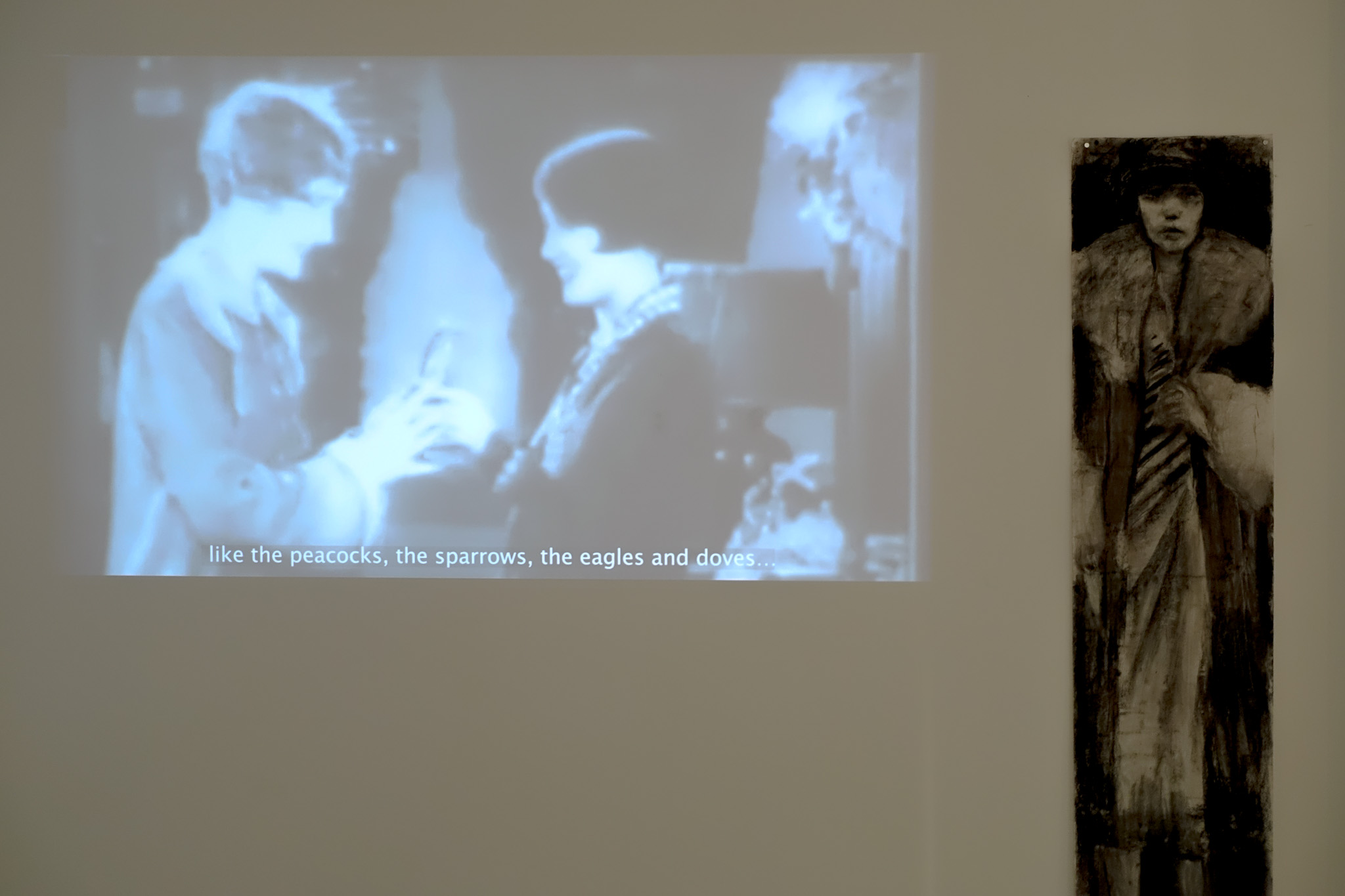
The Elephants in the Room, 2025
video, 00:07:30
The Elephants in the Room responds to ‘The Forty Elephants’: an all-female gang of thieves who operated across South London during the 20th century. An Aesop’s fable is used in the first scene to explore the elephants in the context of the patriarchy and the emergence of modern capitalism. In the second scene, archival footage is edited into a collage which compares and contrasts the lives of women from different social classes and how female violence is portrayed on-screen; specifically in the genre of the gangster film. The final scene incorporates the Dadaist cut-up technique: cutting up and jumbling the script from the A Thousand Blows TV show (in which the 40 elephants feature) as the starting point for an original scene. The result is a surreal and satirical take on the roles of women in crime drama influenced by David Lynch and the theatre of the absurd.
www.jessicabrauner.wordpress.com @jessicabraunerartist
www.janehughesart.com @hughes.jane60
Jolene Liam
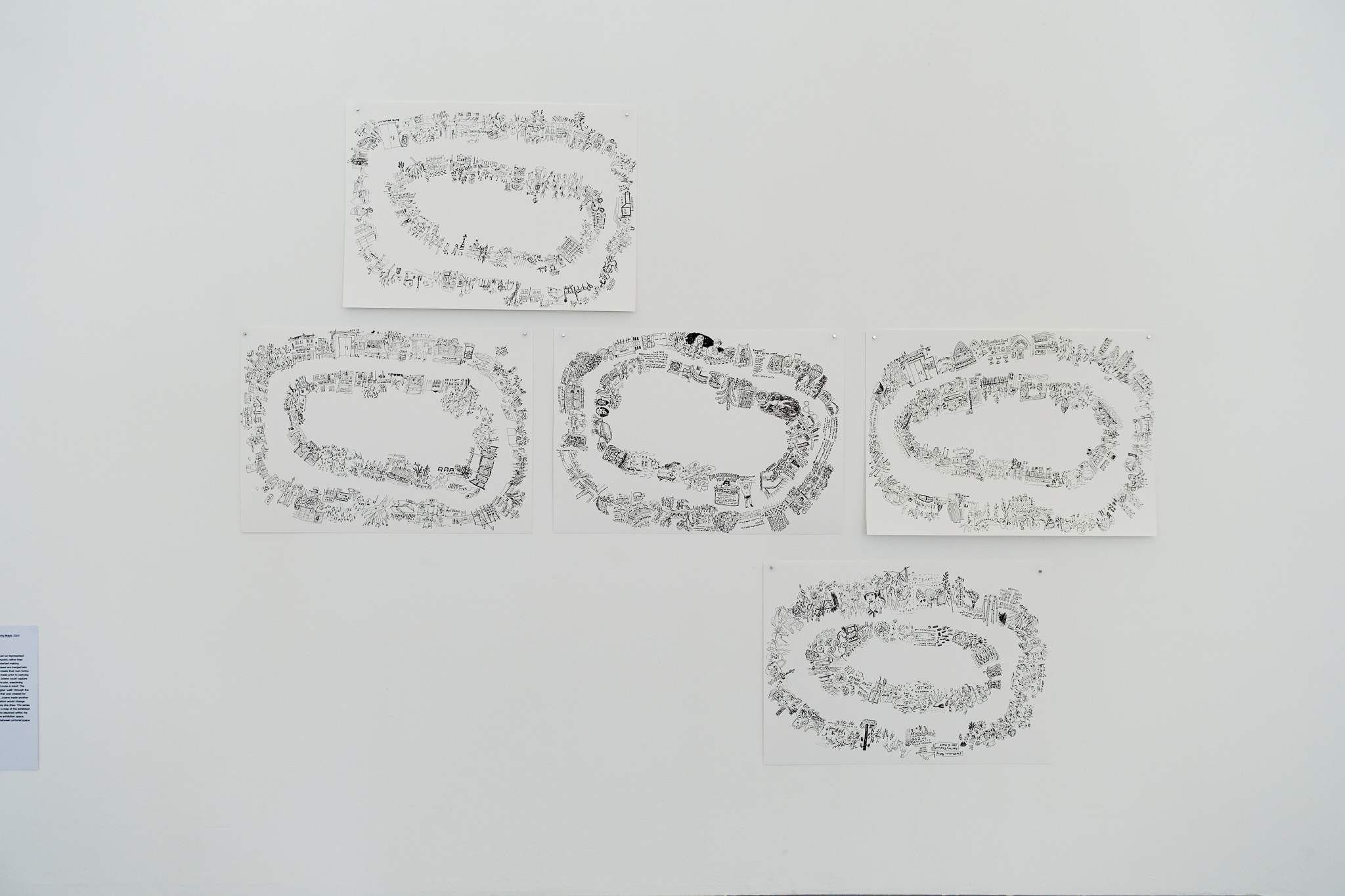
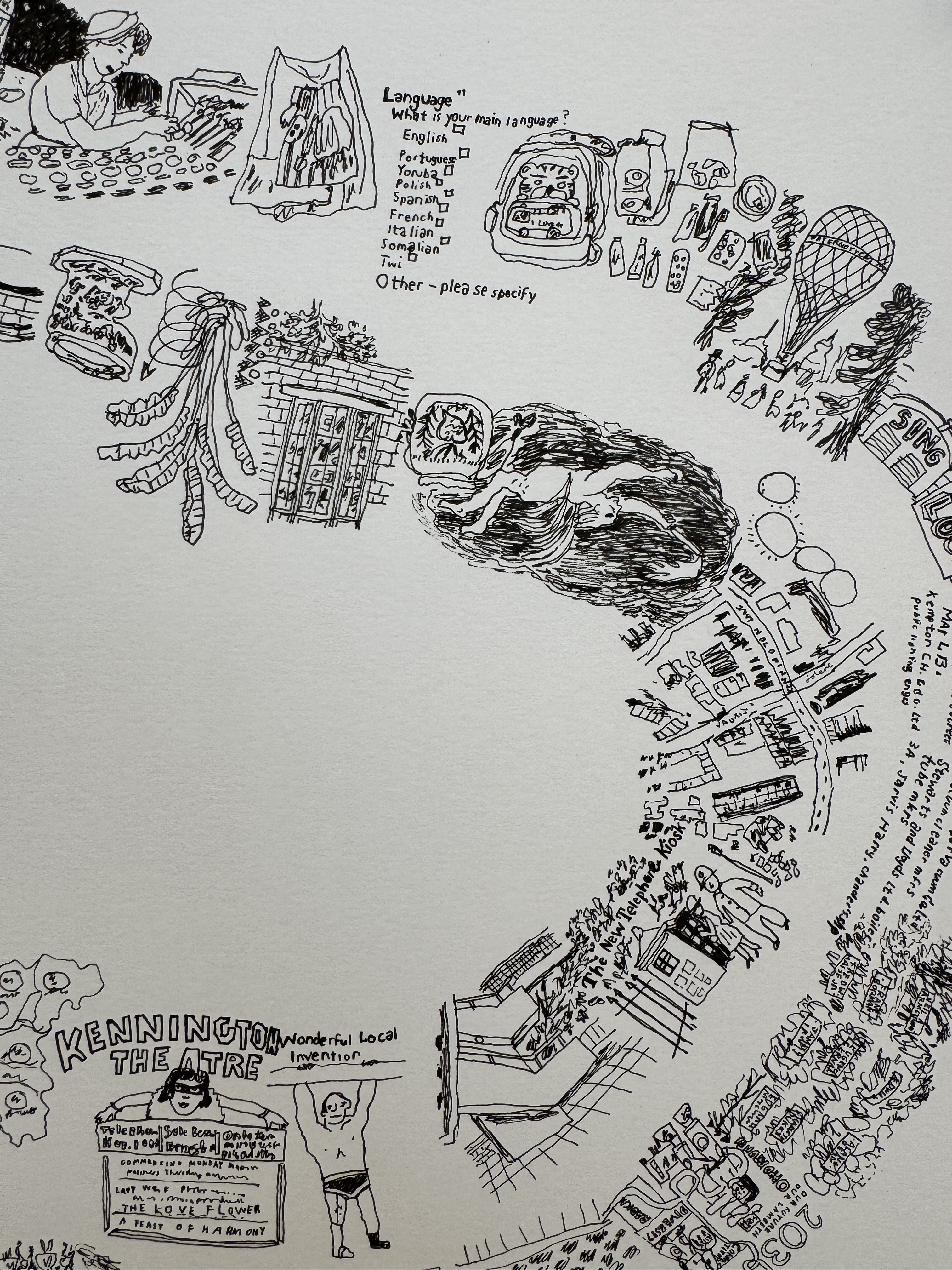
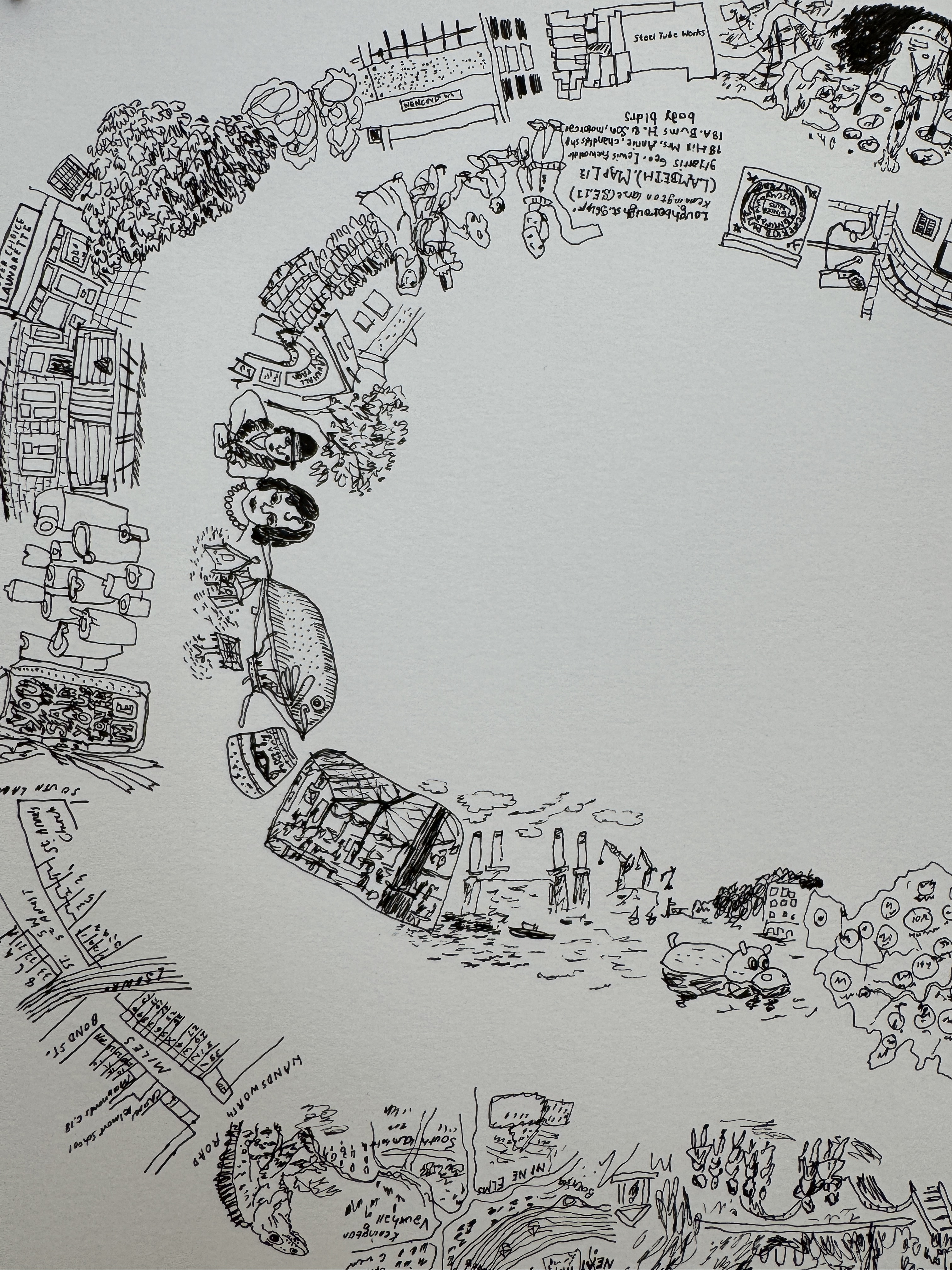
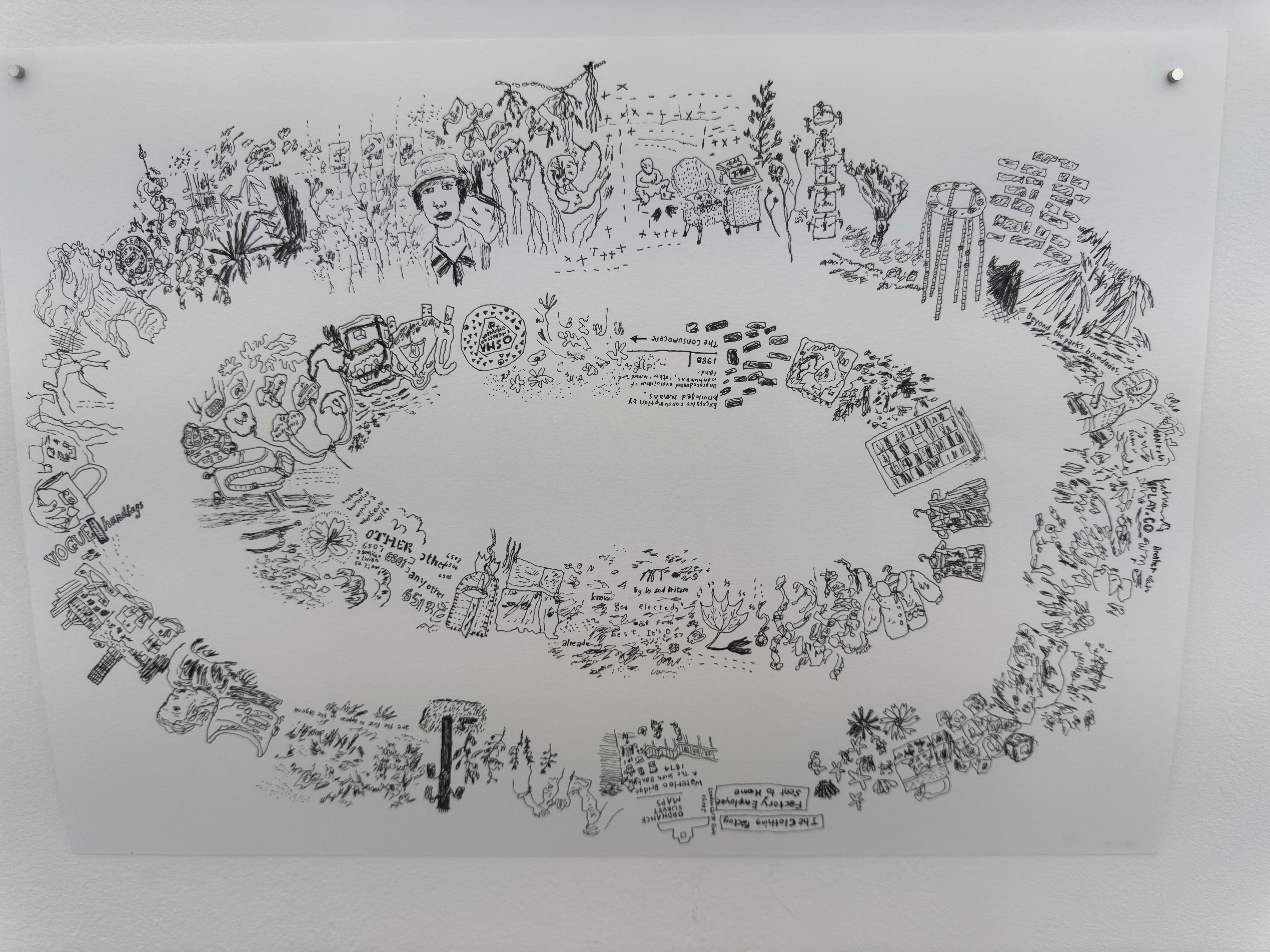
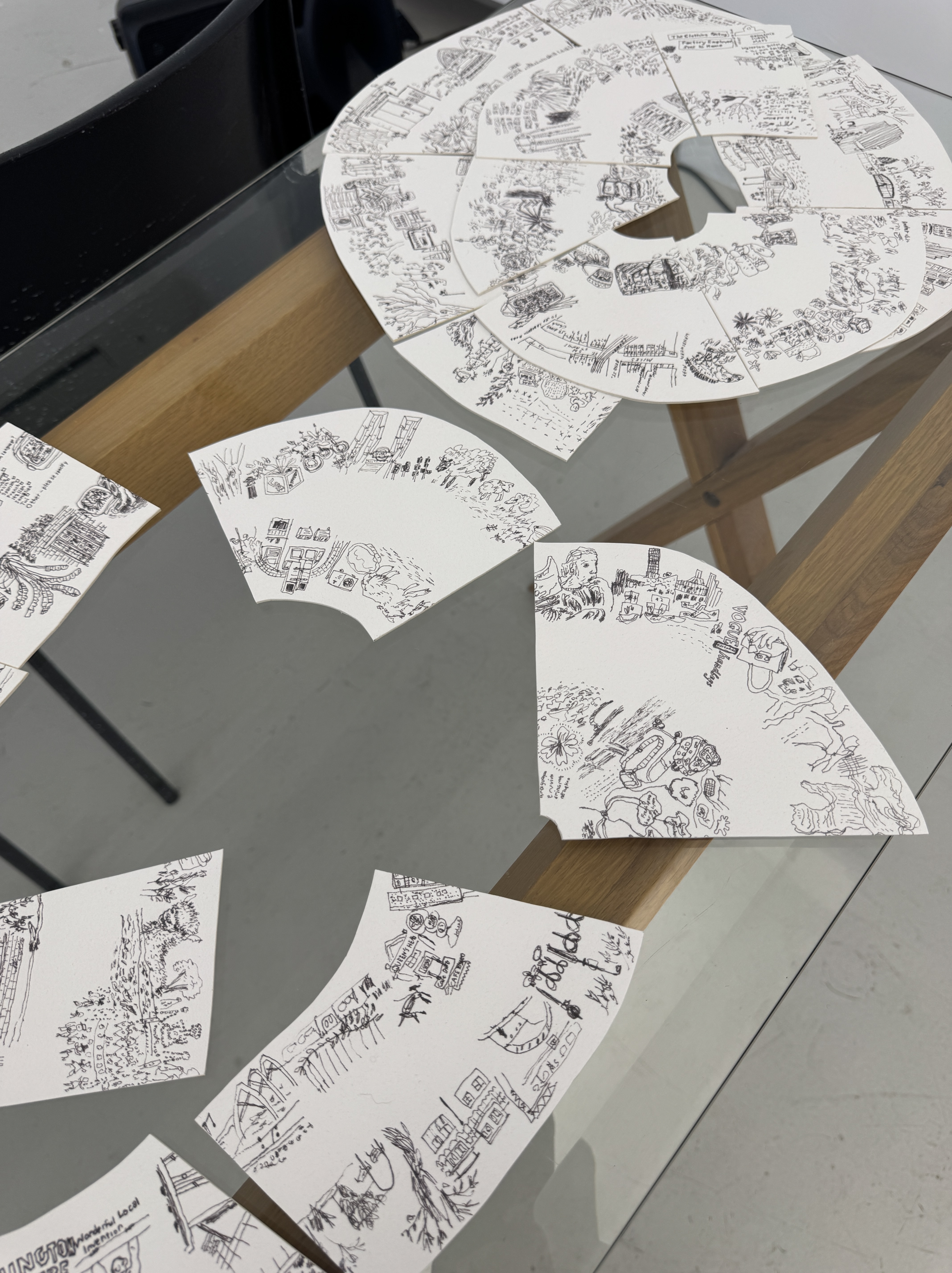
Handbag Factory Walking Maps, 2025
ink on paper, 30 x 42 cm each
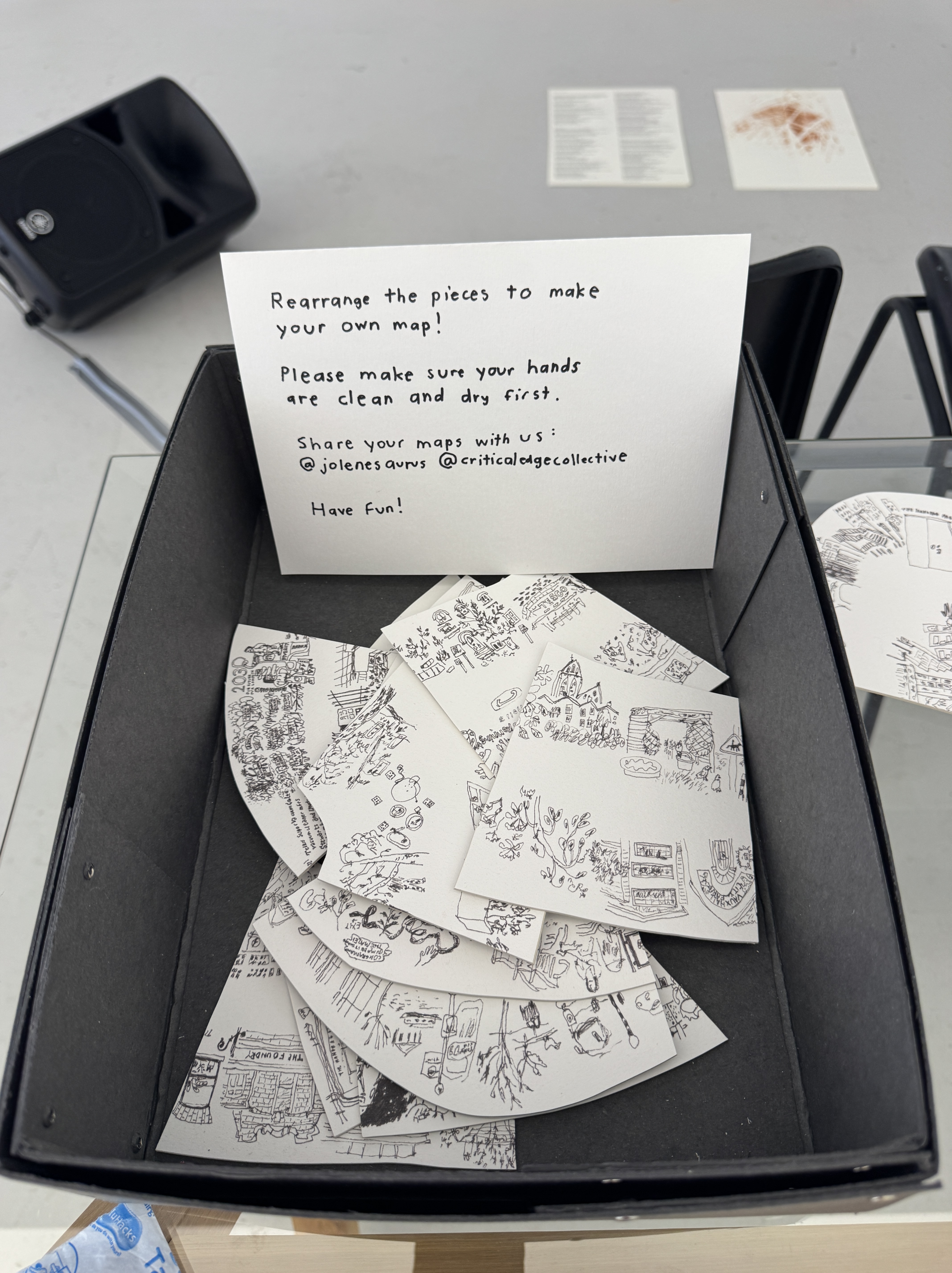
Walking Maps Rearranged, 2025
digital print on cardboard
To explore how spaces can be represented from an experiential viewpoint, rather than singular images, Jolene started making walking maps. Multiple views are merged into continuous loops which create their own forms. The first two maps were made prior to carrying out any research so that Jolene could capture her initial responses to the site, wandering intuitively without a fixed route in mind. The third map describes a digital ‘walk’ through the shared research archive that was created for this exhibition. After this, Jolene made another map to see if this information would change where she went or the way she drew. The series concludes (for now) with a map of the exhibition itself, combining elements depicted within the artworks and views of the exhibition space, blurring the boundaries between pictorial space and physical space.
An interactive work that invites visitors – no longer just viewers but co-creators – to rearrange these map fragments and make their own imagined journeys. The original drawings are walking maps of the area around The Handbag Factory that Jolene made in the last few months, including one of the exhibition itself. The repeated process of rearrangement mirrors the ever-changing nature of places and spaces around us, and how the way we perceive or remember them also shifts over time. This is also an opportunity to reinterpret the exhibition in a new way, thinking about how it has been curated and taking ownership of what is presented to us, illustrating how the same objects and spaces can be seen from many different points of view.
www.joleneliam.com @jolenesaurus
Joy Stokes
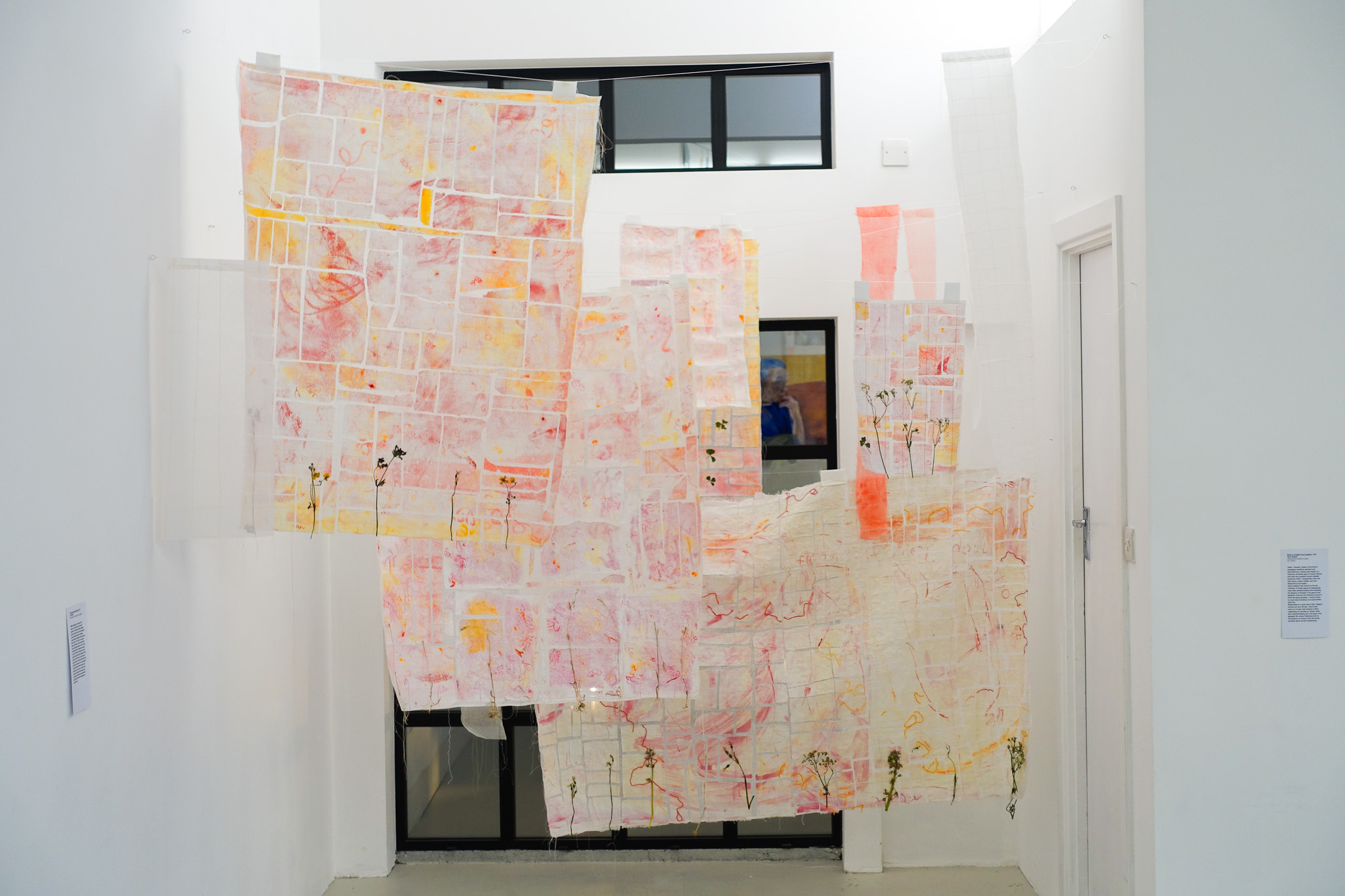
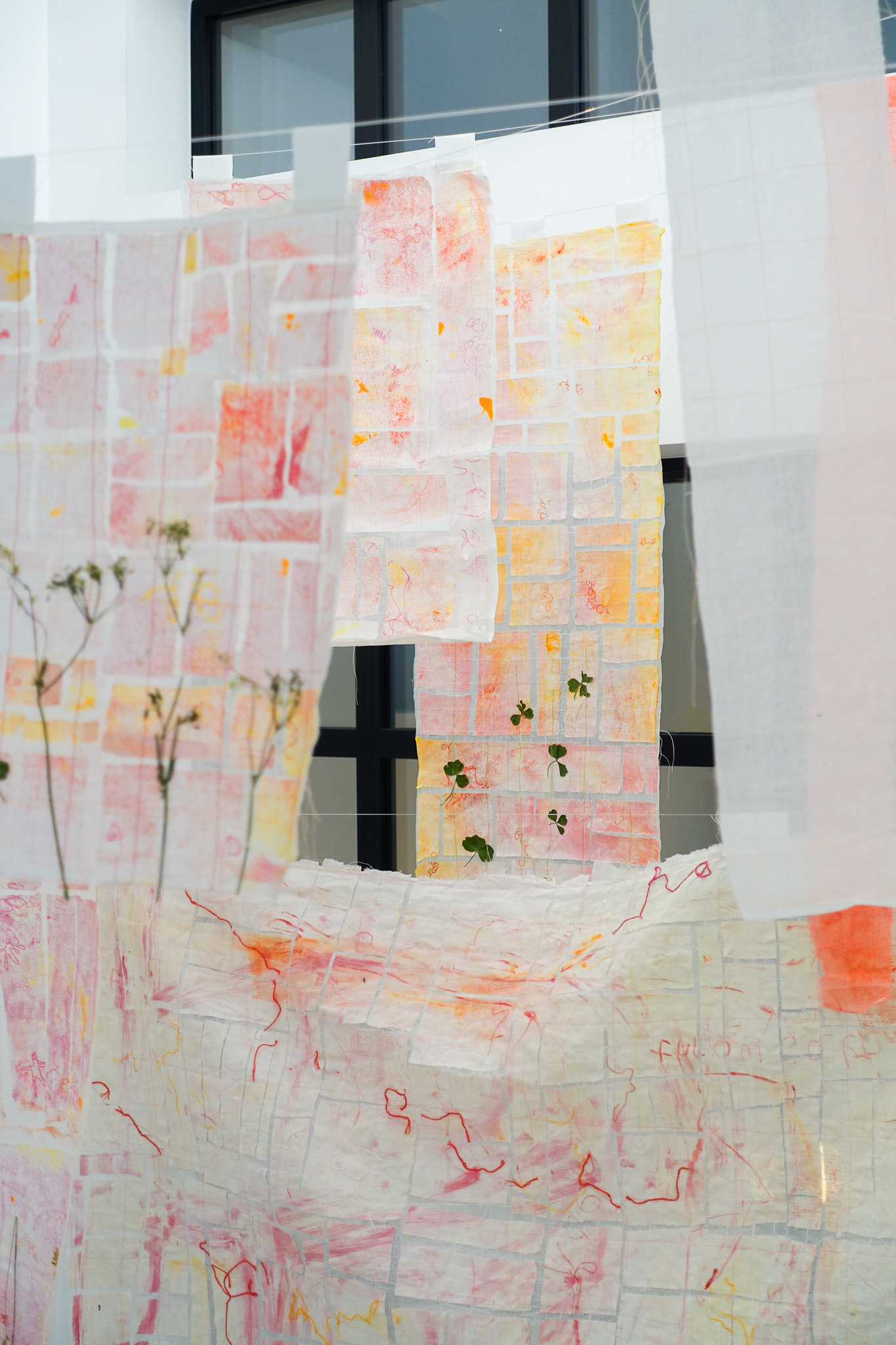
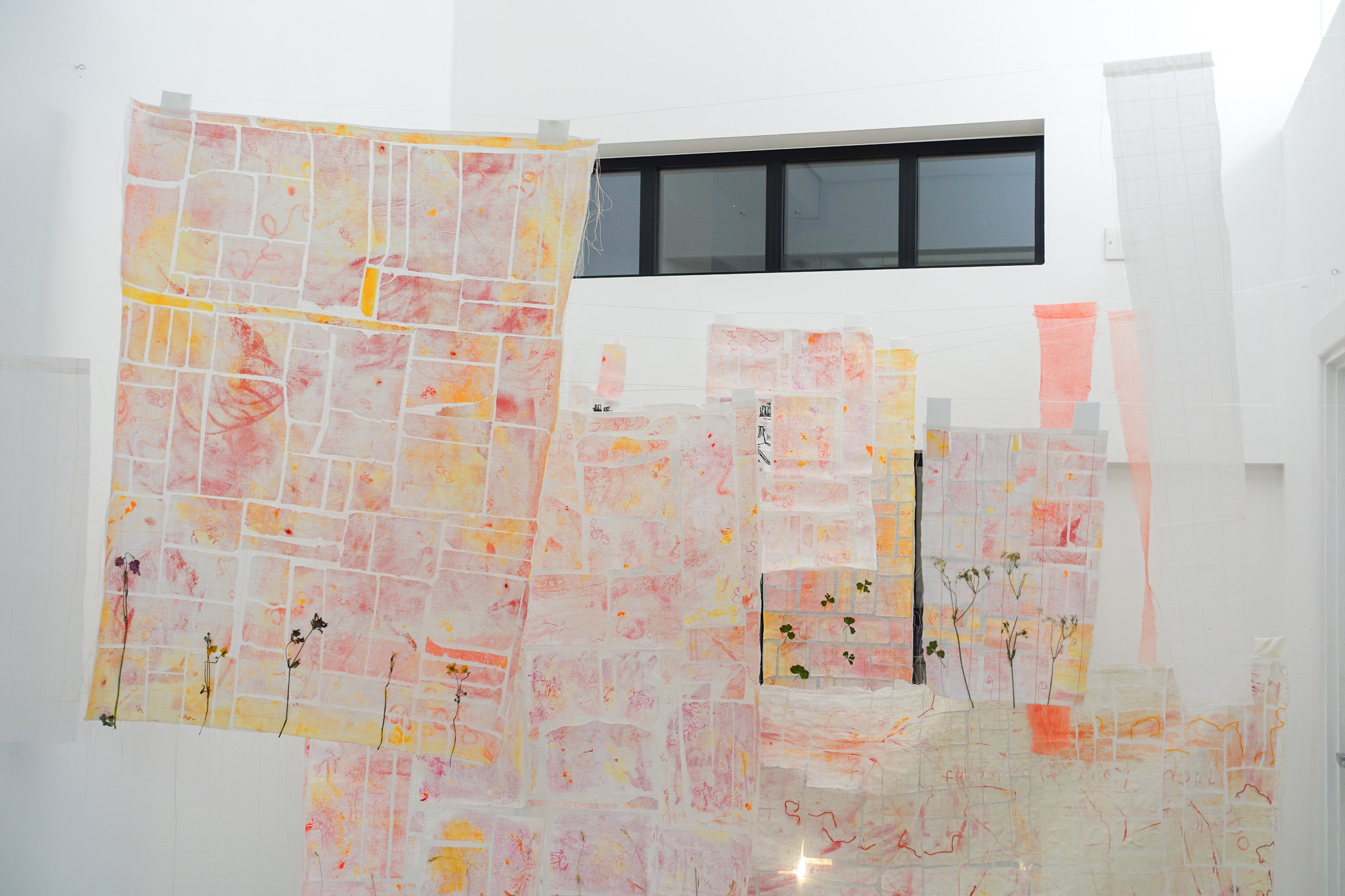
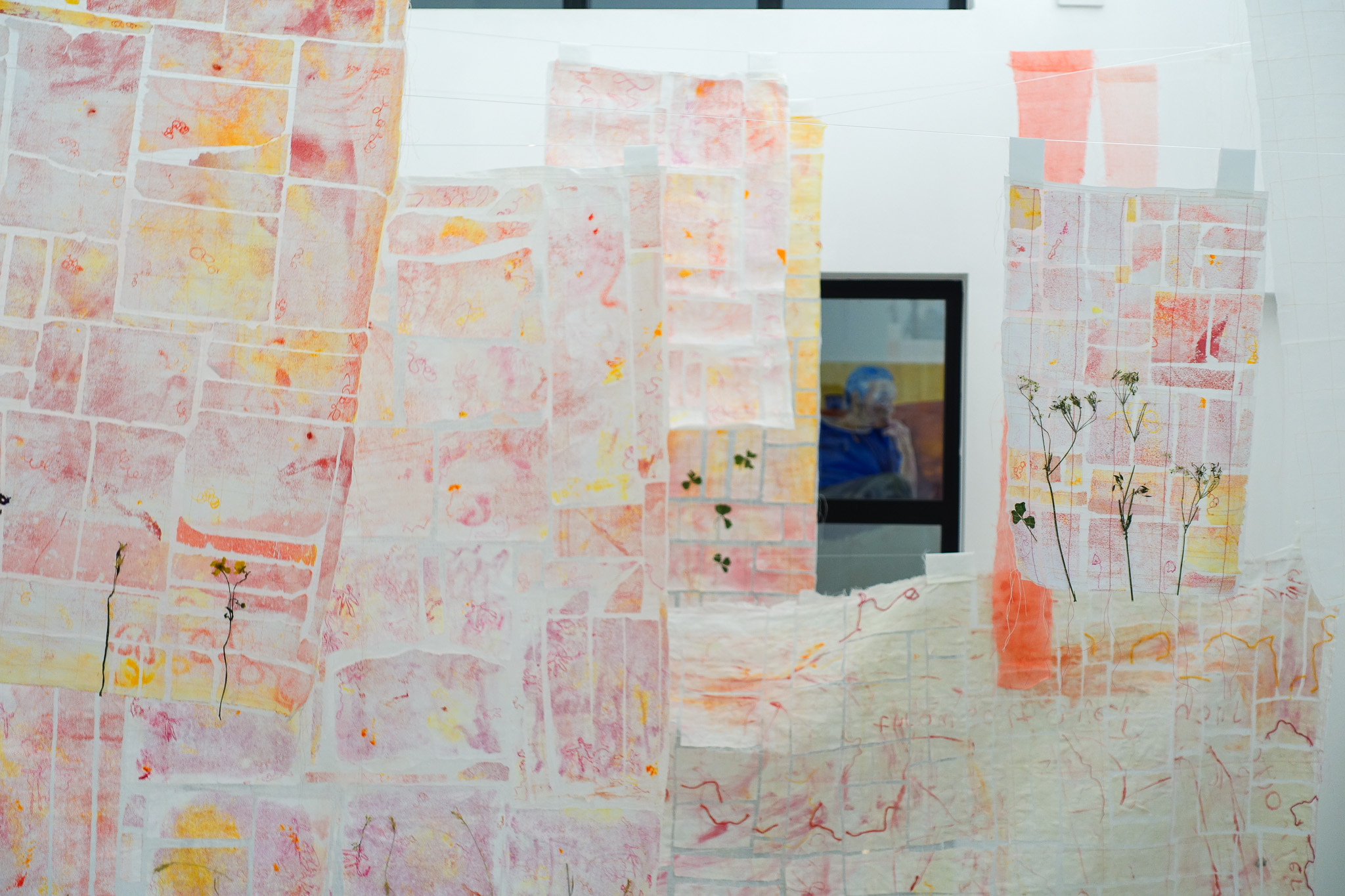
Over the ground that held us, 2025
hosho paper, ink, thread, cotton organdie, dried flowers
Initially responding to the notion of the factory and its connection to the mass-production of textiles and climate change, Over the ground that held us has developed to also encompass fixing and mending, putting things back together when they have been torn apart. The ‘factory’ is a place of creation and making, which can have both positive and negative impacts on our world. This juxtaposition felt connected to events in Joy’s life at the time of making this work and why putting pieces back together felt so important. Joy has found solace and ritual in the ground that has held her, whether in garden, park or countryside. The pressed flowers which are placed as if growing from the ground, are relics and mementos of the plants that have grown from the ground which has supported her and the walks which have sustained her during this time.
Kate Kelly
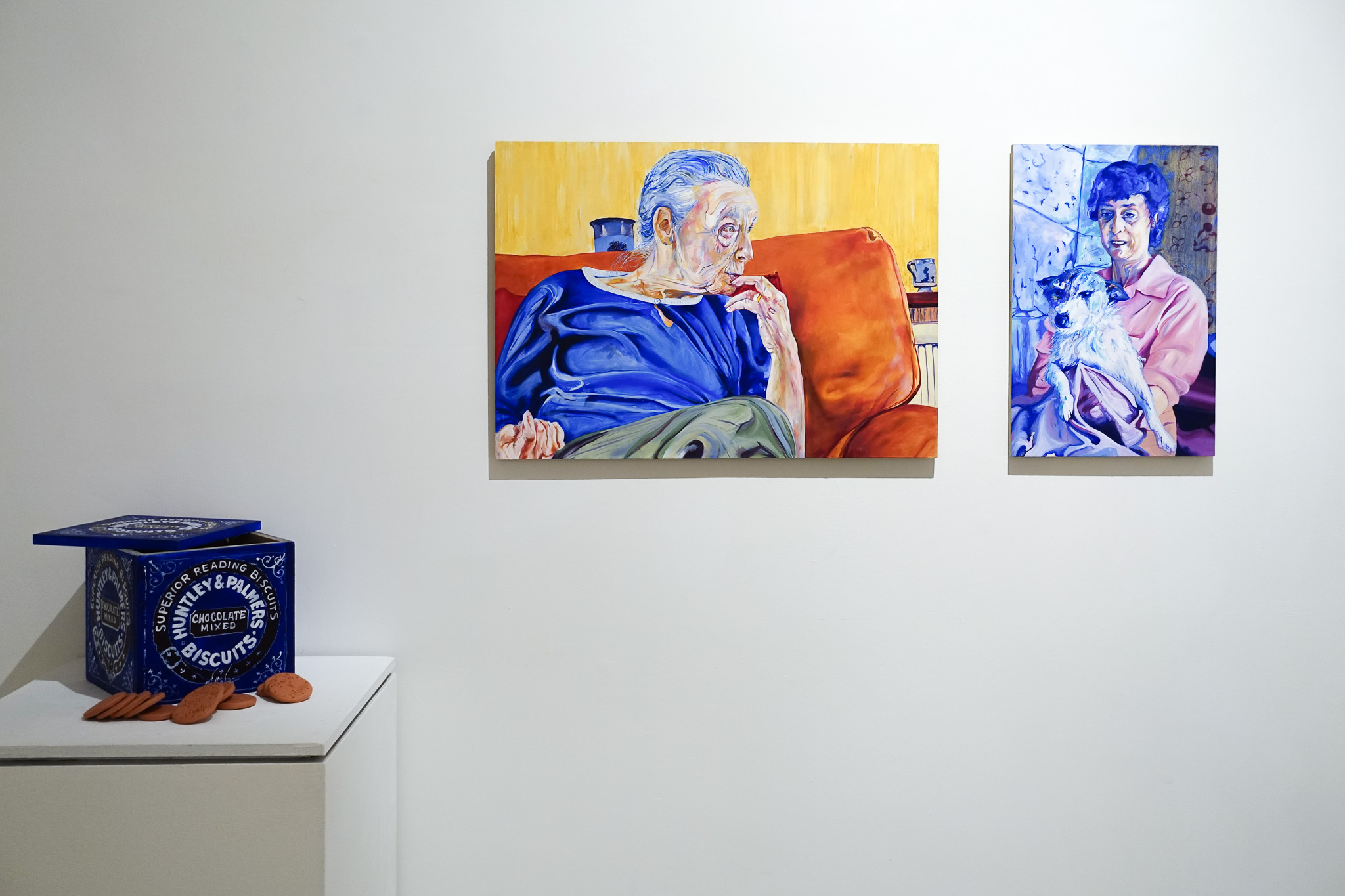
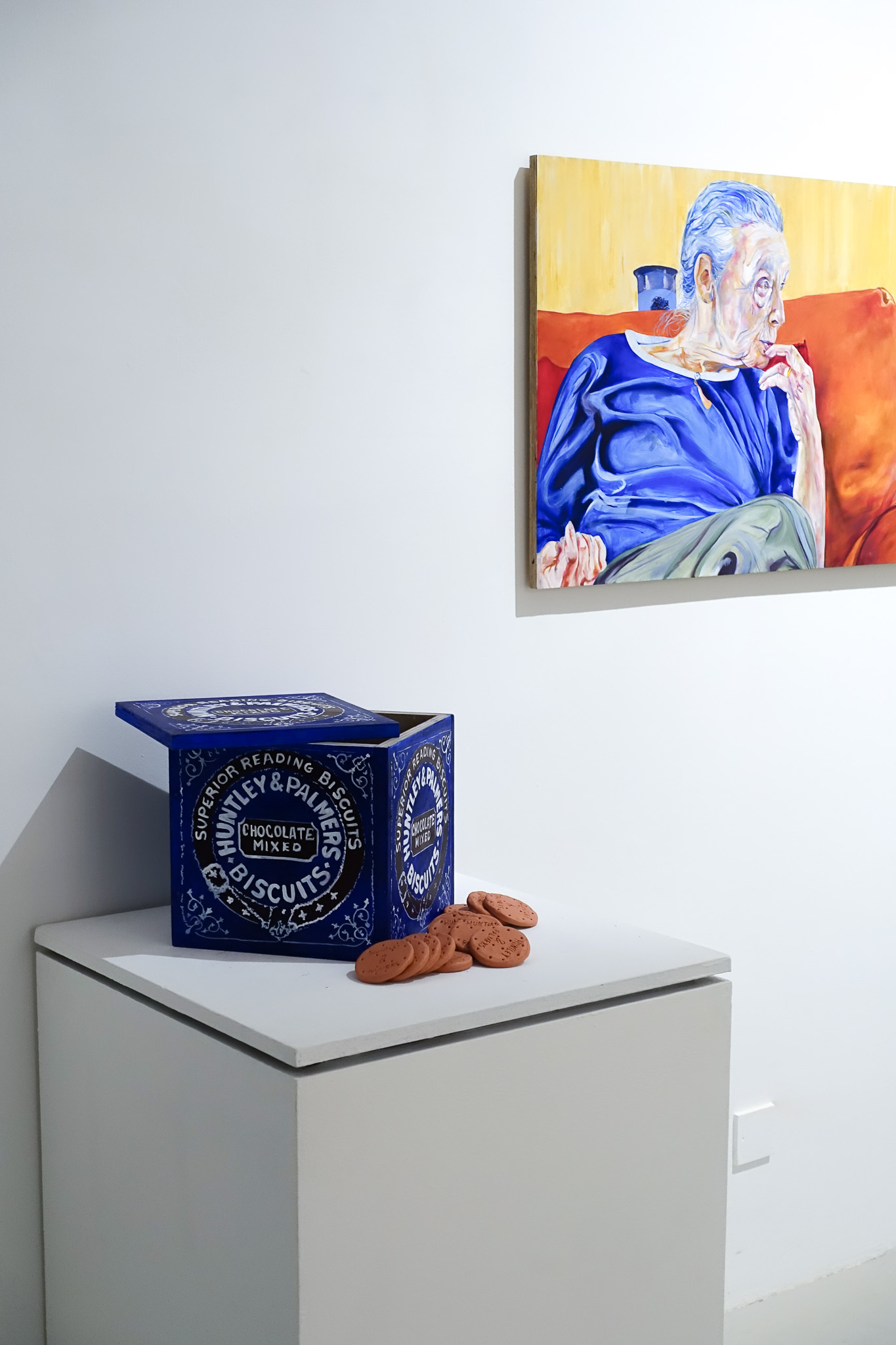
Biscuit Tin, 2025
oil and wood with screws, 27 x 27 x 27cm
Computer Operator, 2025
oil on board, 60 x 85cm
6-10pm, 2025
oil on board, 40 x 60cm
Kate has been exploring personal family archives alongside those of the Huntley & Palmers biscuit factory in Huyton, Liverpool. Her focus is on Ann Hennigan – Kate’s ‘Nanna Ann’ – who worked on the conveyor belt at the factory during the 1960s and 70s and joked that she was a “Computer Operator.” She worked the evening shift, 6–10pm, a pattern common among women at the time. Huntley & Palmers offered flexible shifts that allowed workers, especially women, to balance employment with school and family responsibilities. The company often favoured married couples and families, which provided women with a sense of independence, while also making it harder for entire families to take strike action. Kate’s research offers insight into women’s experiences of labour and uncovers both personal and collective narratives of work, resilience, and identity. Through this, she aims to honour overlooked herstories and reimagine personal and industrial memory.
www.katekellyart.co.uk/ @katekelly5015
Laurelle Blake
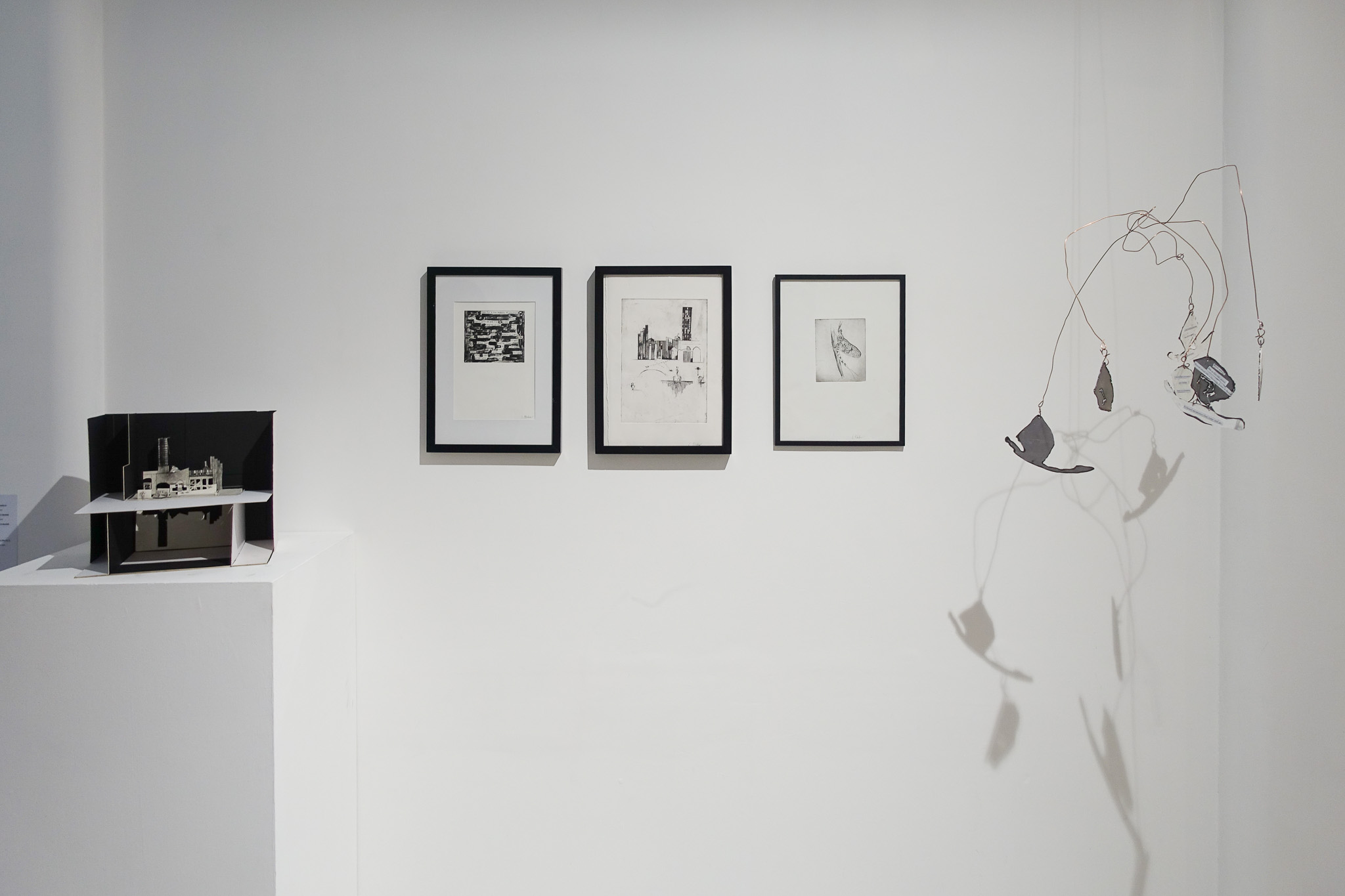
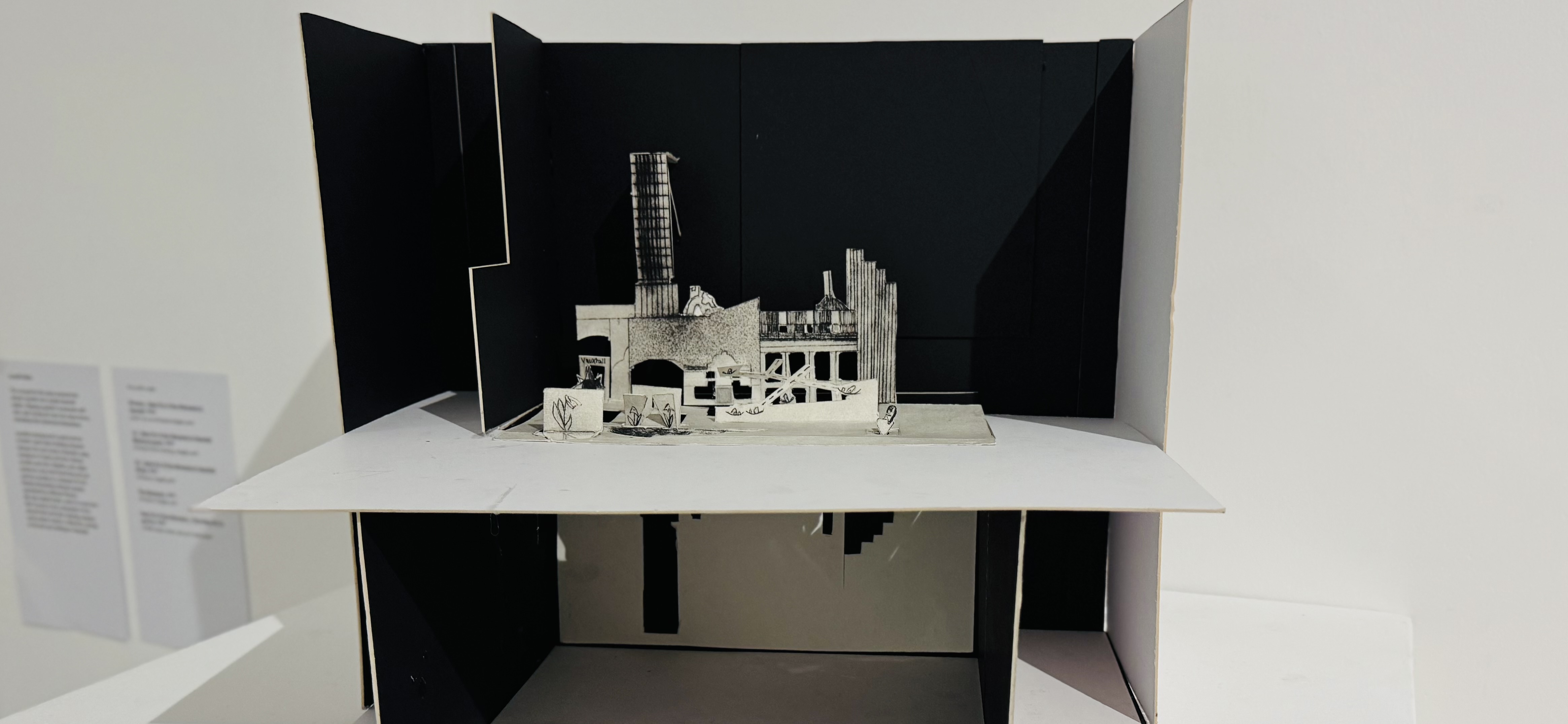
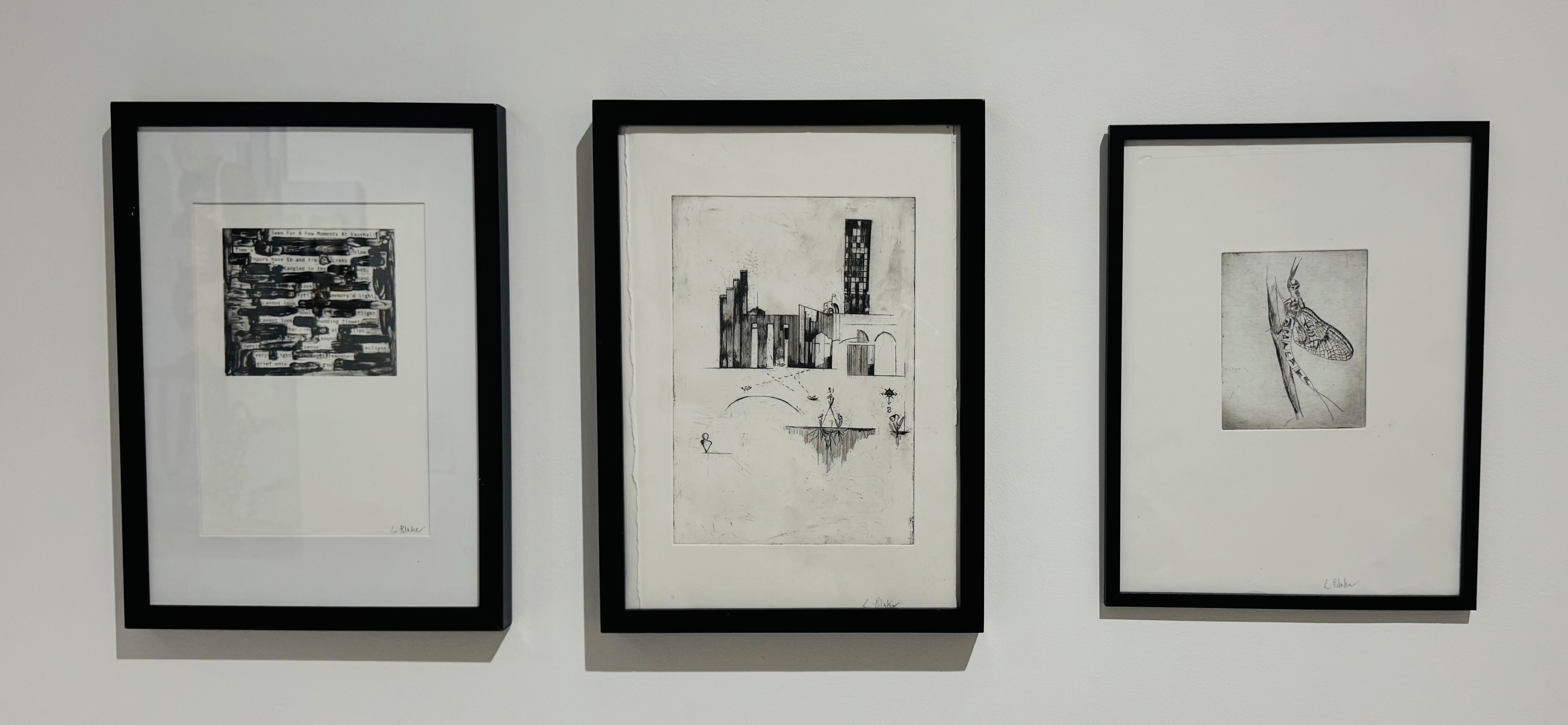
Diorama – Seen For A Few Moments In Vauxhall
paper cut out oil based intaglio print
1.0 – Seen For A few Moments In Vauxhall (Blackout poem)
oil based photo etching, intaglio print
2.0 – Seen For A Few Moments In Vauxhall (Print)
oil based, intaglio print
The Ephemera
oil based, intaglio print
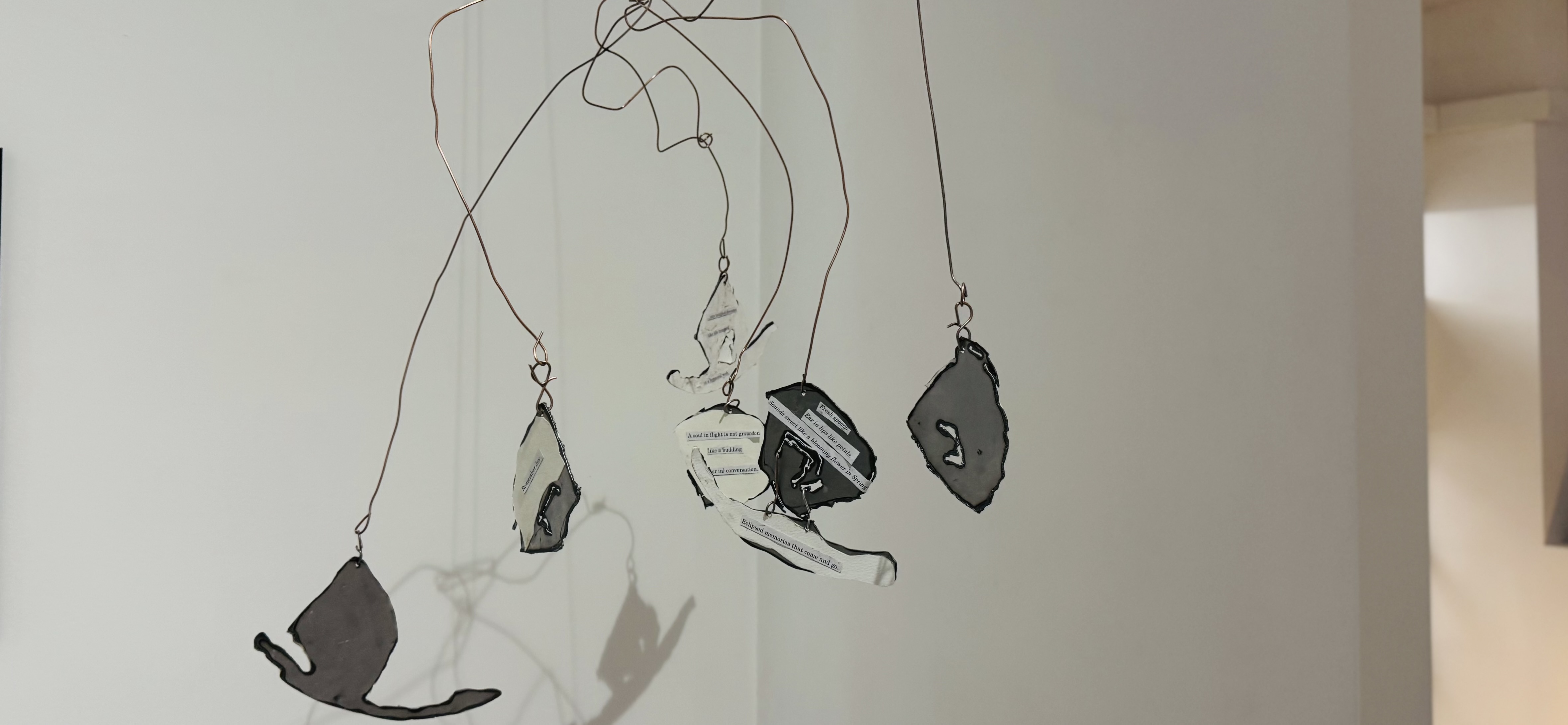
Seen For A Few Moments – Time May Fly To and Fro,
mobile-sheet metal, wire and metal paint
The concept for this piece evolved from photos Laurelle took outside Vauxhall station, mapping people’s movements with dots, later turning the dots into nature forms, translating their ephemeral interactions. Her background in poetry led Laurelle to Keats’ poem about fleeting moments between him and a lady in Vauxhall using metaphors of nature and time, themes she uses here. Mayflies, also called ephemera, have short-lived lives and are used by Laurelle as a metaphor for the fleeting interactions between people, represented by different flowers. She also adapts Keats’ poem to a new form that focuses on the composition of the natural forms and their meaning, keeping some archaic words to reflect the contrast of old and new buildings in Vauxhall.
@laurelle_artist_
Matty Emery
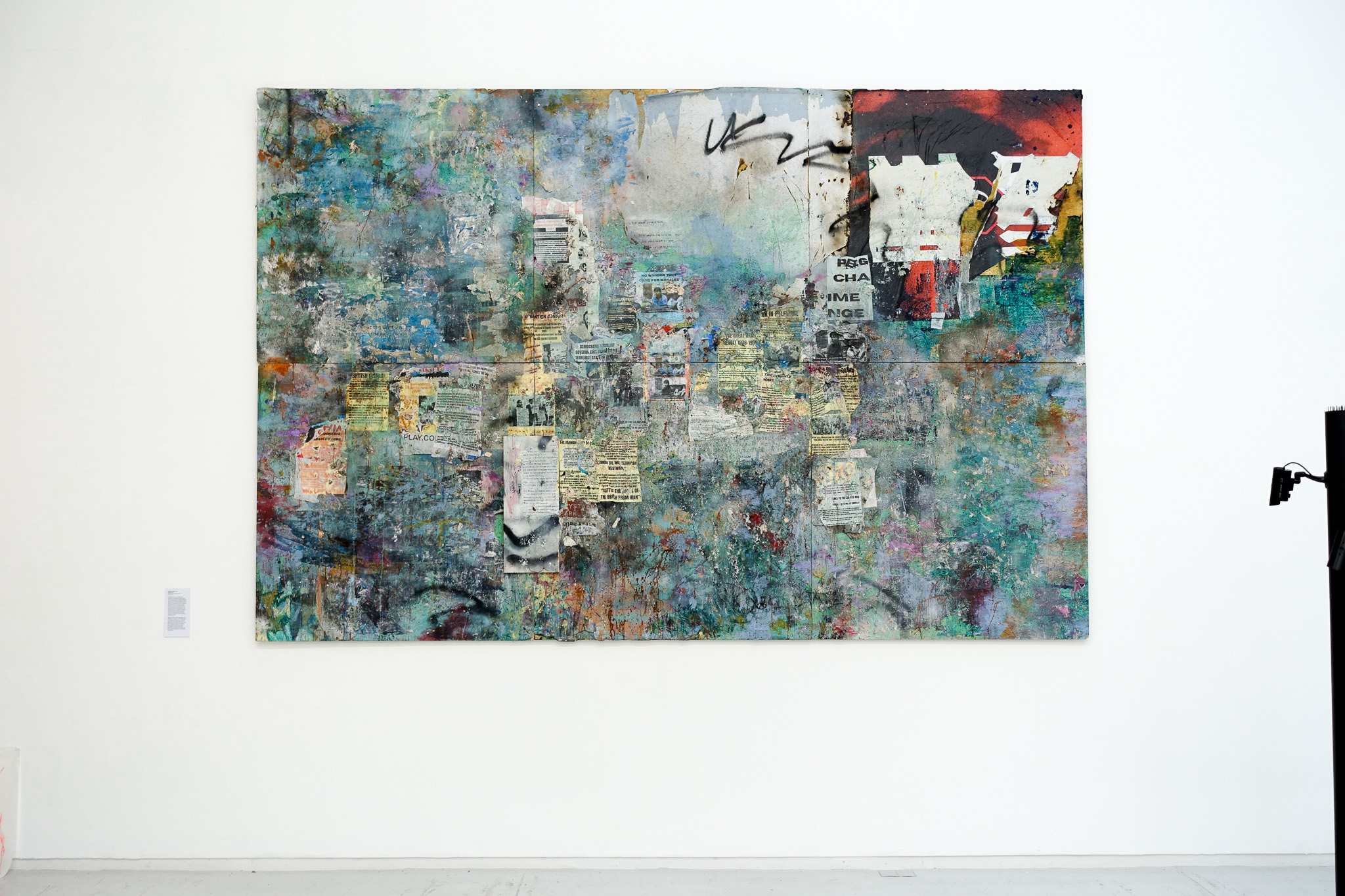
Regime Change 2025
Mixed Media on wooden panel, 360 x 240cm
Vauxhall is home to two institutions symbolic of transatlantic imperial power: Mi6, the home of British foreign intelligence; and the US Embassy, whose ability to fund lobby groups such as the British American Project may have allowed them to influence British democracy. The phrase ‘regime change’ is used to describe the removal of one government, often by force, to be replaced by another. Historically, the new governing body is cooperative of Western-capitalist values and often replaces left-leaning democratically elected leaders looking to redistribute wealth amongst the indigenous people. Regime Change appears as a kind of ‘anti-billboard’; a comment on the opaque nature of mainstream media and its cooperation with US and UK foreign policy. The work features text and archival information in the form of images, cables and declassified documents that ought to be common knowledge about western atrocities; instead, they erode and die back into the surface without holding the power-classes accountable.
Megan Segre
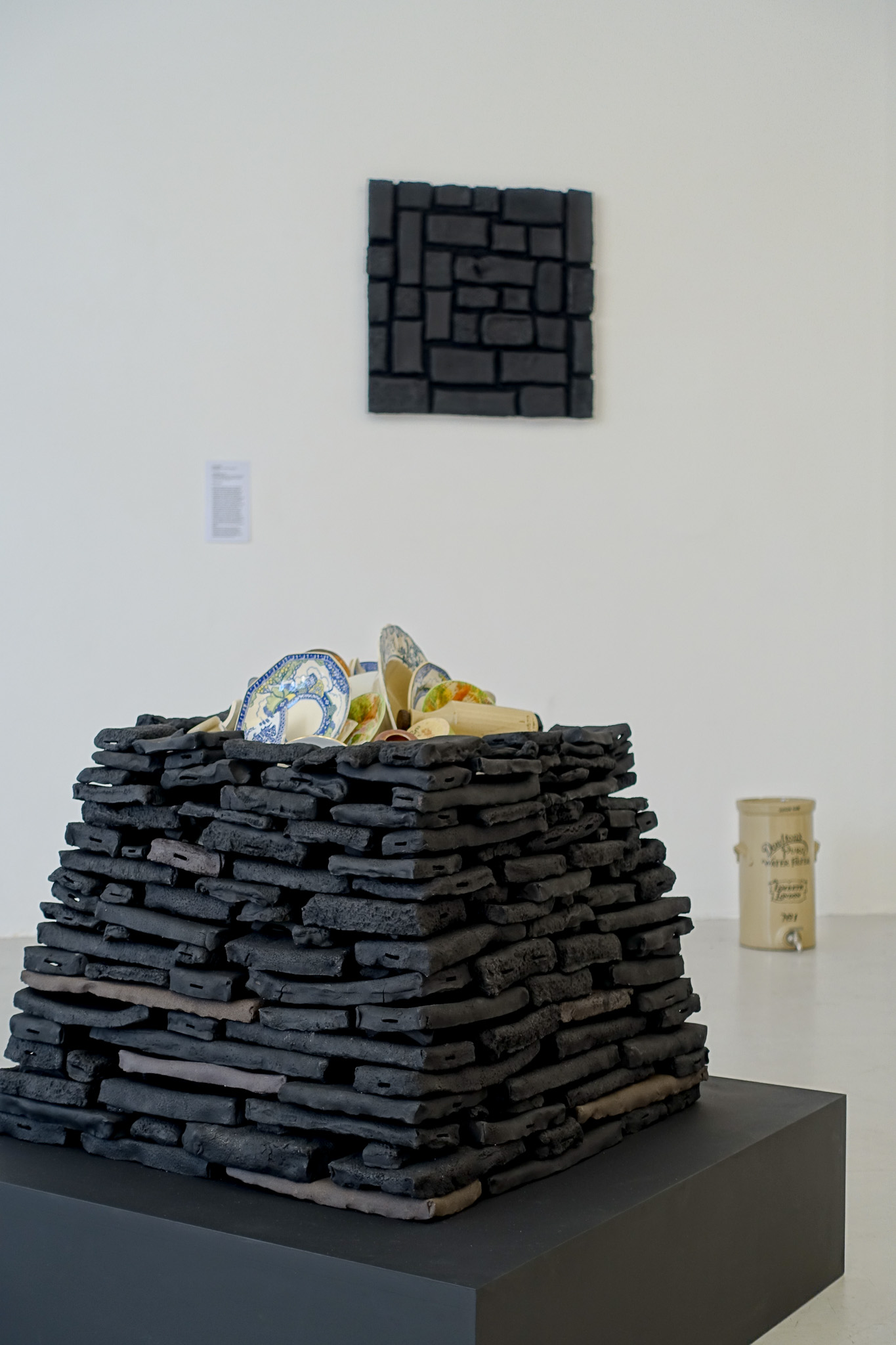
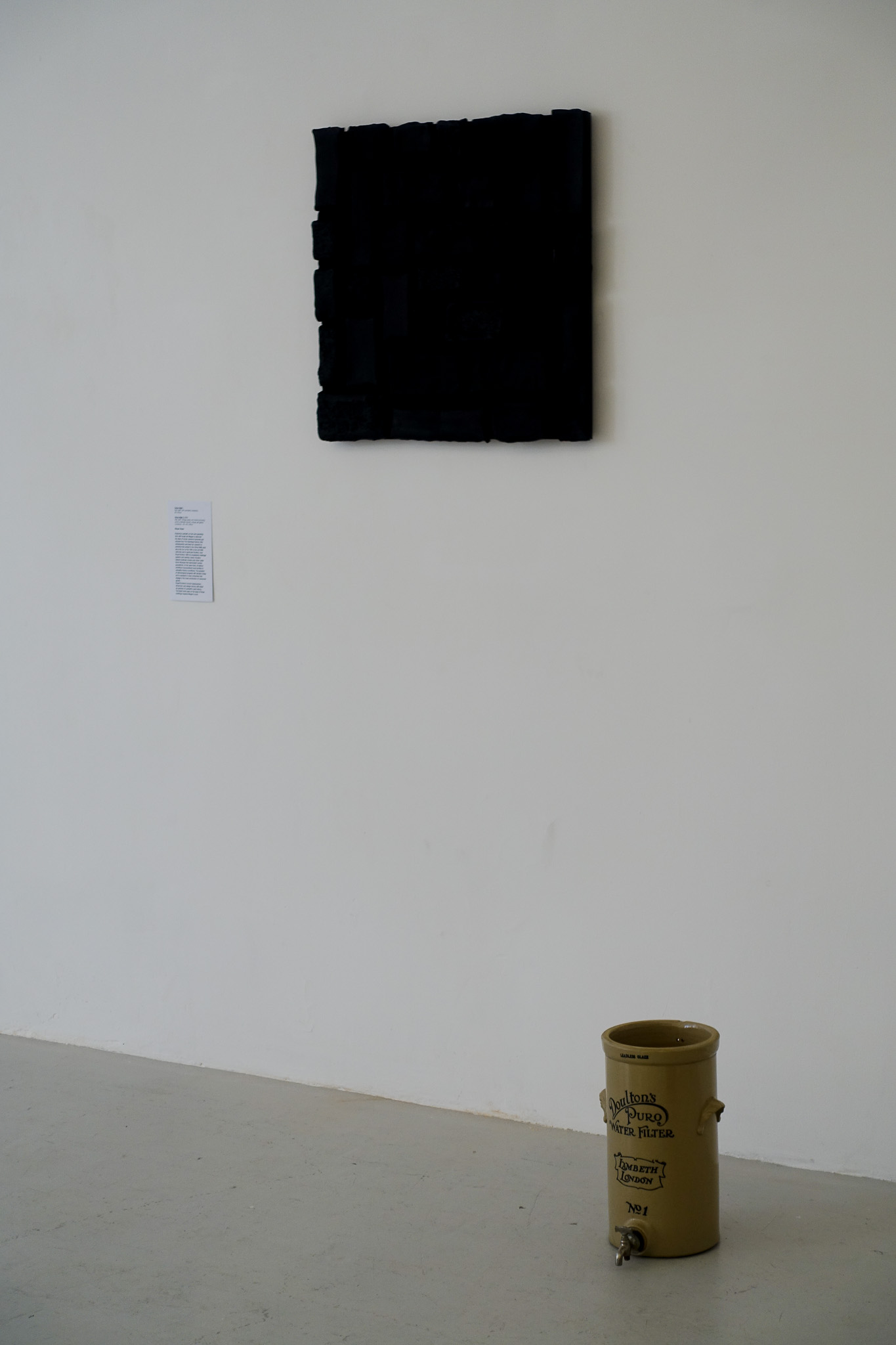

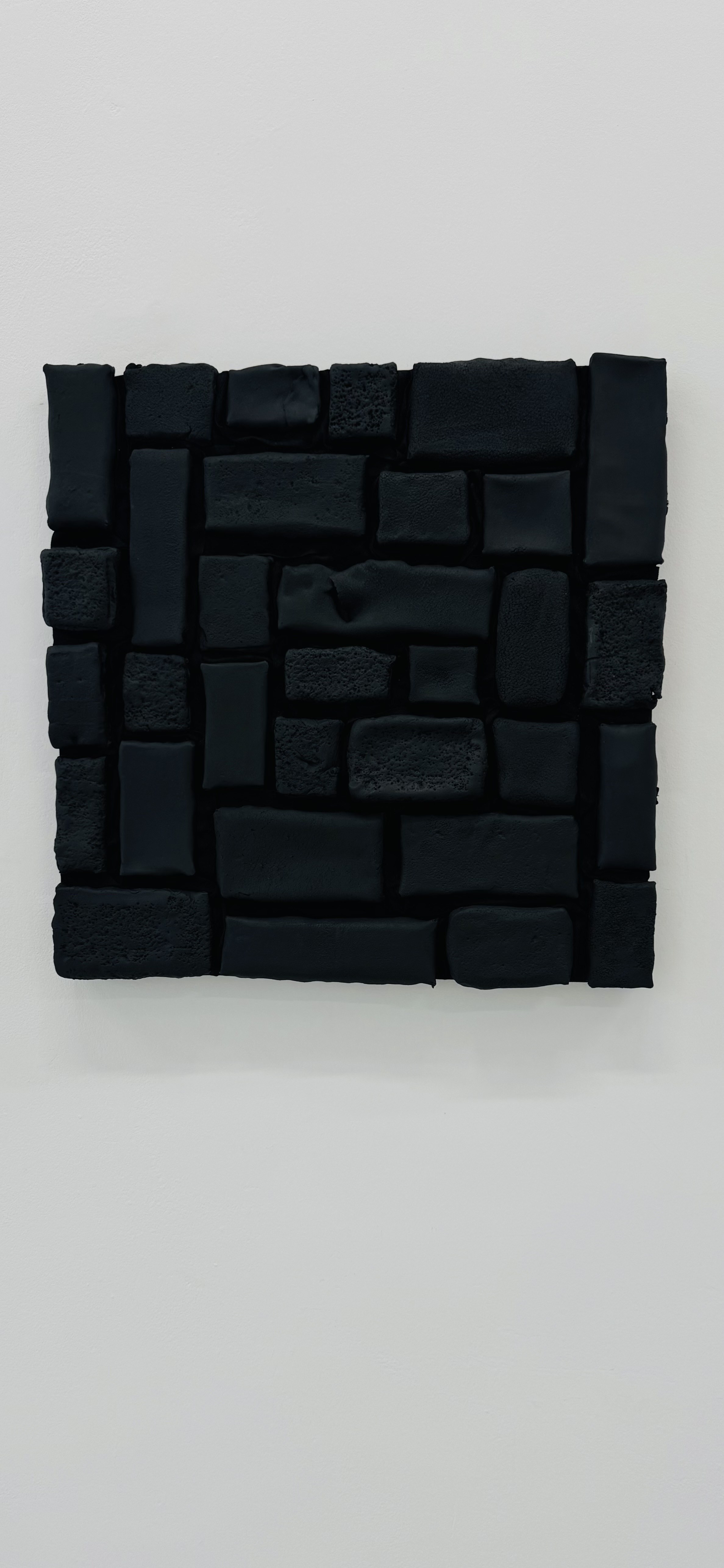
China Walk I
clay, paint, and upholstery strapping, 60 x 60cm (wall piece)
China Walk II
clay, paint, vintage plates and shards (including some mudlarked shards), vintage salt glazed containers, 60 x 60 x 80cm
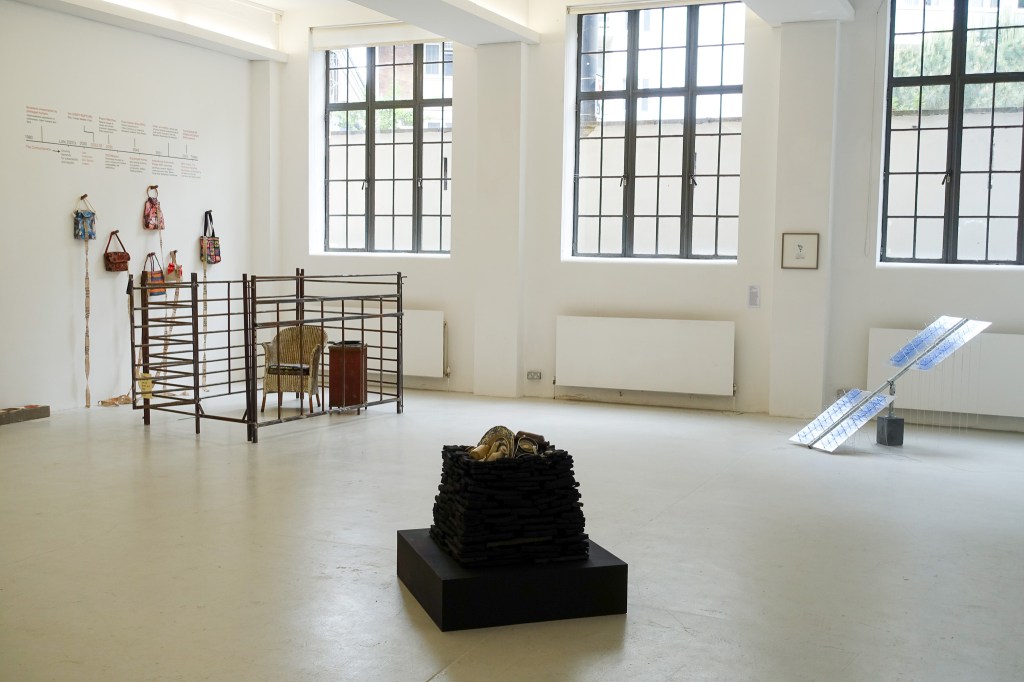
Exploring Lambeth on foot and spending time with locals led Megan to discover the sites of former ceramics factories just minutes from The Handbag Factory. She subsequently narrowed her research to potteries that existed in the China Walk area since the turn of the 19th to the mid 20th centuries and in particular Doulton, now Royal Doulton. With its progressive drainage systems and sanitary wares, Doulton helped eradicate cholera and other water borne illnesses that decimated London populations. At the same time, its labour conditions impoverished local families in unhealthy factory conditions. The paradox of technological progress still remains today and is repeated in many industries that engage in the mass production of consumer goods. Royal Doulton’s former headquarters, showroom and design factory still stand as symbols of Lambeth’s past history. The black brick seen on the base of these buildings inspired Megan’s work.
www.megansegre.com @megansegre
Natsuki (Summer-Moon)
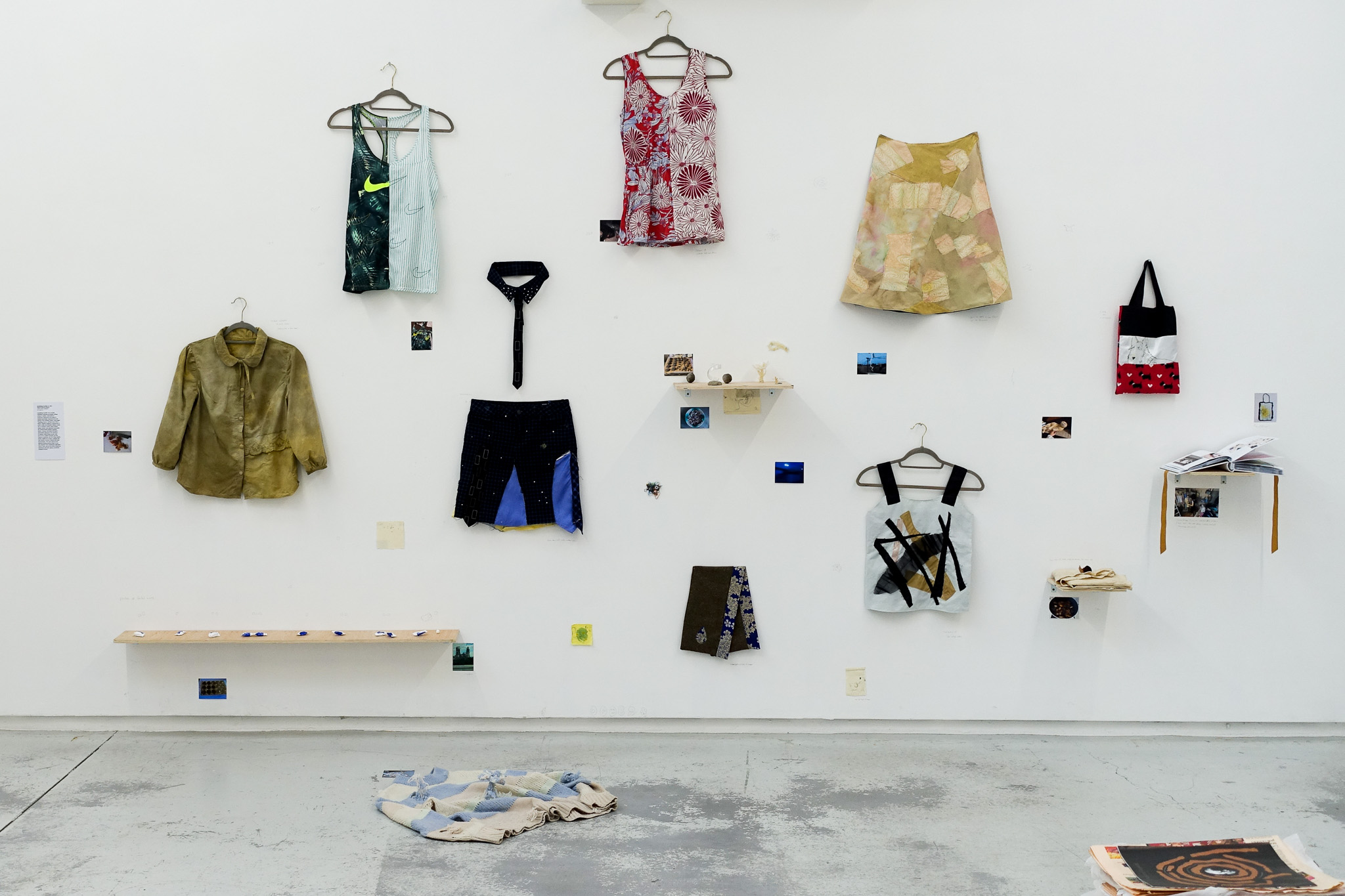
hAndBAGg FactORy Yy, 2025
mixed media installation
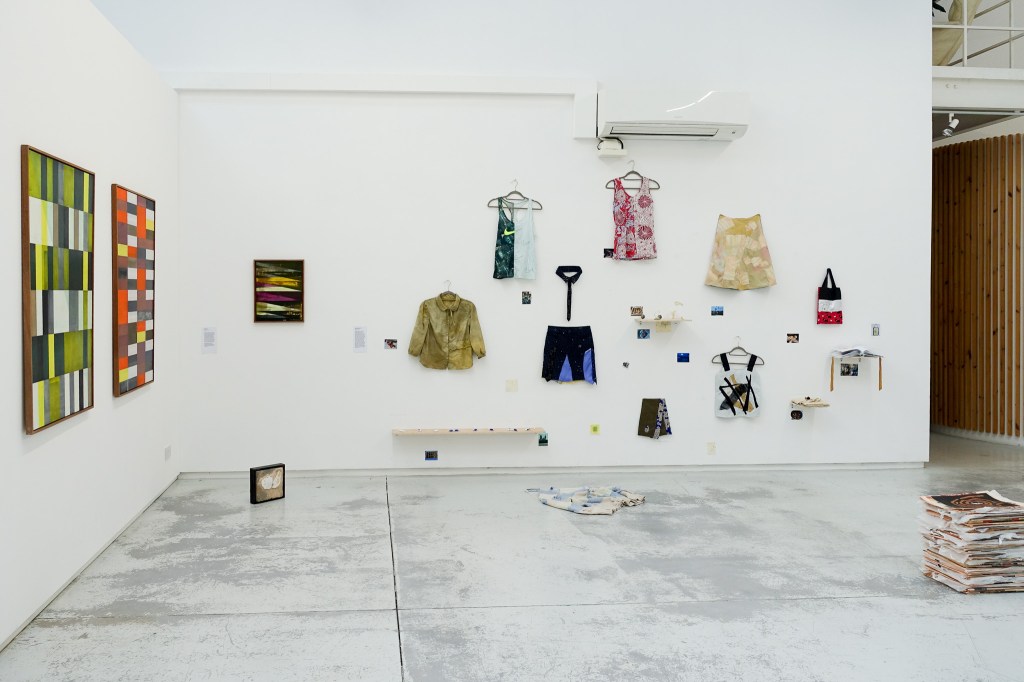
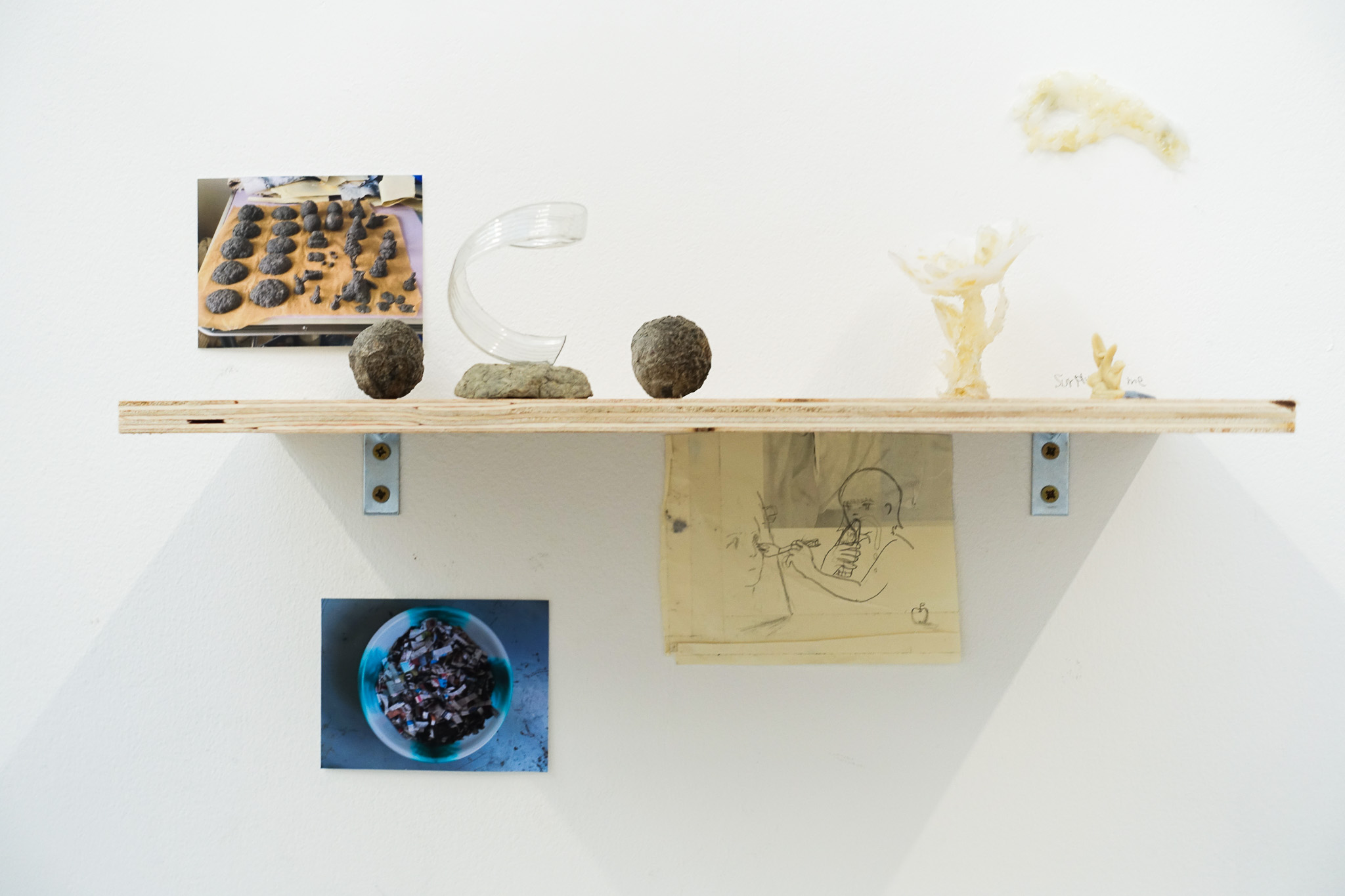
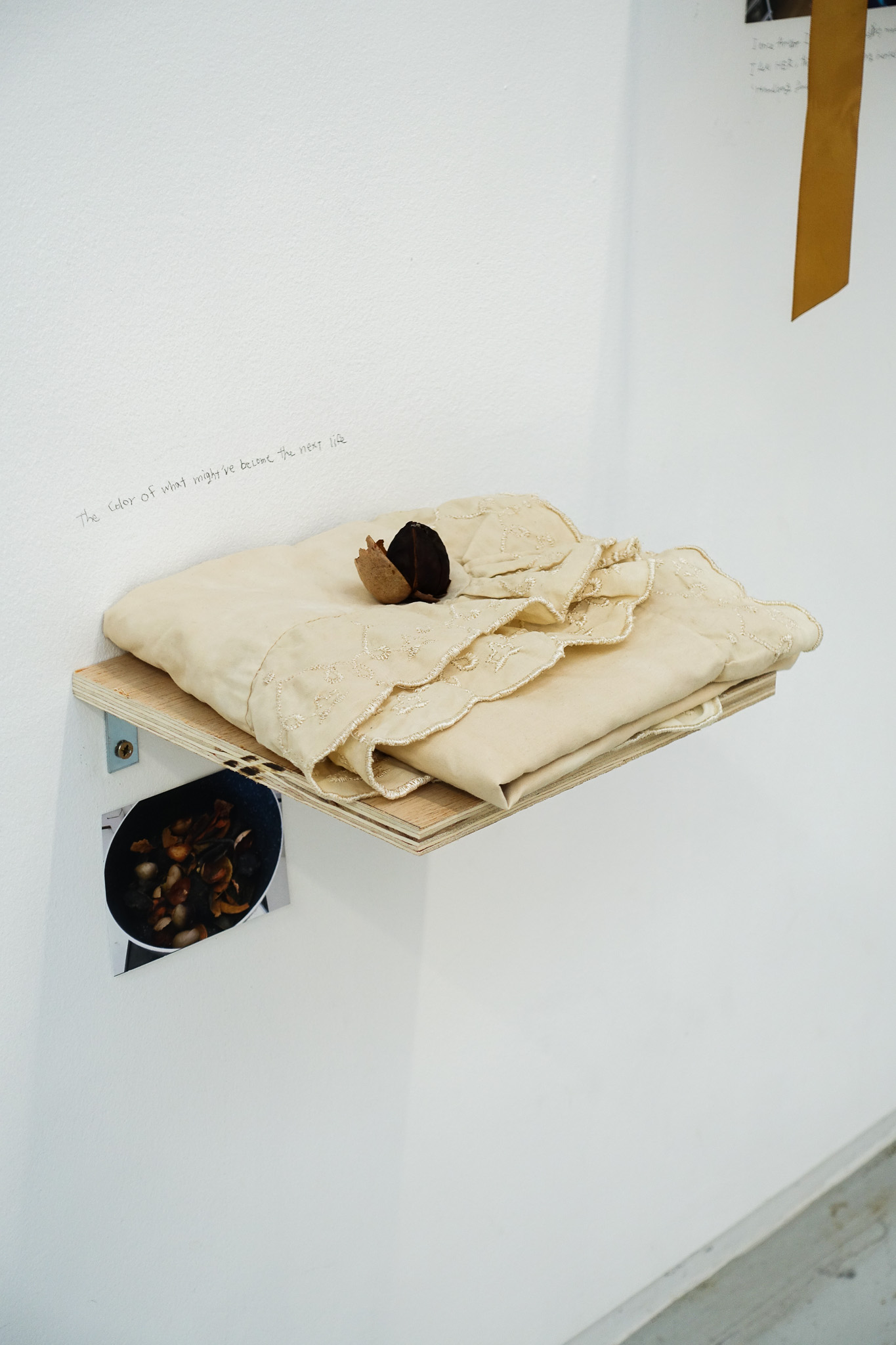
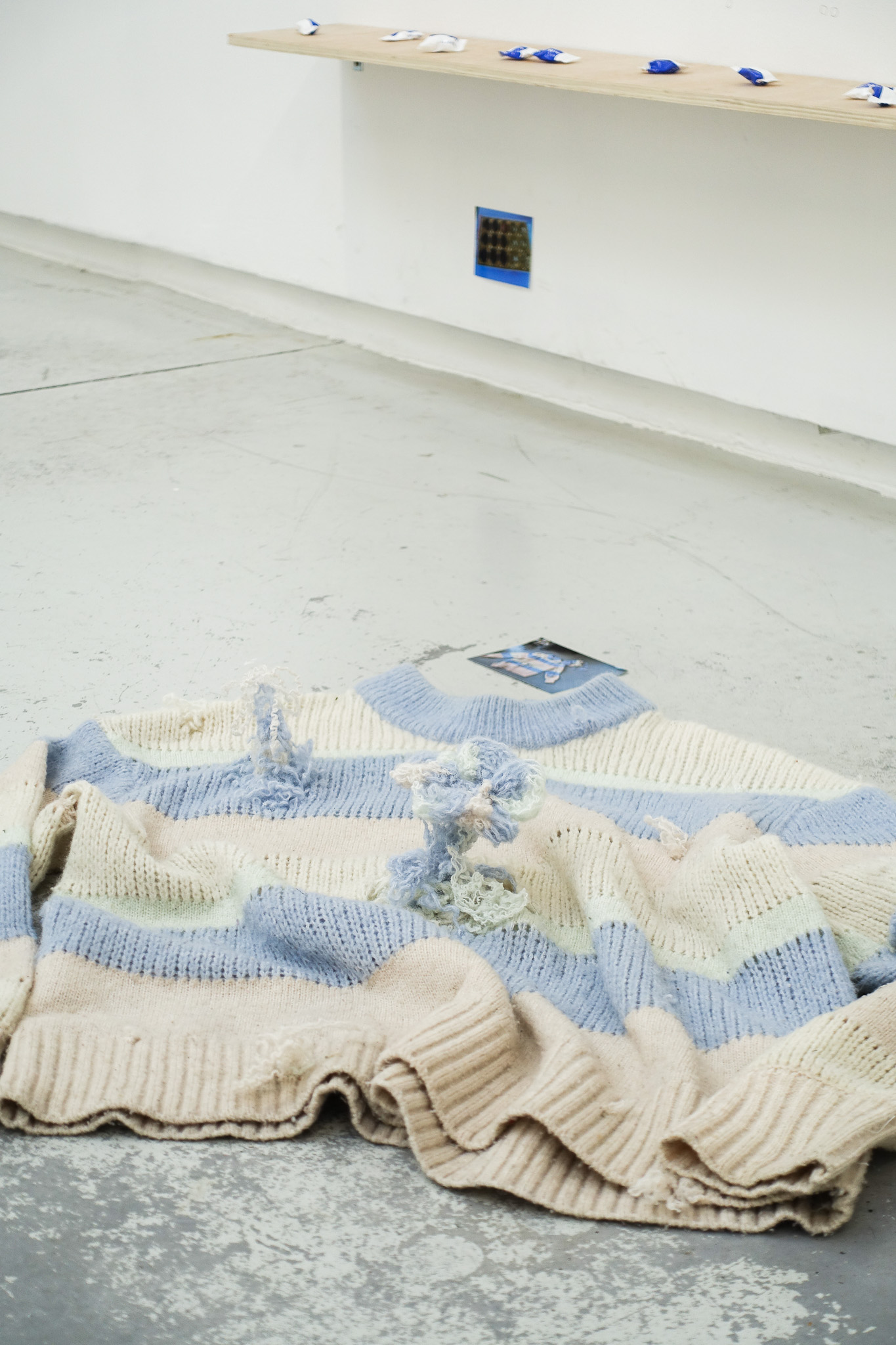
hAndBAGg FactORy Yy is a tactile installation exploring the broken, offbeat energy of making—quiet forms of production happening at the edges of systems and bodies. Inspired by the odd identity of the exhibition space—once called “Handbag Factory,” perhaps never truly a factory—Natsuki imagines a misfiring site of poetic, bodily, and energetic making: a small site of metabolic activity, where creative residue, texture, and sentiment accumulate. Her practice brings together upcycled fashion, drawing, and objects through a performative approach to the dynamics of making—where things unravel, shift, and re-form. Creation emerges not from control or perfection, but from things slightly broken, slightly out of place—charged with care, tension, murmurs, rhythms and quiet transformation. This work explores how Natsuki’s intuitive practice might, in fact, also represent micro-resistances, alternative forms of care, and an inner ethics shaped by tenderness and quiet urgency, sometimes wrapped in humor.
Www.natsukiiwamoto.com @natsuki.nako @poeticalalchemylfab
Nasus Y Ram
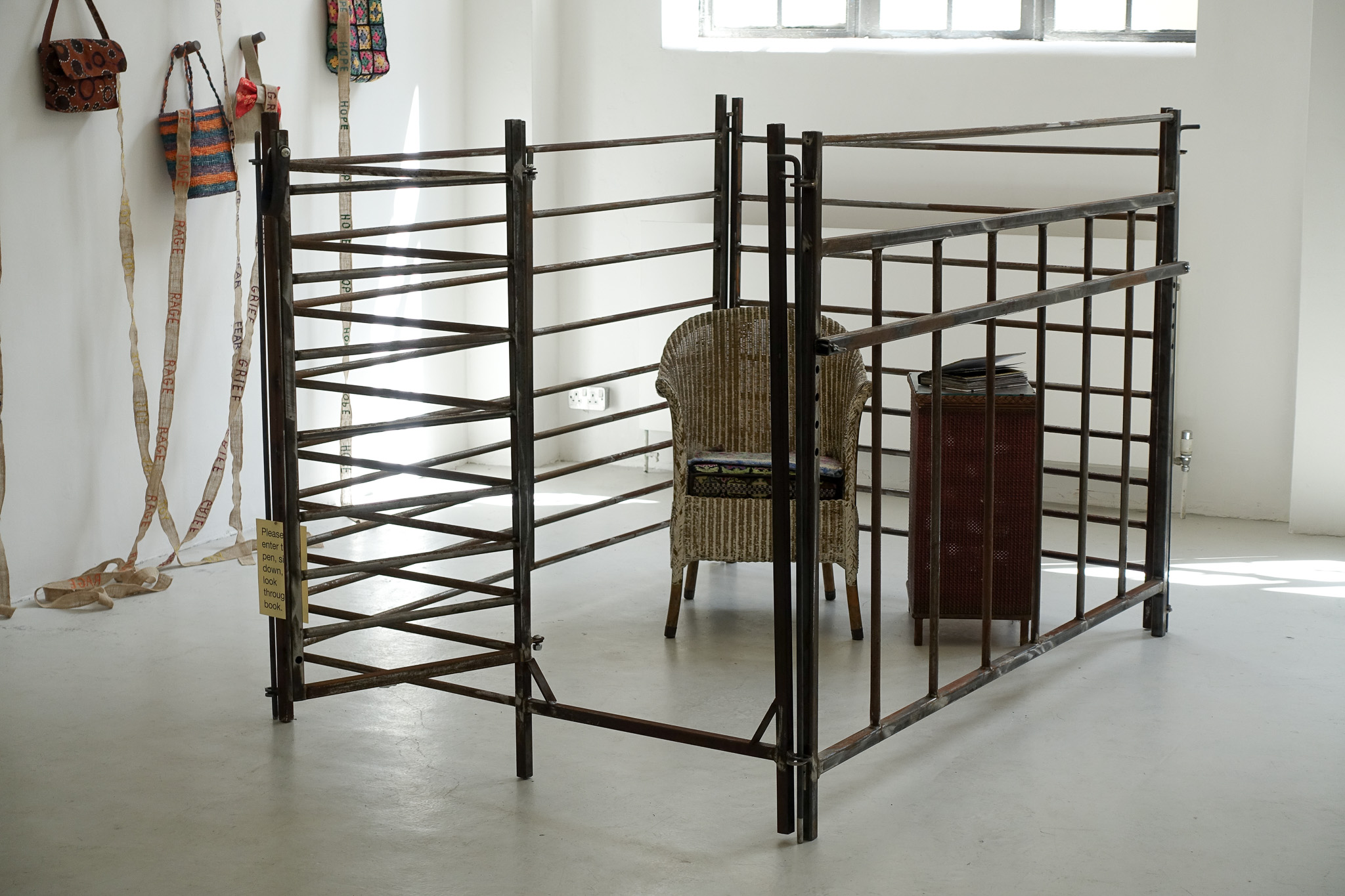
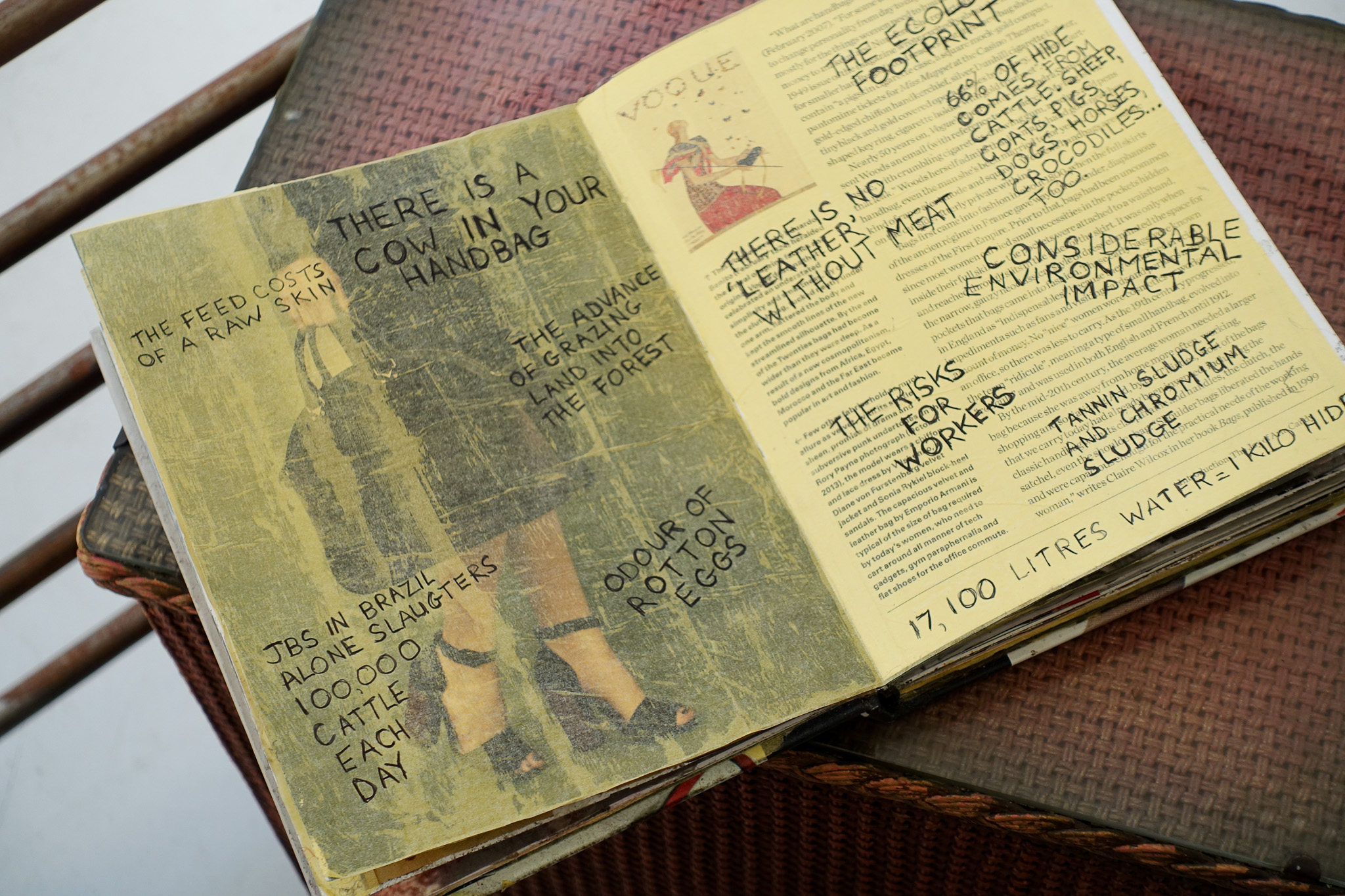
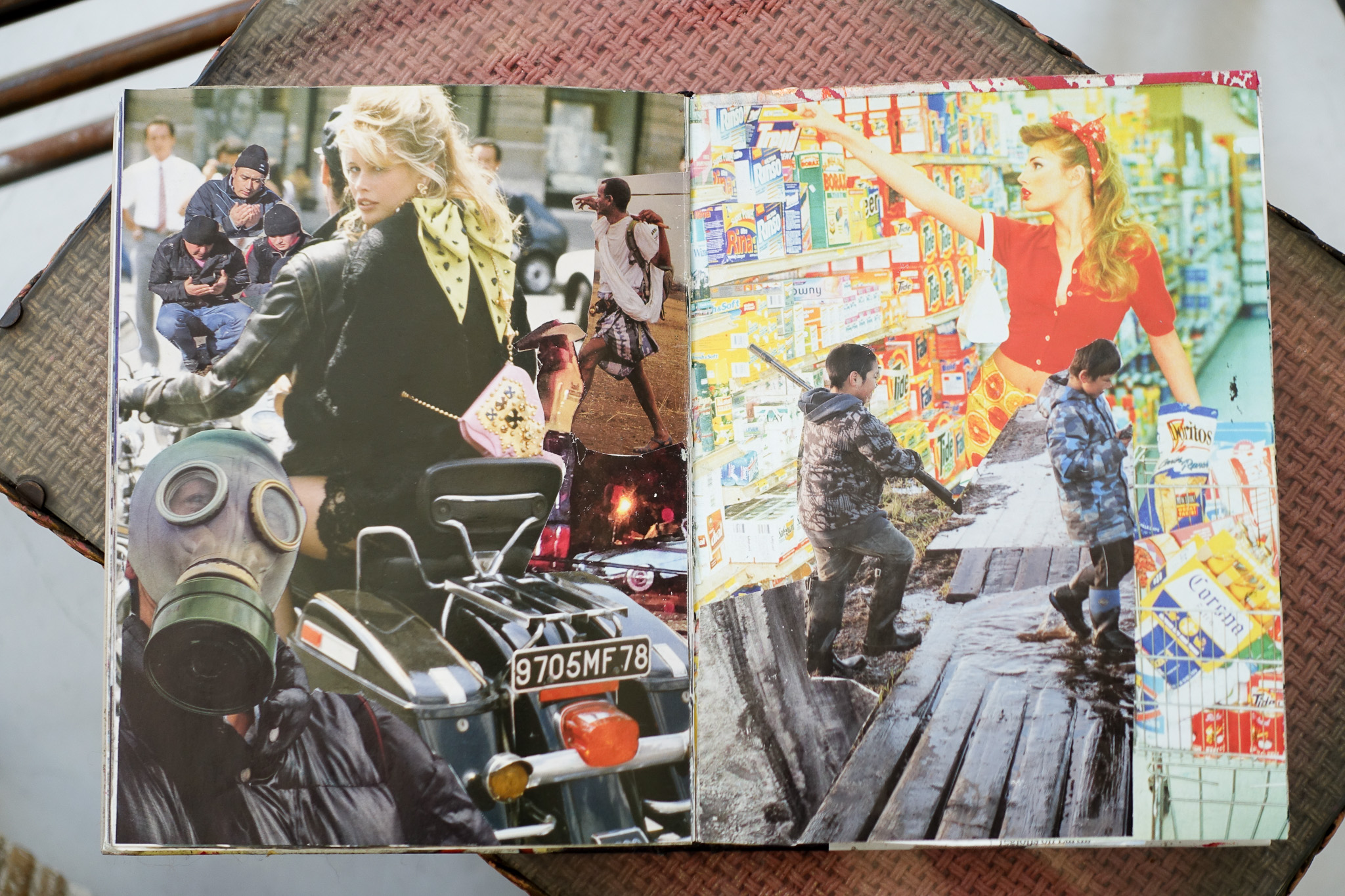
Hide, 2065
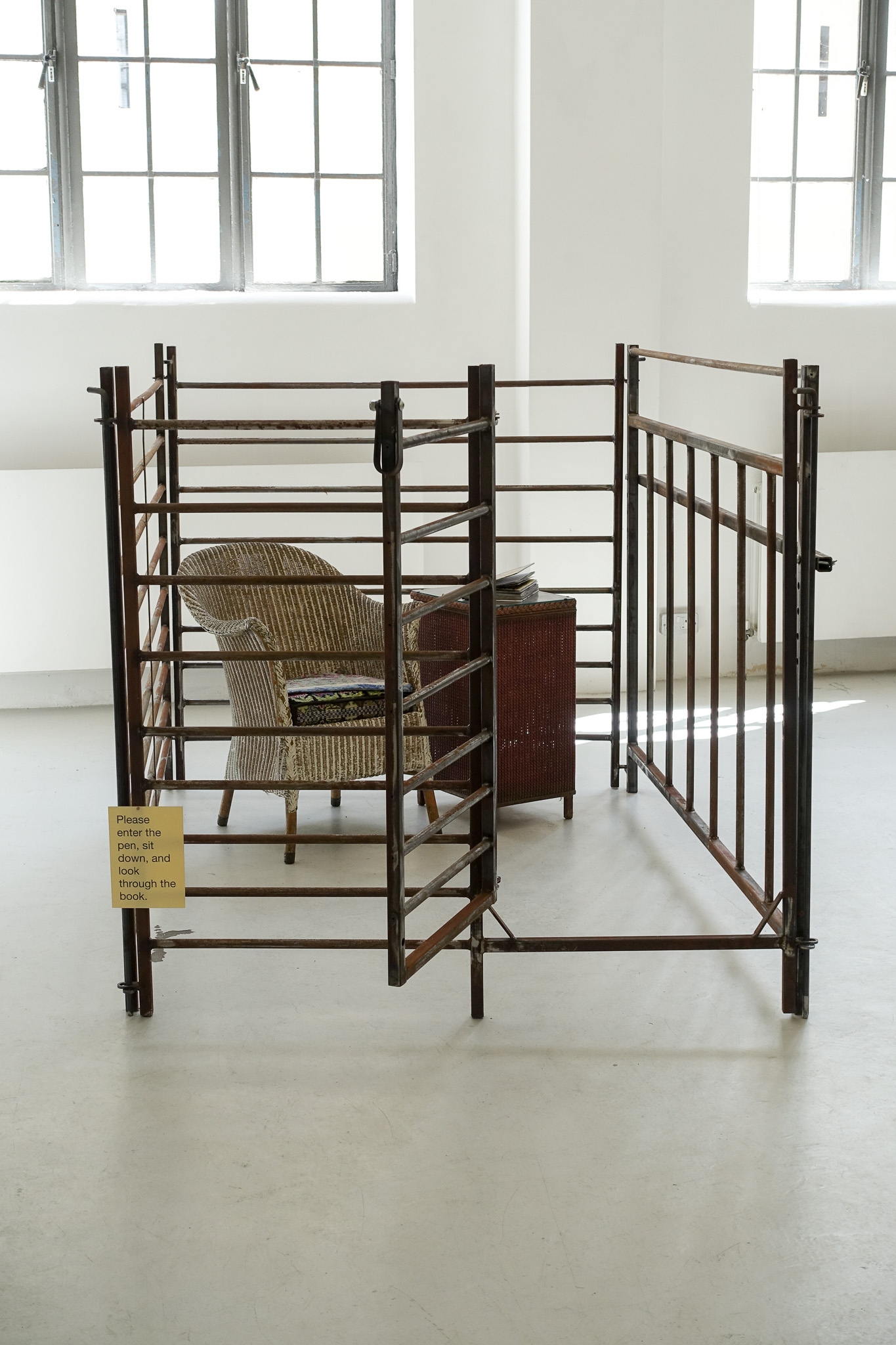
steel, mixed media drawings, found objects, 200 x 125cm
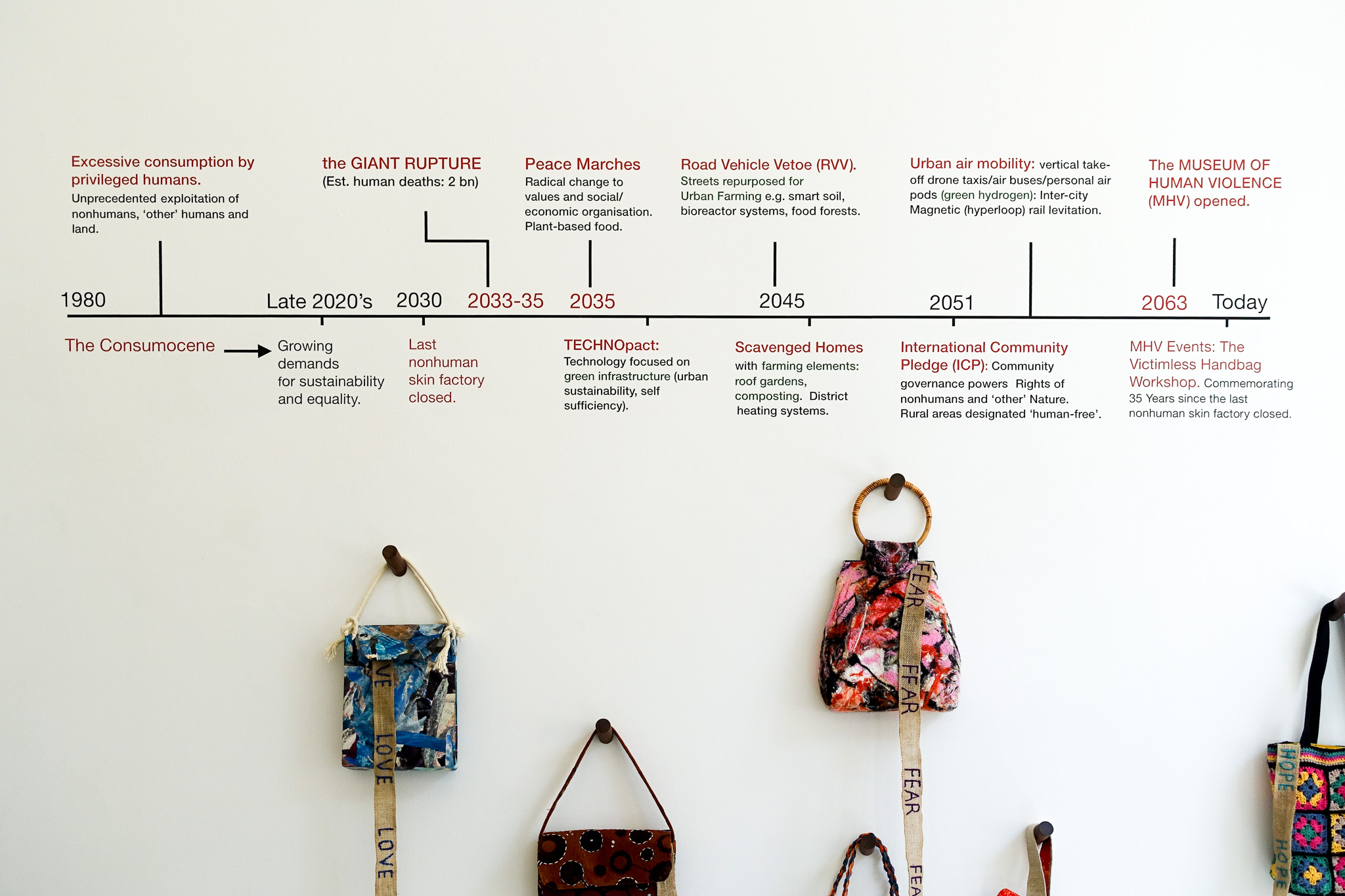
Time-Line
eco-vinyl, 220 x 60cm
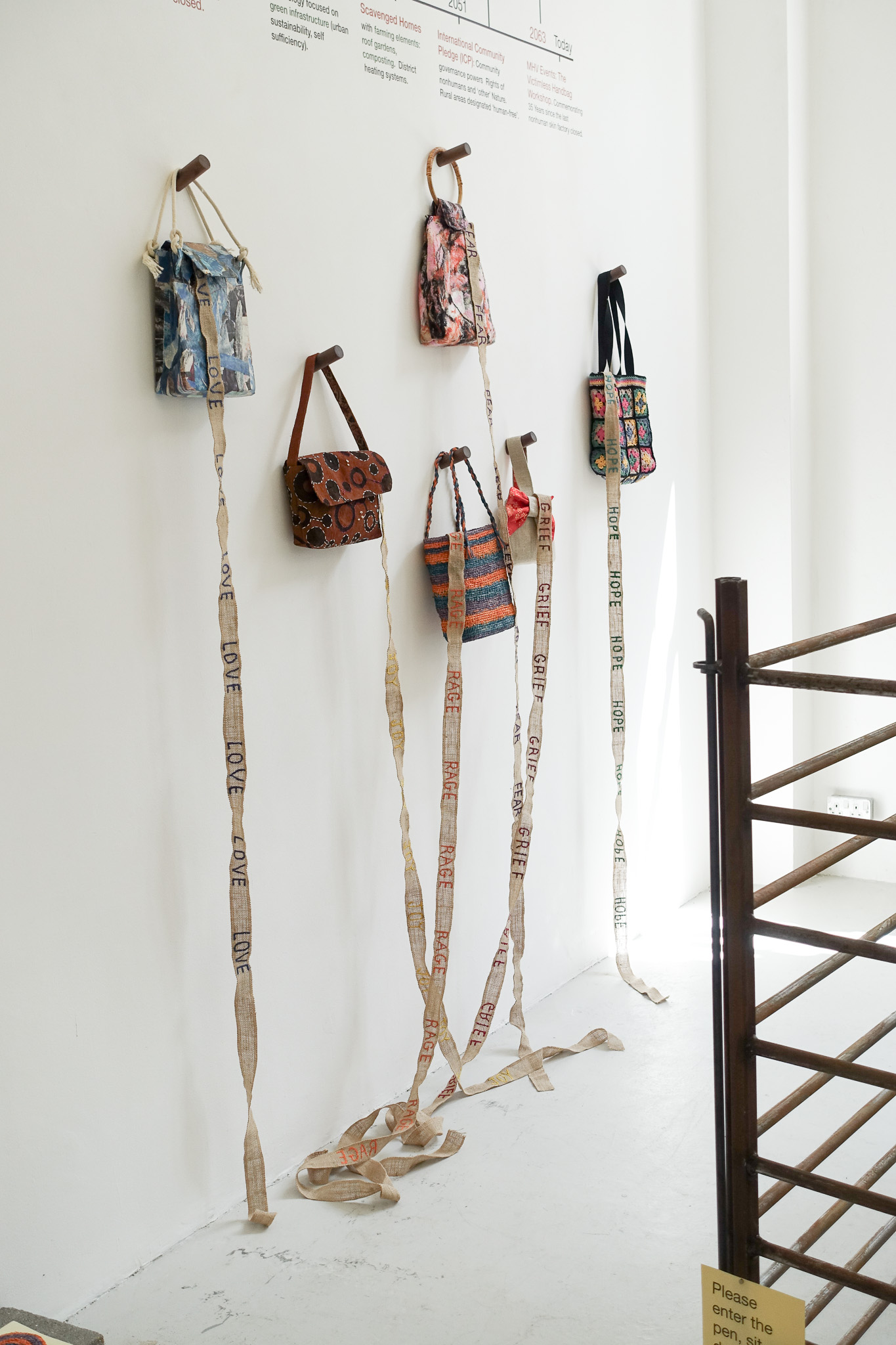
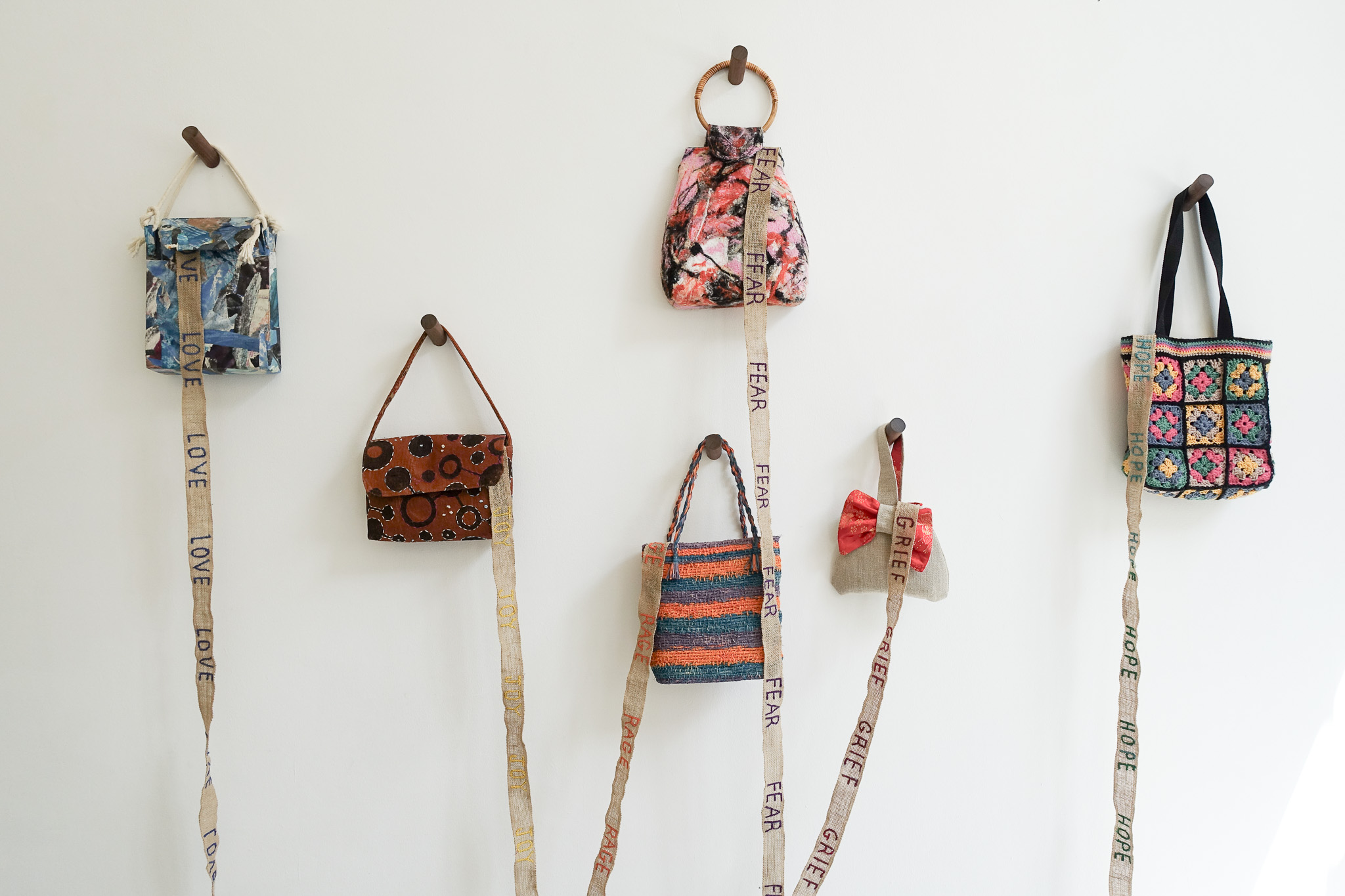
Victimless Handbag Workshop
eco and sustainable fabrics
Commissioned by the Museum of Human Violence in 2065, these works commemorate the closing, 35 years ago, of the last handbag factory in the UK using nonhuman skin. The installation is influenced by Heidegger’s belief that the purpose of art is to ‘unconceal’. A steel pen was used pre-Rupture to cage nonhumans, often prior to slaughter. Visitors are invited to sit in the cage and to look inside the ‘coffee table’ book which has been deconstructed to draw attention to excesses of the era, alongside the horrors of the skin industry. Significant events leading from the Consumocene through to our Age of Concord are highlighted in Time-Line. Participants in the Victimless Handbag Workshop, in this fiction, are encouraged to make and use bags metaphorically as ‘holders’ of trauma both pre- and during Rupture.
themuseumofhumanviolence.com @the_museum_of_human_violence
Nele Bergmans
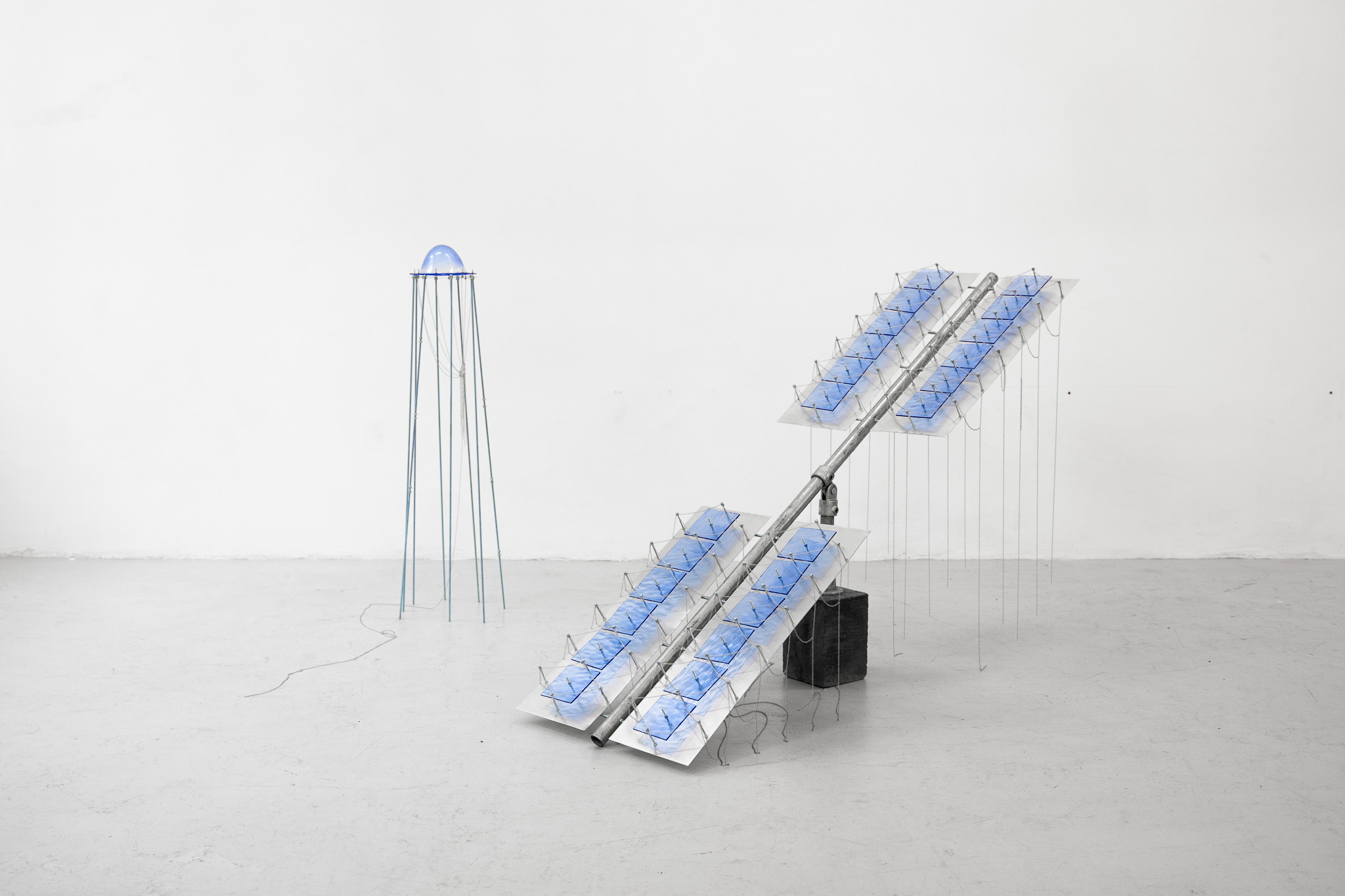
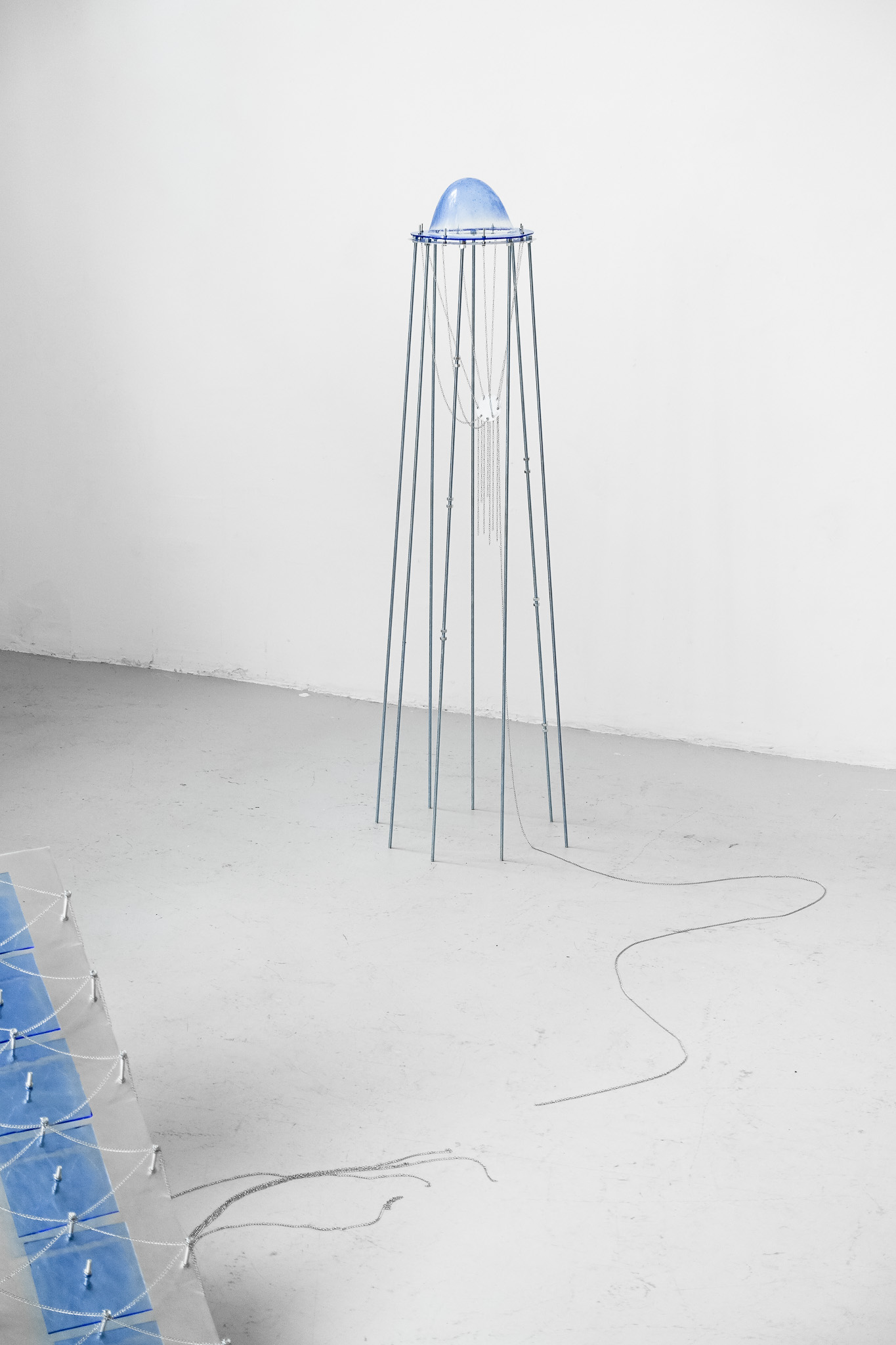
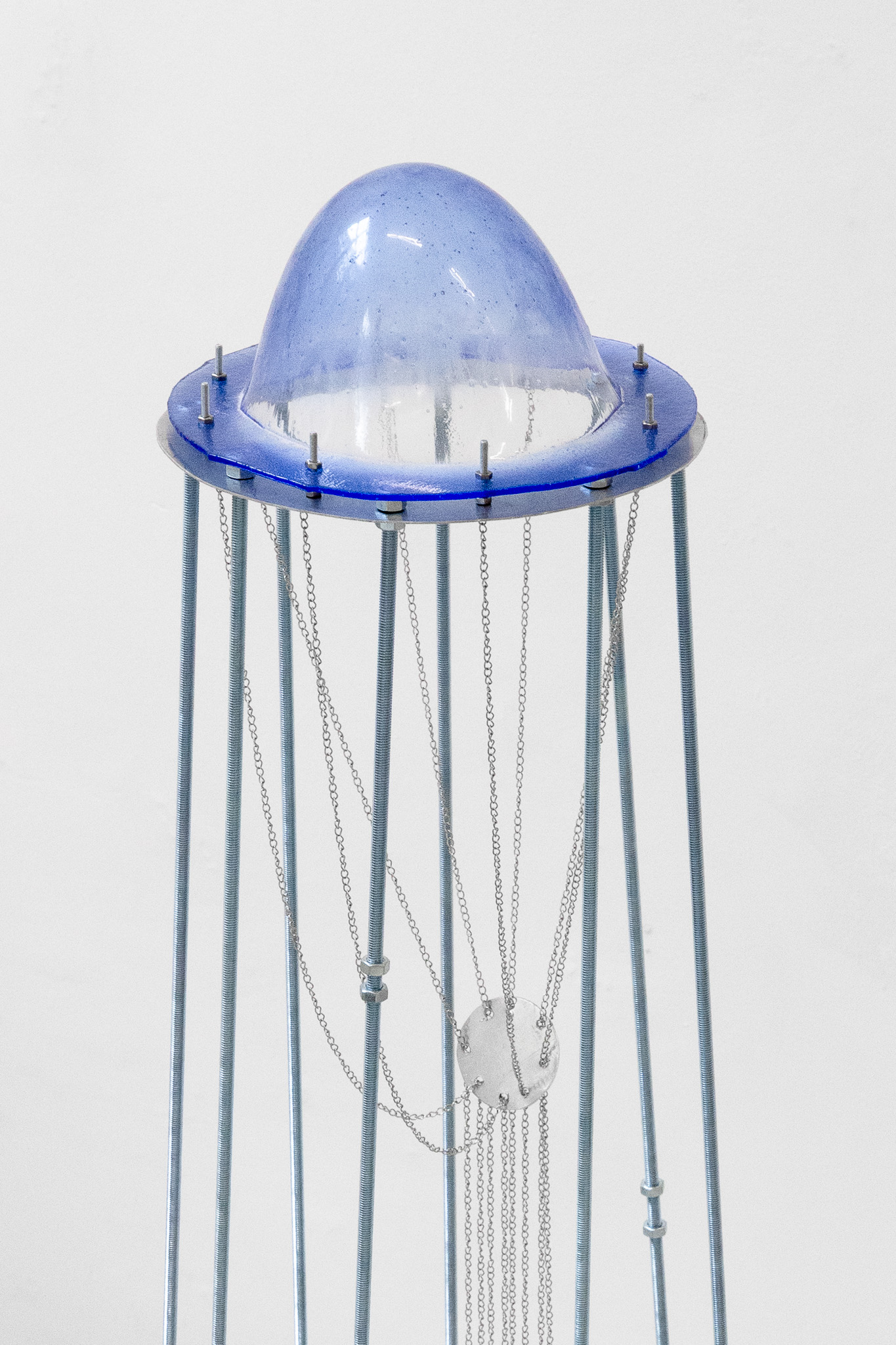
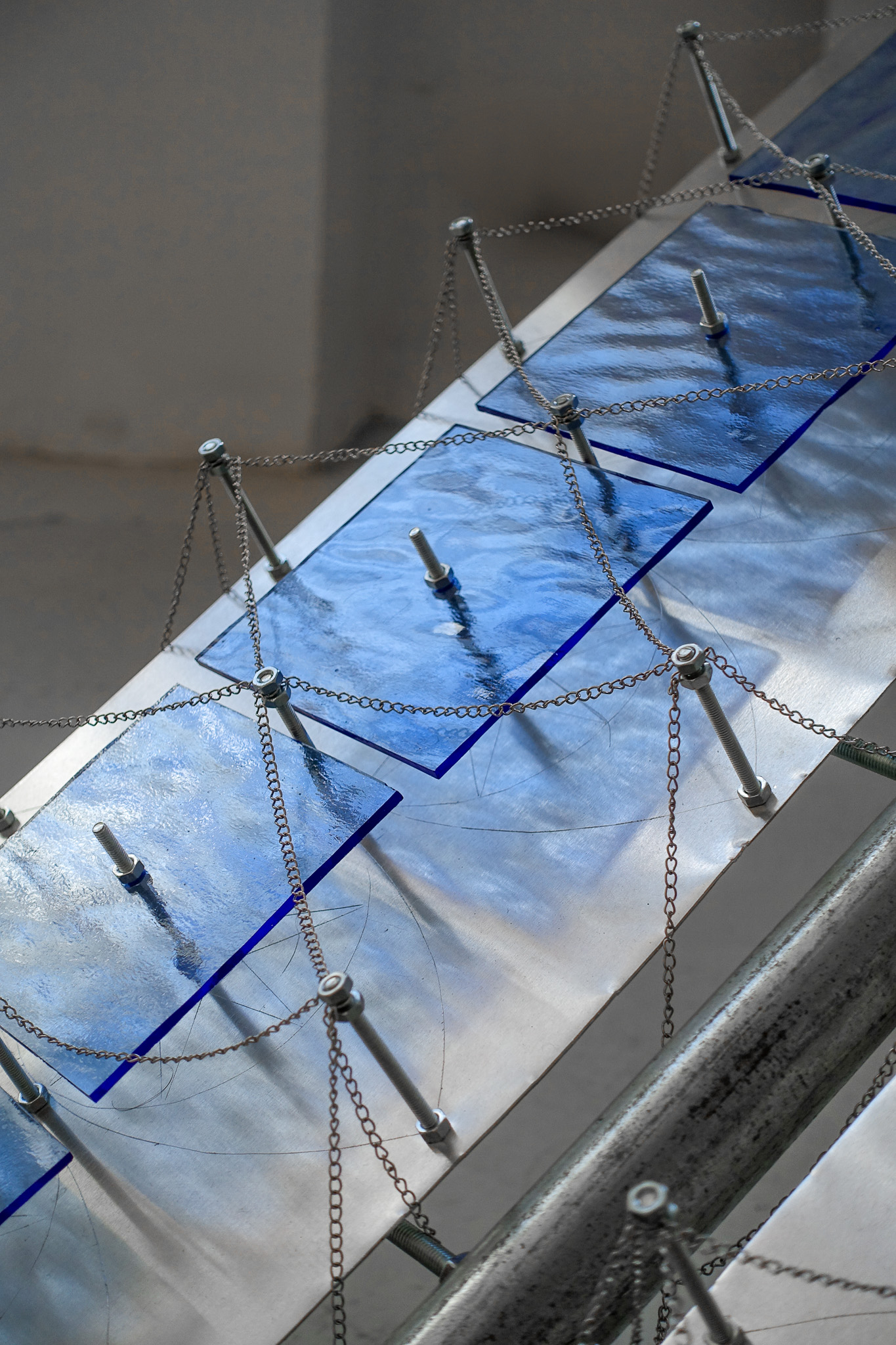
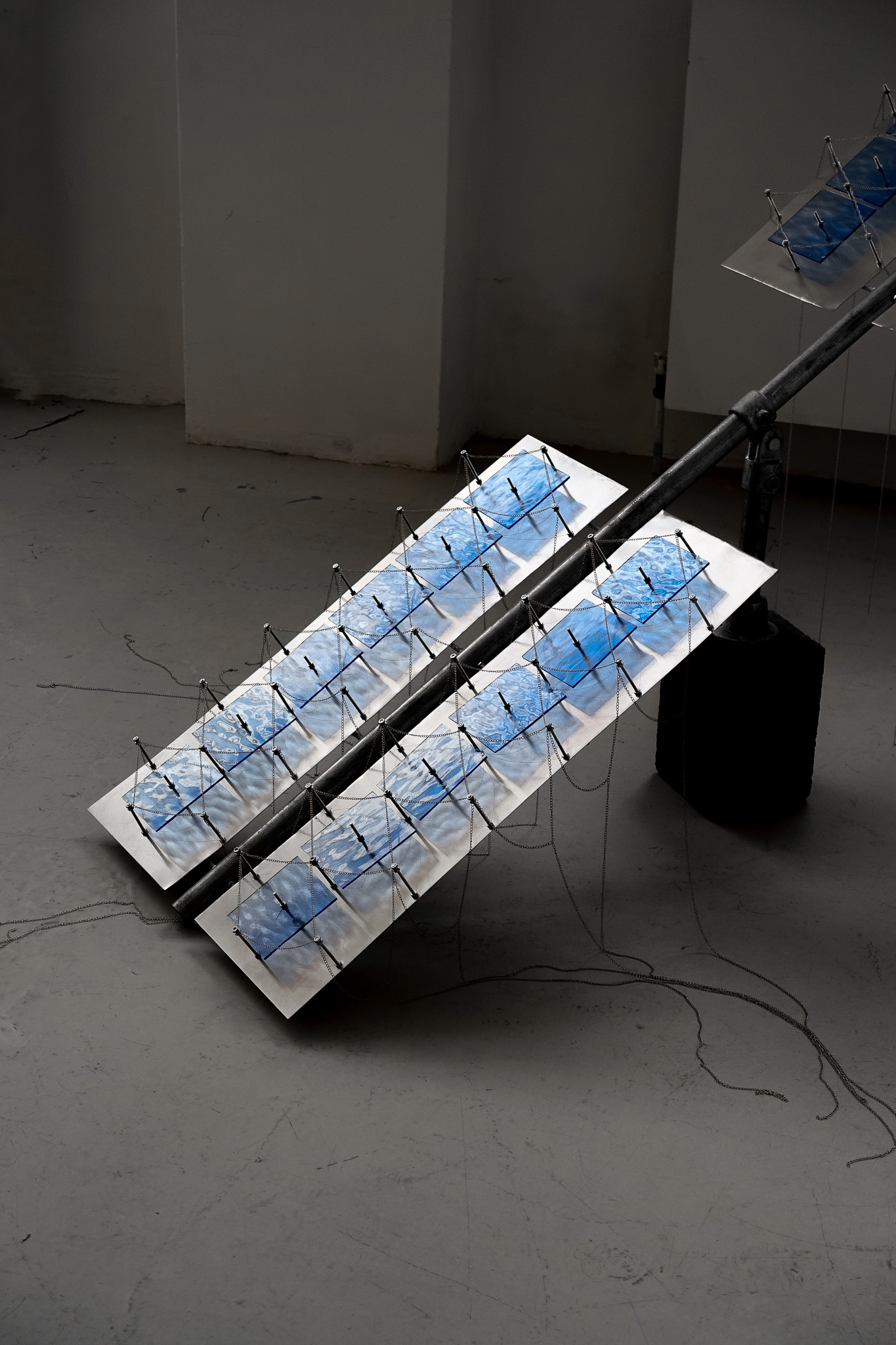
Flight to Nassau I & II, 2025
glass, steel, aluminum, chains, breezeblock, 110 x 30cm; 30 x 165 x 165cm
These works are inspired by Charles Green, Britain’s most famous hot-air balloonist. In 1836 he set off from Vauxhall Pleasure Garden in his balloon ‘Royal Vauxhall’, flying overnight to Nassau, Germany. On a subsequent flight he tied the parachute of Robert Cocking to his balloon, to drop him from high above. The parachute tragically failed, turning Cocking’s lifelong dream into his death. The incident gripped the public imagination, inspiring numerous engravings of Cocking captured mid-fall. This work also draws from the broader history of ballooning and its early ties to military operations. From high above, balloonists could observe enemy movements and pass that information to troops on the ground—an early form of aerial surveillance. Today, satellites and drones serve a similar purpose. Why is it that humans want to go up in the sky—seeking height in fragile vessels, chasing dreams and disaster alike. To rise is to risk falling—but the pull upward remains.
www.nelebergmans.com @nelebergmans
Nimmi Hutnik
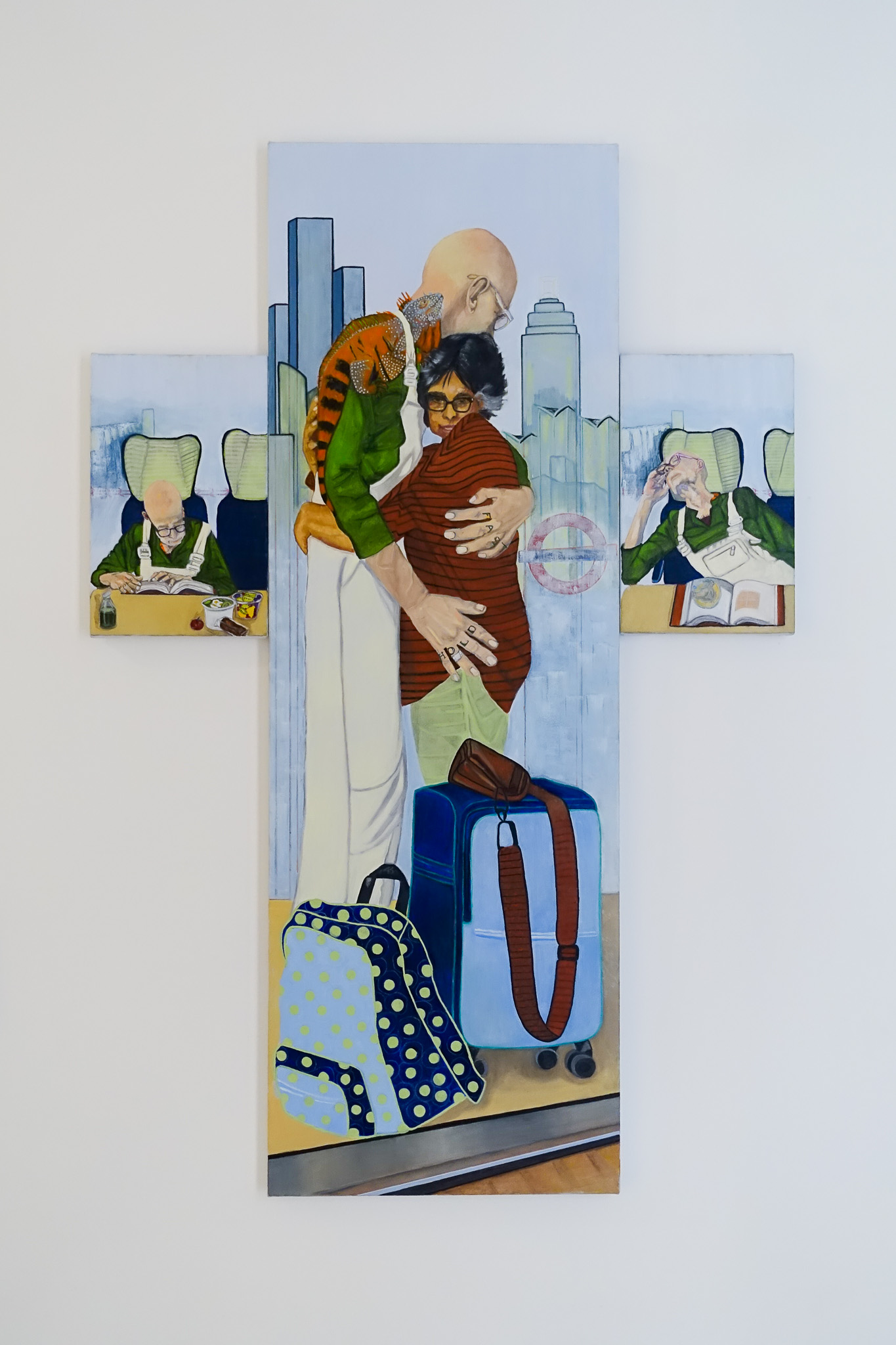
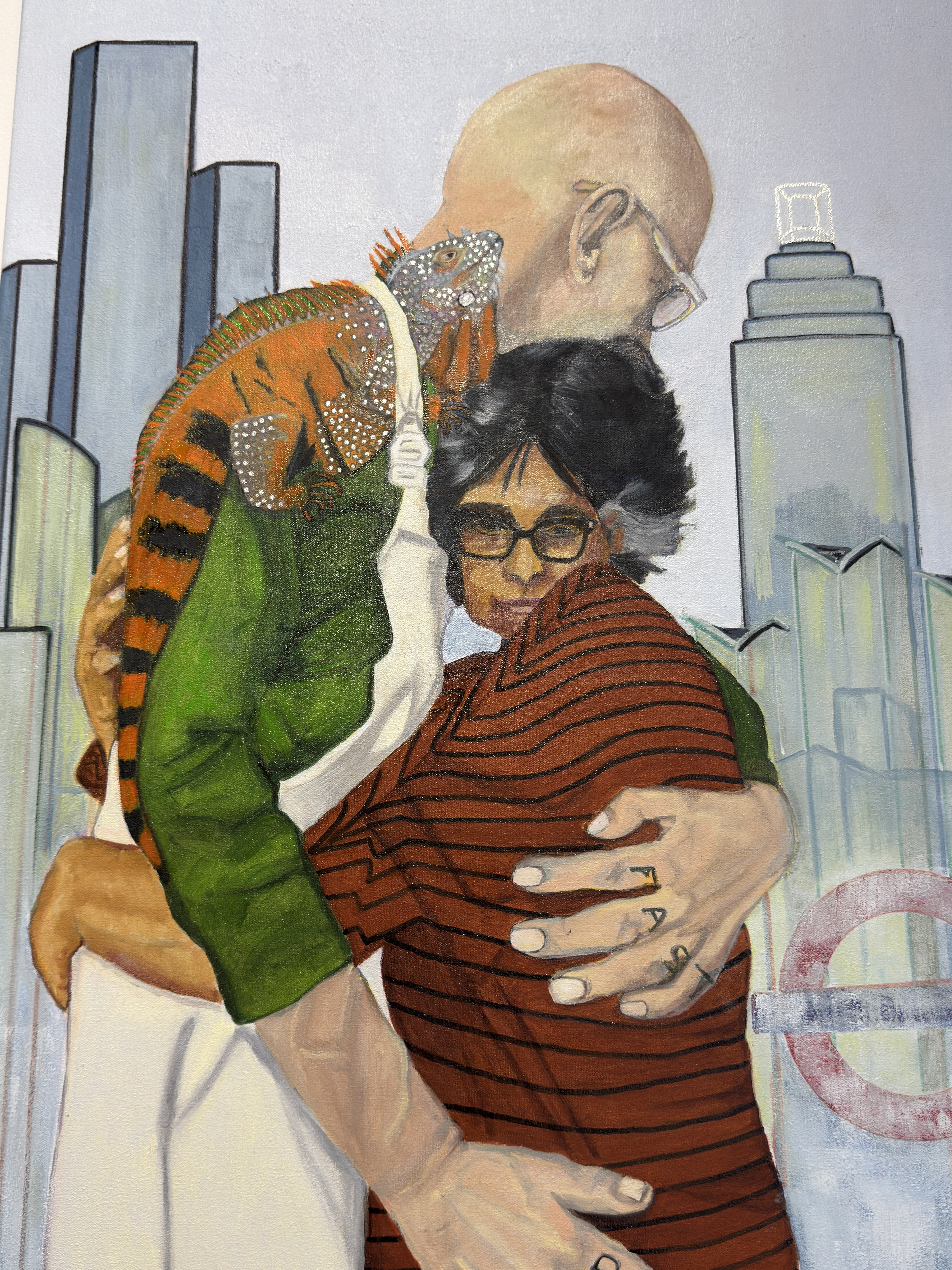
LAT (Living Apart Together), 2025
oils on canvas, 100 x 150 x 4cm
Nimmi is both an artist and practising psychologist. Her recent work explores political realities such as uncompassionate immigration policies, capitalism, and class structures that are unsympathetic to the poor. Typical of a return to artistic sincerity and a post post-modern, or metamodern mindset, Nimmi took Vauxhall Station and The Handbag Factory as her starting points for this piece: she and Andrew, her partner, regularly travel through Vauxhall on their journeys to and from each other. Vauxhall is reflective of the diversity of South East London’s population and representative of migration and diaspora – themes which feature heavily in Nimmi’s work. Handbags, in the form of luggage, have been close companions. The struggle of these journeys is represented in the configuration of the cross.
www.nimmisart.com @nimmihutnik
Rhi Stanton
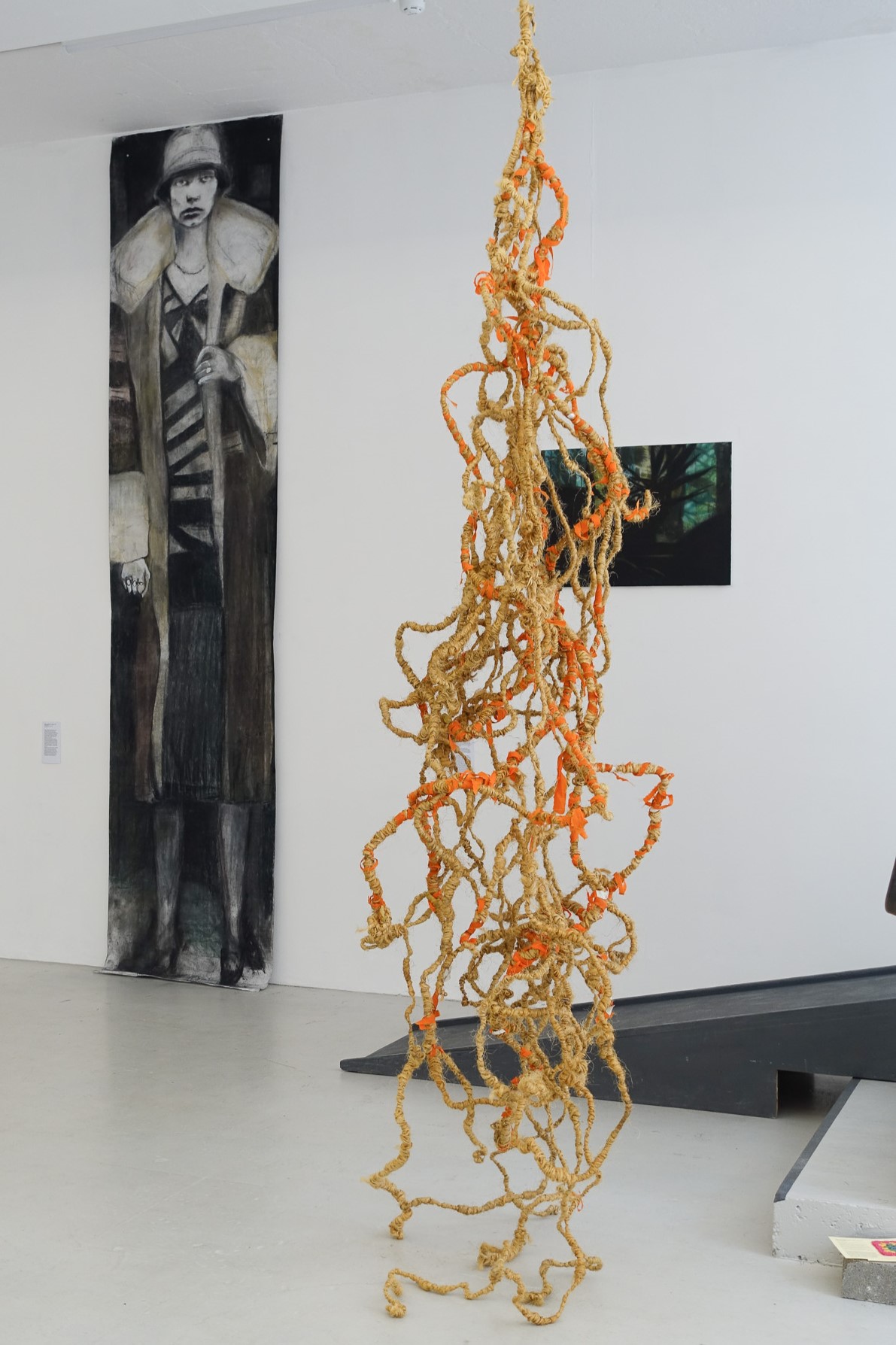
Ode to the Oakum Pickers, 2025
Fibre, 300 x 50 cm
This sculptural work reclaims a historically punitive labor, picking oakum as a form of resistance. Once imposed on the poor, prisoners, and workhouse inmates to discipline the body through slow, extractive labour, the act is here transformed into a practice of care, endurance, and memory. Hundreds of meters of reclaimed sisal rope are unwound into strands and rewound by hand with the orange fragments from dismantled life jackets, materials marked by migration, survival and disposability. In resisting speed and efficiency, this process challenges the capitalist logics of productivity and value. It centres what is cast off: the damaged, the unwanted, the unprofitable. Through repetition and touch, Rhi confronts systems that commodify human life and erase certain forms of labour. Picking oakum is not nostalgic, it is a reckoning.
www.thewordsdontfit.co.uk @Rhi Stanton
Sabrina Rodrigues
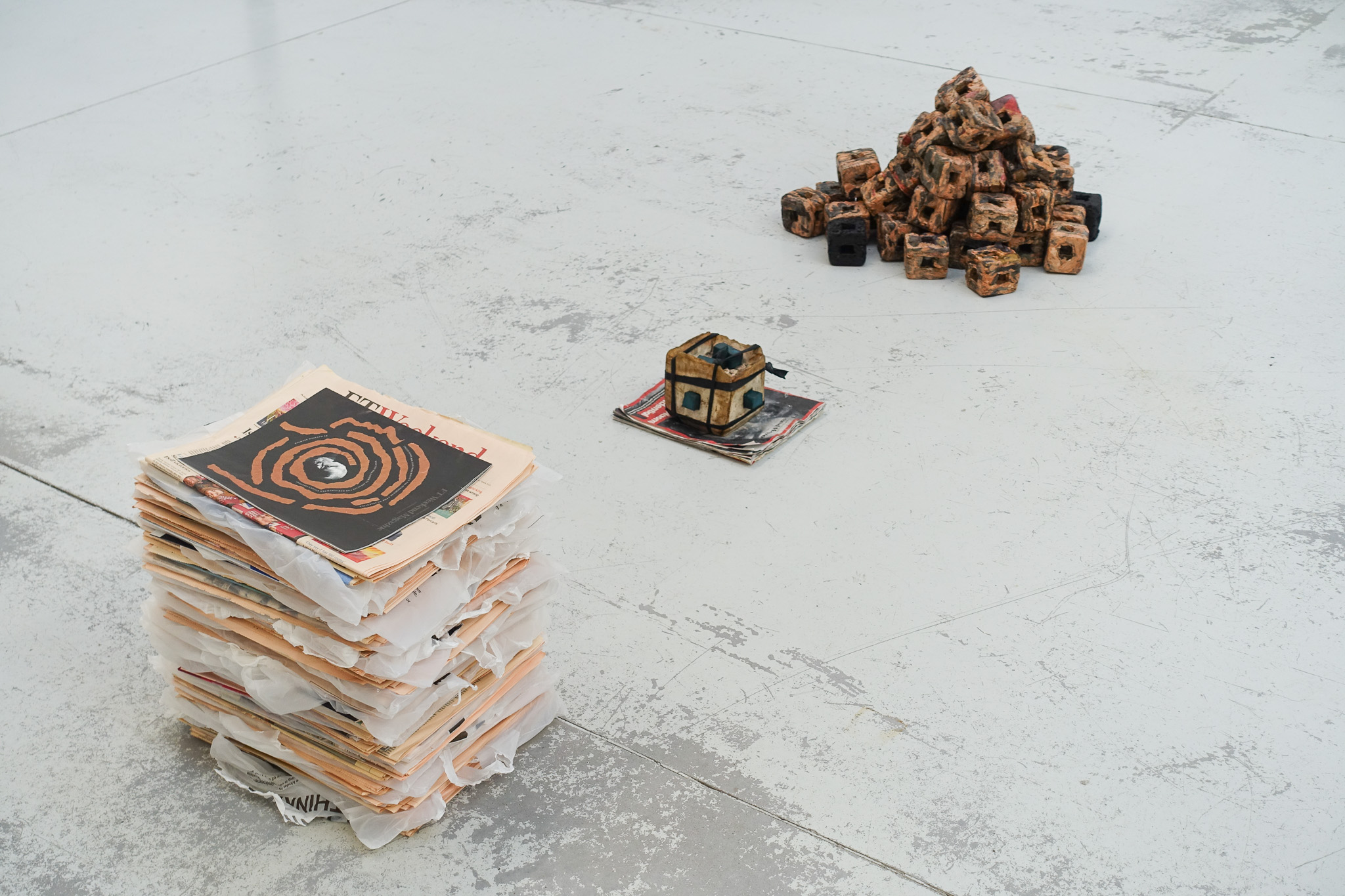
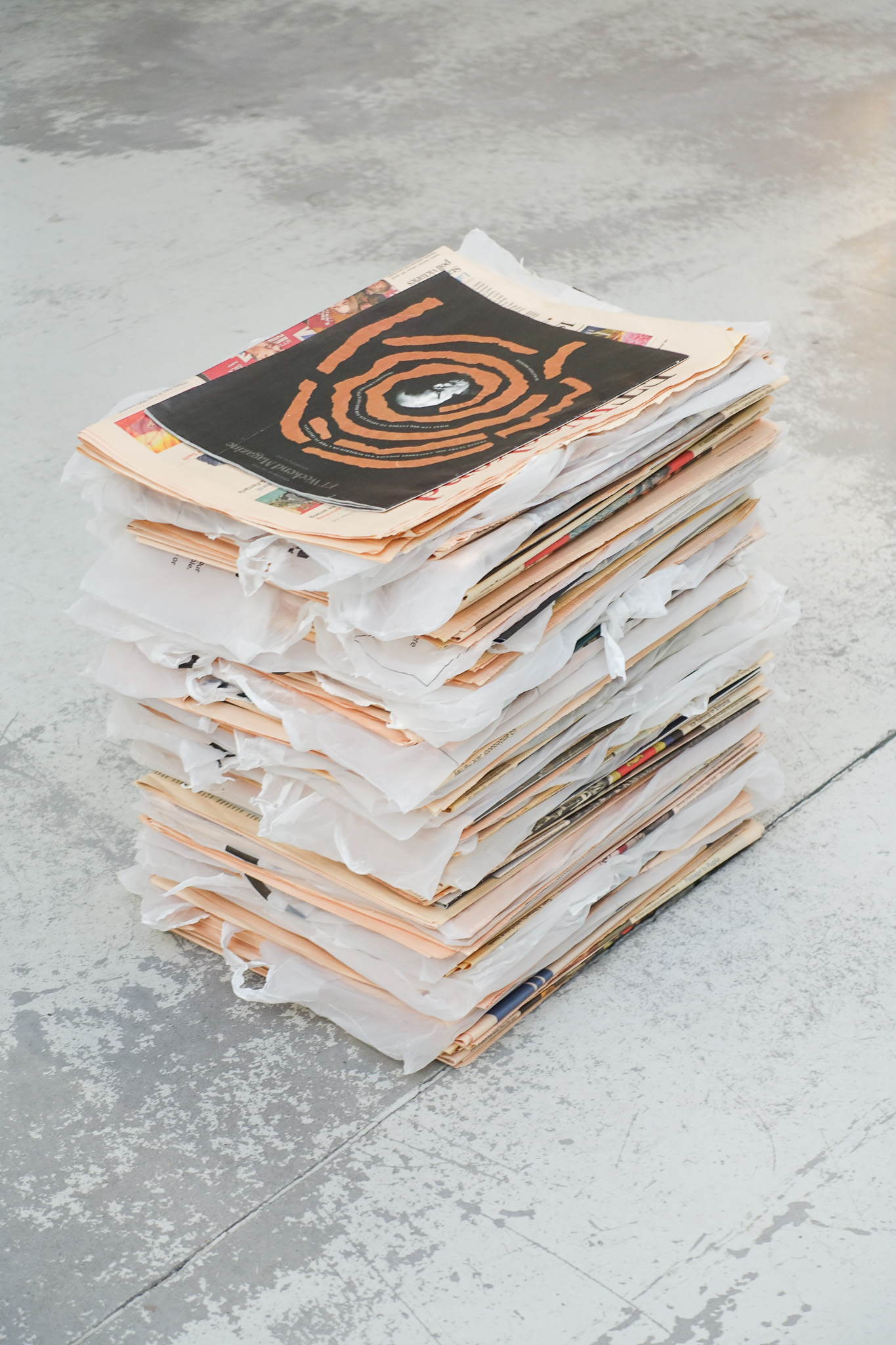
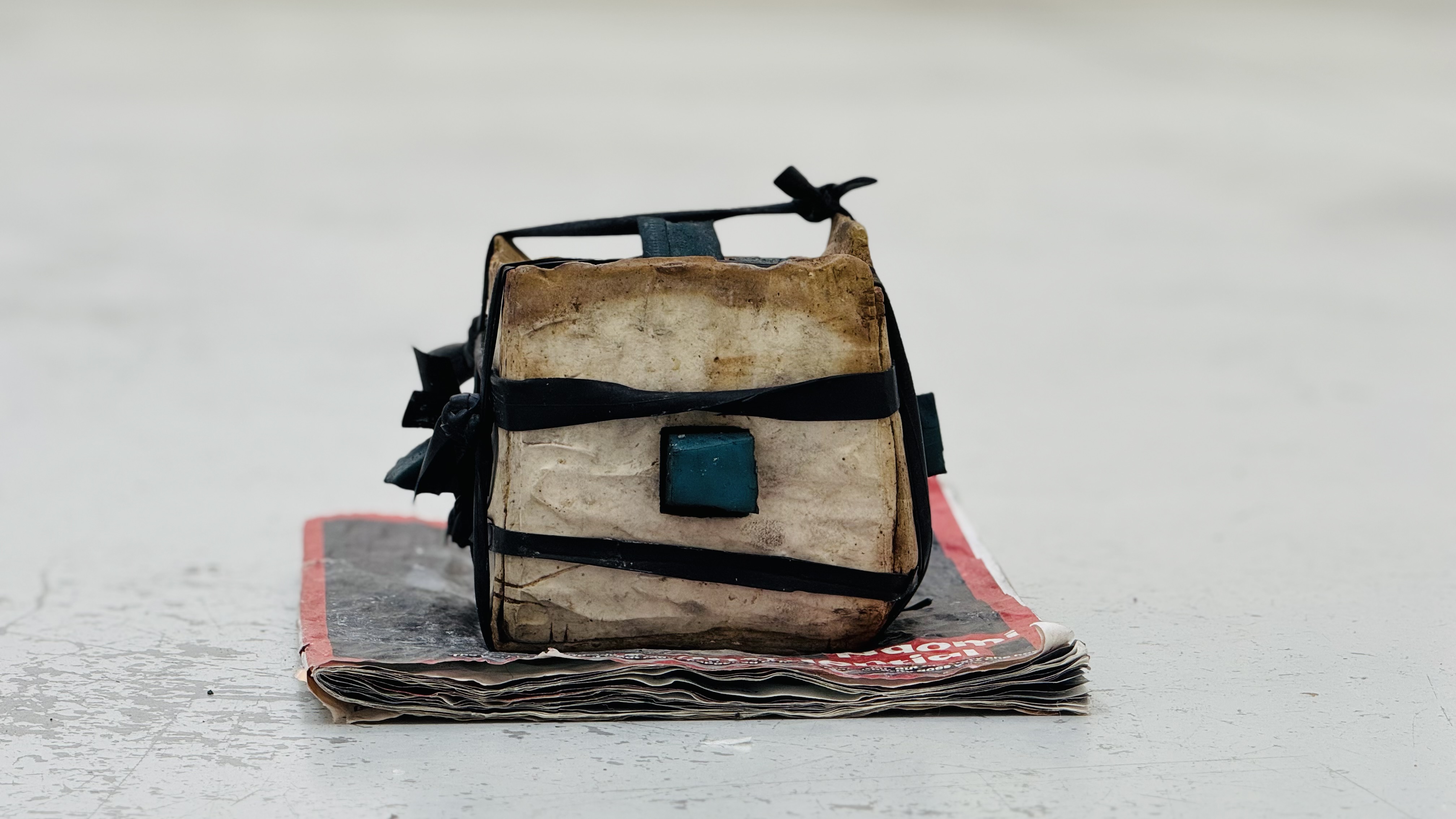
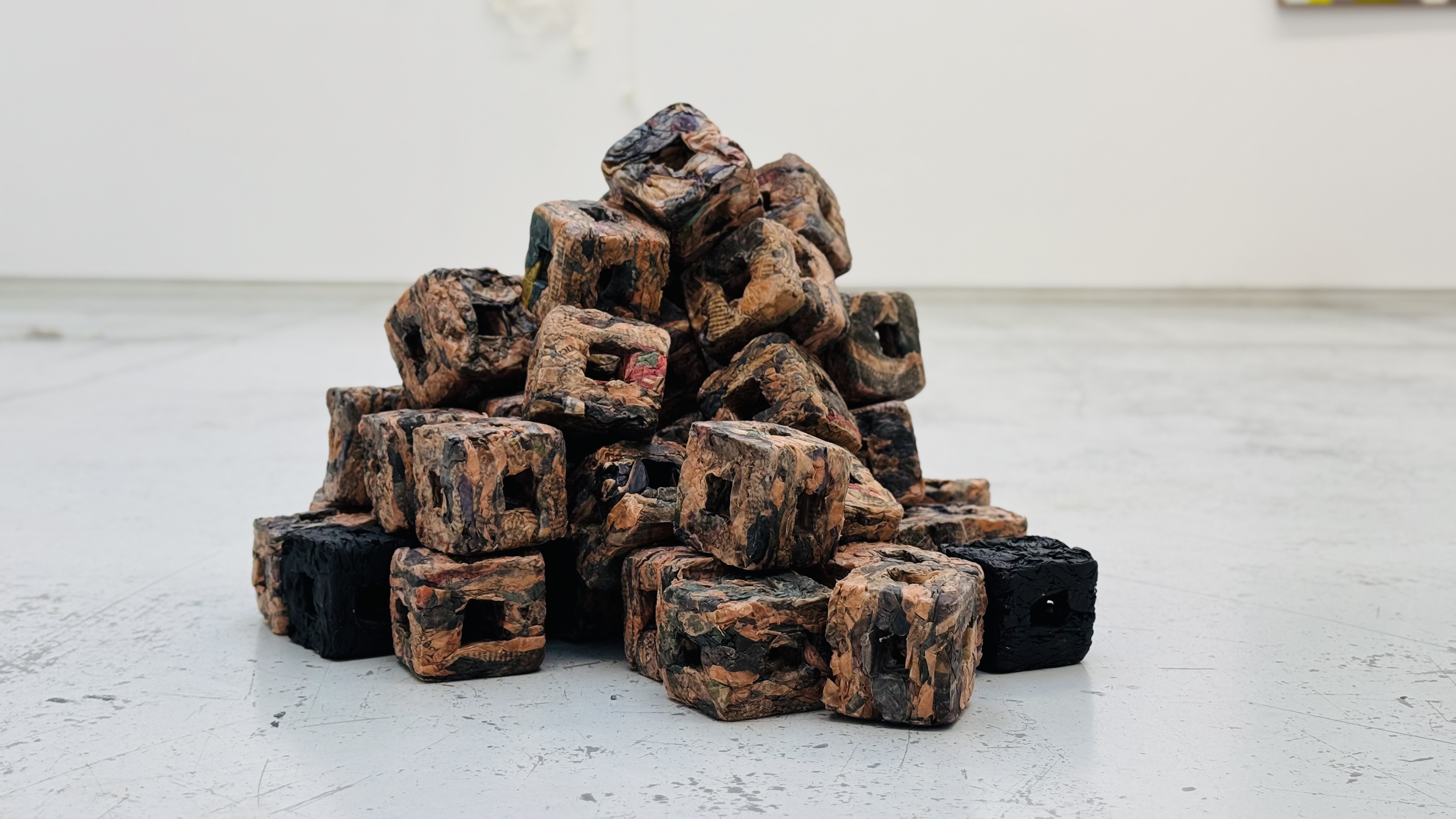
Fabrication I, 2025 WIP
discarded newspapers, plaster and silicone mould, beeswax, 270 x 100 x 70 cm
Drawing inspiration from the inherent repetition of factory-based manufacturing and the ubiquitous presence of heaps, stacks, and piles across industrial floors, this installation emerges from an exploration of factory production. Utilising a mould—an enduring emblem of industrial fabrication—nine sheets of discarded newspaper have been cut, rinsed, compressed, dried, and shaped into a humble open cuboid form. This process, methodically repeated over several days and weeks, underscores the mechanical rhythm of the production line, evoking themes of accumulation, standardisation, and waste. The installation encourages viewers to reflect on the invisible hand of societal norms and on the environmental implications of material excess, prompting consideration of how the serial reproduction of even a single object can collectively generate a significant environmental footprint.
www.sabrinarodrigues.com @sabrina.da.rodrigues
StevieRay Latham
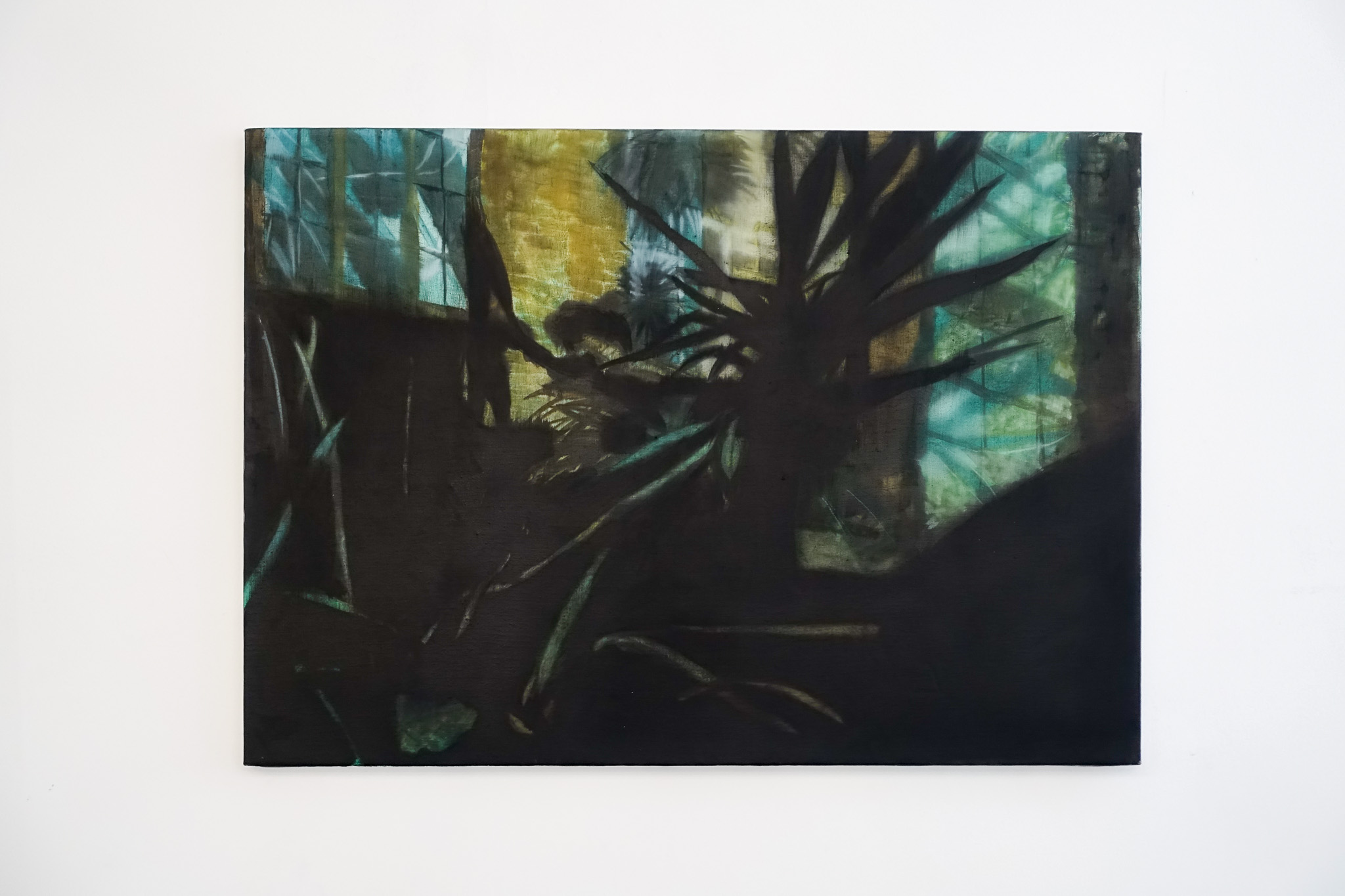

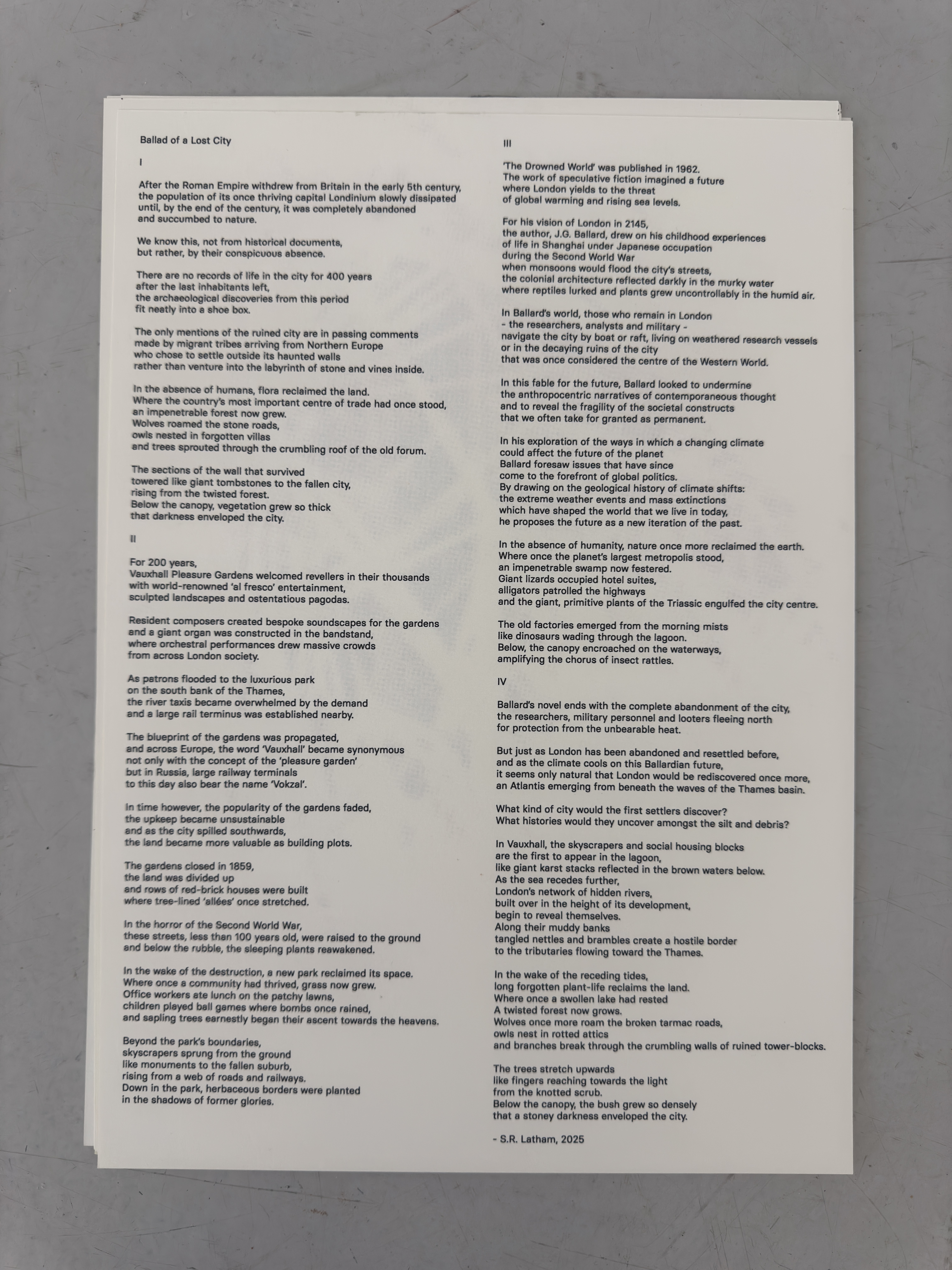
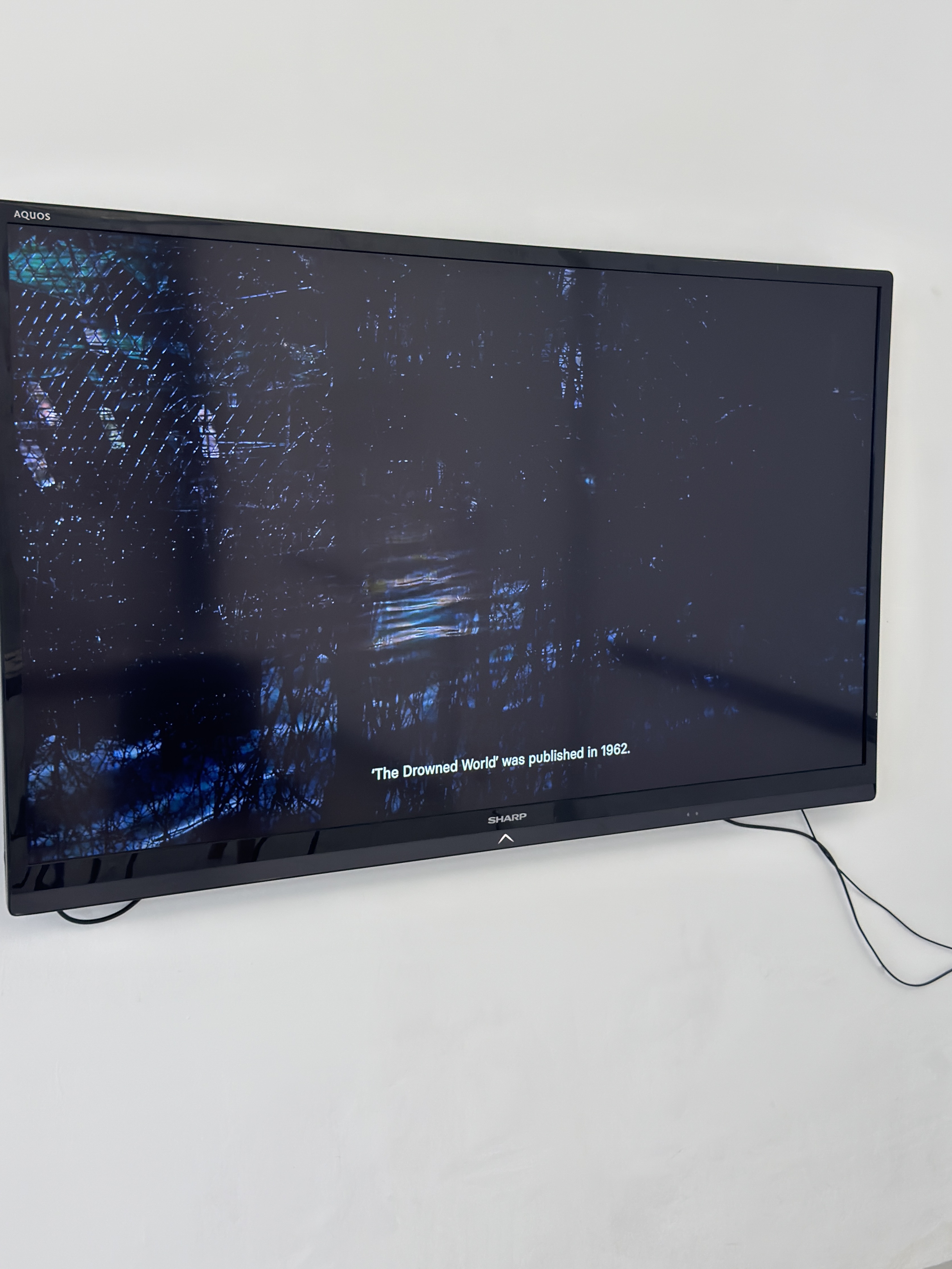
Ballad of a Lost City, 2025
video, 2 channel sound installation, oil on linen
Engaging with the cyclical histories of construction, abandonment, decay and regeneration at Vauxhall Pleasure Gardens and the City of London, StevieRay explores London through the dual lenses of history and science-fiction. Layering footage of Vauxhall’s post-industrial architecture with tropical plants from the nearby Vauxhall Pleasure Gardens, Latham imagines a future where vegetation reclaims the city. The accompanying sound-work takes a composition by Vauxhall Pleasure Gardens’ resident composer James Hook (1746-1827) and slows the score down by a factor of 250, representing each year between the piece’s initial performance at the gardens and this exhibition. At this speed, the lively Baroque piece becomes an almost static wall of sound filled with the synthetic tension of a science-fiction soundtrack. Combined with the layered images, this work speculatively explores the past, present and future psycho-geographies of the land where the Handbag Factory now stands.
www.stevieraylatham.com/art @stevieraylatham
Te Palandjian
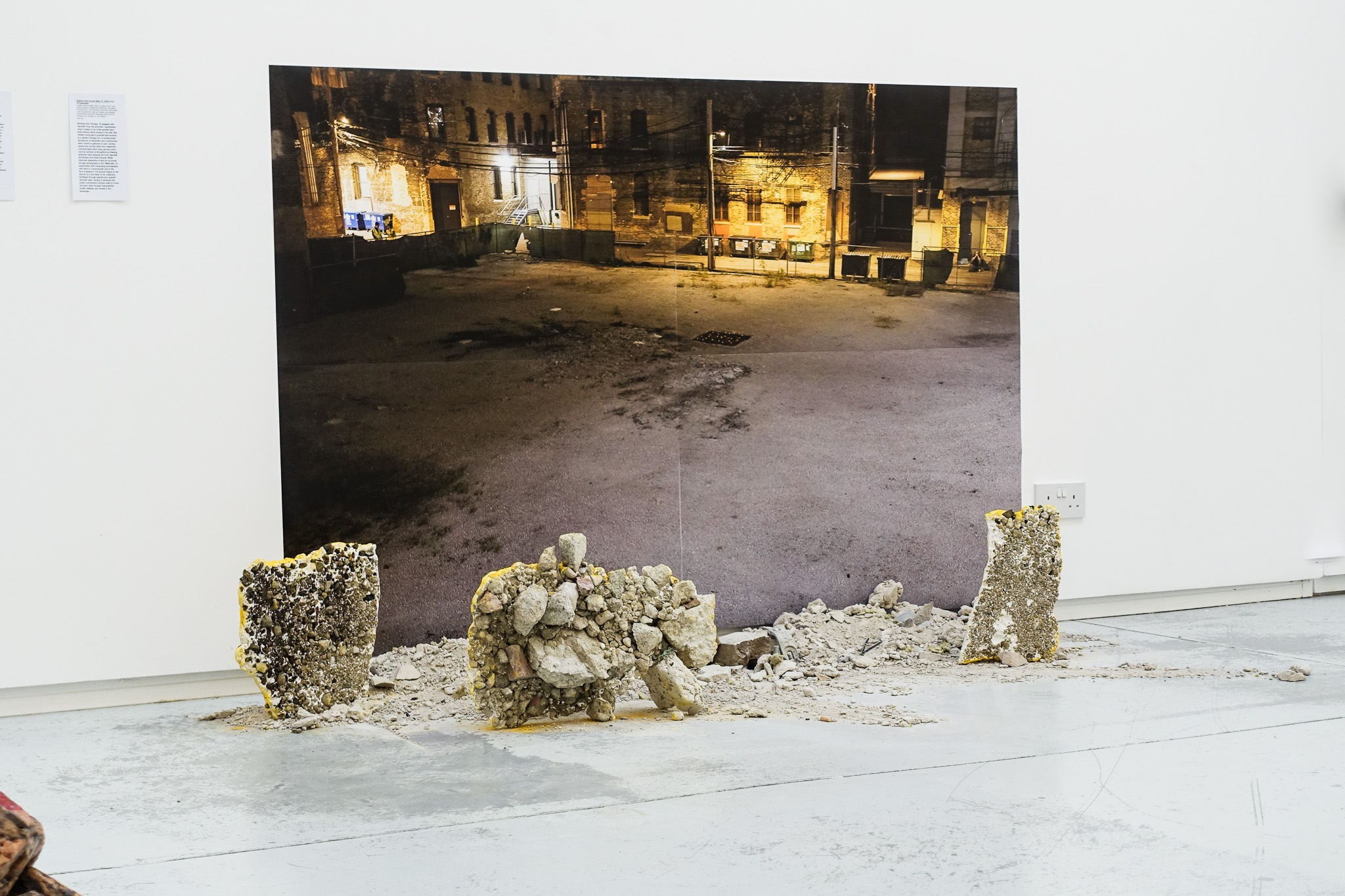
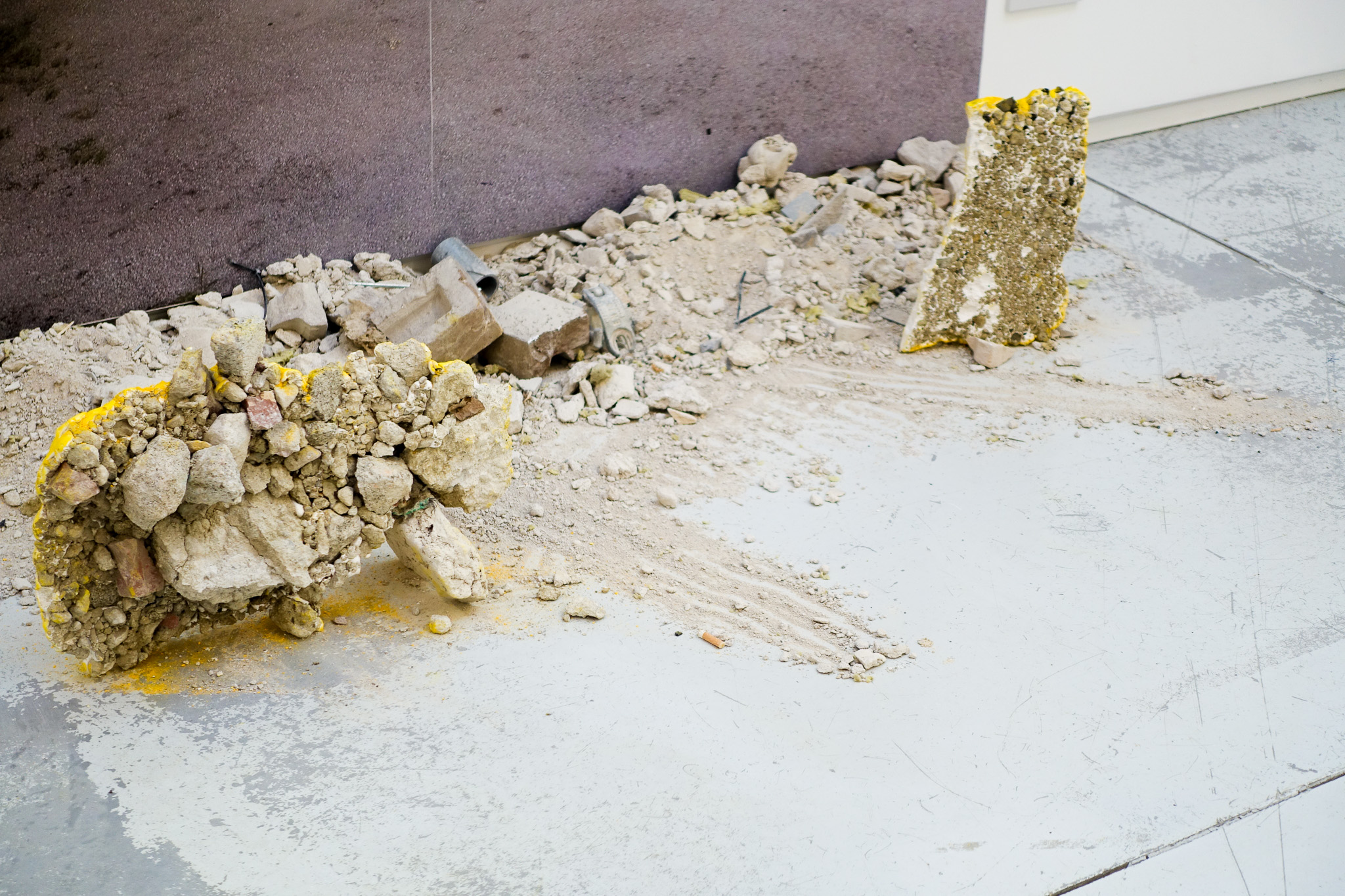
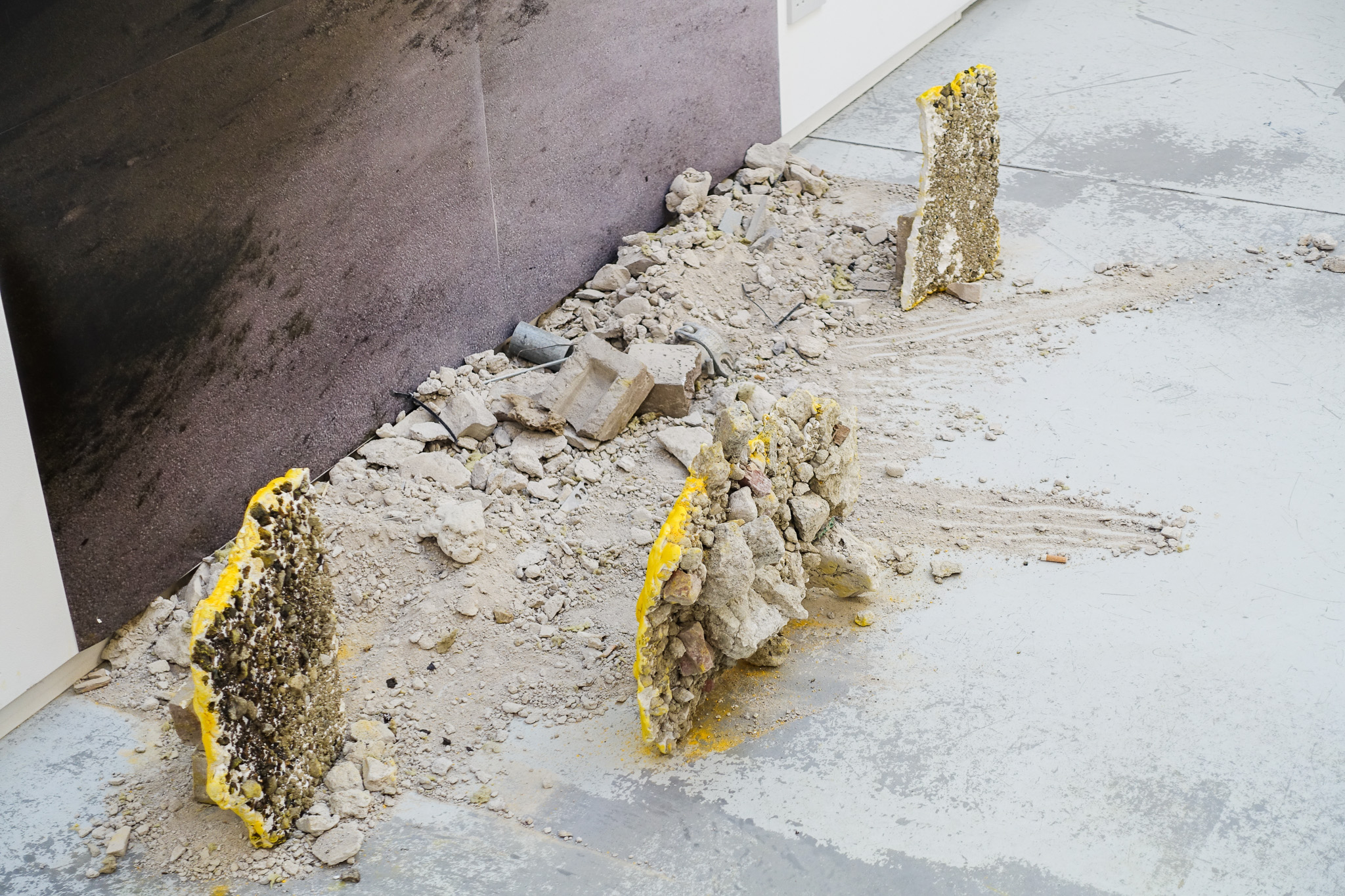
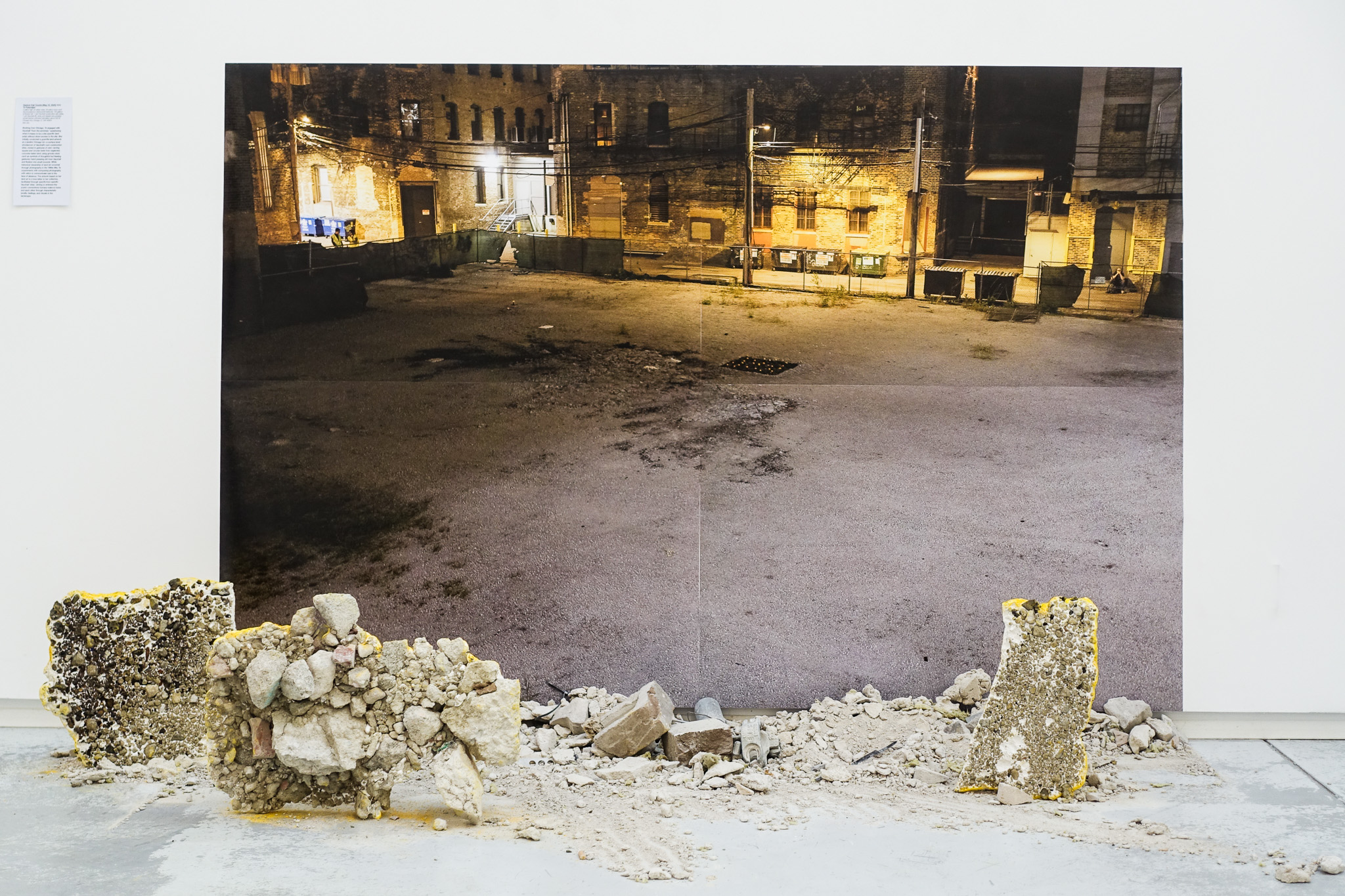
Gesture that Counts (May 15, 2025), 2025
2 yellow high-vis safety vests, 29 yellow moon cacti (Gymnocalycium mihanovichii freidrichii), 100 gallons of Boston dirt, 1 pint Vauxhall construction-site rubble, 1 pint Vauxhall dirt, body, and derelict and privately-owned (owner unknown) demolition site at 233 W Chicago Ave, Chicago, IL, USA 60654.
929 m2
Working from Chicago, Te engaged with Vauxhall “from the armchair,” questioning what it means to be a site-specific land artist without direct access to the site. She initially conducted a guerrilla land-artwork at a derelict Chicago lot—a surface-level simulacrum of Vauxhall’s own construction sites, rooted in gestures of care: carving square and circular beds from neglected, concrete-laden land; using grocery store cacti as symbols of thoughtful but fleeting gestures; hand pressing dirt from Vauxhall and Boston into small mounds. While historical viewership of land-art occurred through photography in the 1960s–90s, Te experiments with composing photography with relics to communicate care in the face of absence. The artwork based on her land art is a love-letter to her collective, facilitated through specific/non-specific Vauxhall ‘sites,’ aiming to embrace the poetic connections humans make to home and each other through characteristic smells, feelings, and visuals in the landscape.
 Critical Edge Collective